Showing posts with label poetry. Show all posts

Friday, January 20, 2012

How Pound and Eliot Changed Modernist Poetry


File:Leathad na Cròice - geograph.org.uk - 171491.jpg
 "Leathad na Cròice"
By Richard Webb (2006).
Source: Wikimedia Commons

Poems like "Hugh Selwyn Mauberly" and "The Wasteland" seem to embody the standard of Modernist poetry. Other Modernist poets like Moore, Millay, and Williams share the aesthetic element of Modernism, which is to allow each line of prose to fall naturally and playfully. However, the sensibility of most Modernist poetry hardly feels playful; poems by Pound and Eliot seem to share their dark perspectives of the world, their thoughts on existentialism, and other feelings through the use of their experiences and memories.

Eliot uses the first person perspective heavily in his poems, such as 'I have', 'I read', or 'I will show' in "The Wasteland". For example, these lines can be interpreted as a memory or experience of Eliot's because of the way they are presented to the reader:


"My cousin’s, he took me out on a sled,
And I was frightened. He said, Marie,
Marie, hold on tight. And down we went."


File:Ezra Pound.jpg
"Ezra Pound"
By Alvin Langdon Coburn
(1913)
Source: Wikimedia Commons
Though he does not use the same first person perspective as Eliot, Pound also seems to reflect on his own life in "Hugh Selwyn Mauberly" when he writes:


"For three years, out of key with his time,
He strove to resuscitate the dead art
Of poetry; to maintain "the sublime"
In the old sense. Wrong from the start –"

By basing their poetry from their own thoughts and experiences, Eliot and Pound bring a cultural disparity to their work, as every human can bring their cultural baggage to the table, so to speak. Because of that disparity, the Modernist poems contain a sense of realism that is relatable on a much wider scope.

Friday, December 2, 2011

Morris Sweetkind and "Poetry in a Scientific World"

Morris Sweetkind’s article “Poetry in a Scientific World” offers a different view on why poetry is still relevant to a society engulfed by technological advances.
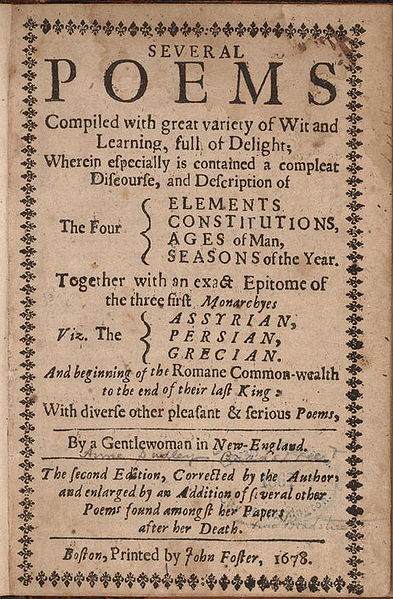
File:Bradstreet first edition.jpg
Author: John Forster, 1678.
Source: Library of Congress via
Wikimedia Commons
Some of Sweetkind’s main points include the importance of poetry in curriculum. While it is true that many students do not see poets at the helm of society (primarily it is politicians and engineers), poetry has a place in education because it can teach things that science cannot. Sweetkind outlines the four components of a healthy individual that the writer Matthew Arnold once spoke of:
 (1) the power of conduct; 
(2) the power of  intellect  and knowledge; 
(3) the power of beauty;
(4) the power of  social life  and manners

In excluding poetry in the sole pursuit of scientific query, Sweetkind believes that a person is only reaching one-fourth of their potential (the power of intellect and knowledge), (360).
Even with all the knowledge of science at his or her fingertips, there is a still a question as to how it can be applied to the world. Will the student use the knowledge they have to judiciously better the world, or will they use it irresponsibly to destroy the world?

Though Sweetkind’s essay is written in the 1970’s, the points he makes about the division of poetry and science are still relevant. Our society today is still heavily centered around technology and advancement. It seems as if everyone has a Smartphone attached to their finger. Book sales have declined and everything is becoming digitized. Still, a complete digitalization of things like books, movies and music is not all bad. Inventions like Amazon’s Kindle have encouraged reading, and Kindles are even being used in some school classrooms.

Sweetkind spoke of technology as being desensitizing and I partly agree with him. Technology is efficient and convenient, but, as Sweetkind suggests, at what cost? 

Works Cited:

Sweetkind, Morris. “Poetry in a Scientific World”. The English Journal, 59.3 (1970): 359-36. JSTOR. Web. 3 October 2011.  

Thursday, July 28, 2011

A Summary, Analysis, and Opinion of "La Belle Dame Sans Merci" by John Keats

File:La Belle Dam Sans Merci.jpg
"La Belle Dame Sans Merci" by Frank Bernard Dicksee.

One of the most famous poems by John Keats is "La Belle Dame Sans Merci" (meaning "the beautiful woman without mercy" in old French). It is not exactly a short poem, but twelve stanzas is not exactly that long, either. There is an alternate manuscript version, but I chose the 1819 published version to dissect. I chose it because of the supernatural elements suggested in the poem, alluding to a 'farey', her powers, and her merciless disposal of men. A few relevant stanzas are: 

Oh what can ail thee, knight-at-arms,
    Alone and palely loitering?
The sedge has withered from the lake,
    And no birds sing. 

I met a lady in the meads,
    Full beautiful - a faery's child,
Her hair was long, her foot was light,
    And her eyes were wild.

I set her on my pacing steed,
    And nothing else saw all day long,
For sidelong would she bend, and sing
    A faery's song. 
-(English, 2011). 

 To begin with, a paragraph of a summary of the poem reads:  

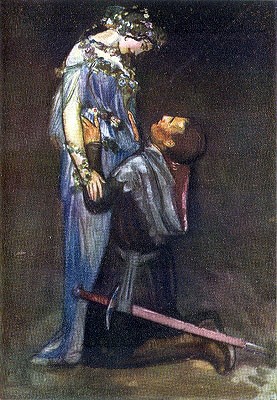
File:Robert Anning Bell - La belle dame sans merci.jpg
"La Belle Dame Sans Merci" by Robert Anning Bell
“La Belle Dame sans Merci,” written in 1819 and published the next year in a form slightly different from the one here, depicts a knight-at-arms who has been seduced and abandoned by a capricious fairy. Told in the form of a dialogue, the poem recounts the experience of loving dangerously and fully, of remaining loyal to that love despite warnings to the contrary, and of suffering the living death of one who has glimpsed immortality," (enotes, 2011). 

This poem could be interpreted in a myriad of ways. There are some people who think that the fairy exists only in the imagination and others who believe her to be equitable to a siren, luring men into become her emotional slaves. One analysis takes a different route:

"The references to "faery" and "elfin" suggest enchantment or imagination. Her "sweet moan" and "song" represent art inspired by imagination. The lady, symbolizing imagination, takes him to an ideal world. The knight becomes enraptured by or totally absorbed in the pleasures of the imagination--the delicious foods, her song, her beauty, her love or favor ("and nothing else saw all day long"). But the imagination or visionary experience is fleeting; the human being cannot live in this realm, a fact which the dreamer chooses to ignore. The knight's refusal to let go of the joys of the imagination destroys his life in the real world," (Melani, 2010). 

In poetry analysis, it may be hard to differ opinion from objective analysis. While searching articles and websites online, I was struck by how similar they all sound. After reading a number of them, I was able to tell them apart more easily. Here is one example of an opinion about Keats' poem:  

File:Arthur Hugues - La belle dame sans merci.jpg
"La Belle Dame Sans Merci" by Arthur Hugues.
“La Belle Dame sans Merci” is one of Keats’s most beloved poems and one of the few important works that seems to evade the kind of critical argumentation invoked by the odes and long poems. Typical of critics’ magnanimity toward the ballad is T. Hall Caine’s 1882 assessment of the poem as the “loveliest [Keats] gave us.” He writes that the ballad is “wholly simple and direct, and informed throughout by a reposeful strength. In all the qualities that rule and shape poetry into unity of form, this little work strides, perhaps, leagues in advance of ‘Endymion,’”  (enotes, 2011). 

One can tell that it is an opinion because of the use of words like "beloved" and "important". The author believes the poem to be a beloved and important work, and that is all based on the author's own opinions. This opinion offers little in the way of new information or analysis.  


English. (2011). La belle dame sans merci. Retrieved on July 25, 2011 from http://englishhistory.net/keats/poetry/labelledamesansmerci.html

Enotes. (2011). La belle dame sans merci: summary. Retrieved on July 25, 2011 from http://www.enotes.com/la-belle-dame-sans-meri/summary

Melani, L. (2010, September 27). The significance of 'la belle dame sans merci'. Retrieved on July 25, 2011 from http://academic.brooklyn.cuny.edu/english/melani/cs6/belle.html#sig

Monday, February 14, 2011

The Times They Are a Changin'

The 20th century changed the world of poetry. Major world events boded on the mind of many a writer, reflecting in their work. Diaspora in the British Empire, the two World Wars, and cultural and societal events was behind the poetic change that took place in the early 1900's.

Claude McKay's "If We Must Die" is a poem that depicts the racial issues he experienced as a Jamaican born citizen living in white neighborhoods. His prose is as full of eloquence as any Romantic or Victorian writer, but the issue he is writing about is something either of those writers could not relate to: being persecuted or even killed because of skin color. "If we must die, O let us nobly die/ So that our precious blood may not be shed/ In vain; then even the monsters we defy/ Shall be constrained to honor us though dead!" (Greenblatt et al, 2006). When reading his poem from an objective stance, one could assume he is describing a bloody battle in any war during any time period. His ultimate message of the poem could be achieving honor, even in death.

Seamus Henley writes about a blacksmith, ever present and non-changing though the world is changing around him: "He leans out the jamb, recalls a clatter/ Of hoofs where traffic is flashing in rows/ then grunts and goes in, with a slam and a flick/ To beat iron out, to work the bellows," (Greenblatt et al, 2006). Though the job of the blacksmith has not differed for decades upon decades, the world has, bringing with it industry and technology.

The world that these poets saw was very different from the world of the Romantics and Victorians. Things in the world of the Romantics and Victorians were easier in a way, more black and white. While the world of the 20th century writer became muddled with grey, full of detail and chaos.

References:
Greenblatt, et al. [Eds]. (2006). The Norton Anthology of English Literature: The Romantic
Period Through the Twentieth Century [vol. 2] (8th ed.). New York,
NY: W.W. Norton & Company, Inc.

Tradition

Tradition. It is a word that has many different meanings, as plenty of words tend to do. For writers, it means repetition, boredom. To T.S. Eliot and other poets of his era, tradition meant a certain quality of writing. Specifically, tradition came into play when comparing modern poets with Romantics and Victorians. Romantics and Victorians influenced writers for generations to come.

The writing styles of the Romantics and Victorians have their differences and their points of agreement. While the Romantic writer fancied nature and created poems with ethereal backdrops, the Victorian writer had a more modern standpoint and wrote more realistically about nature and issues that interested them. This is not to say that either of the the writers had more imagination than the other, but they merely used it in ways that suited them. Poets of the 20th century seemed to have taken both of these styles and merged them, to create poems that are full of modern sentiment, but romantically spoken.

English writer T.E. Hulme would have disagreed because he was a man who longed for writers to lose their "romantic view[s] which drag in the infinite," (Greenblatt et al, 2006). He believed that Romantic poems were always "moaning or whining about something or other [...and true romance and...] beauty may be a small, dry thing," (Greenblatt et al, 2006). Many of T.S. Eliot's works echo this sentiment, such as "The Love Song of J. Alfred Prufrock". In this poem, Eliot writes of the mundane but presents it in such light that it takes on a life of it's own: "Let us go, through certain half-deserted streets/ the muttering retreats/ of restless nights in one-night cheap hotels/ and sawdust restaurants with oyster shells" (Greenblatt et al, 2006).

Eliot's view of traditionalism stemmed from his respect for Hulme and his base of literary history. He believed that in order to be a great writer, one had to study about literature. By learning different styles and reading about different stories, a writer would know better about how to develop their own style; "This historical sense, which is a sense of the timeless as well as of the temporal and of the timeless and of the temporal together, is what makes a writer traditional. And it is at the same time what makes a writer most acutely conscious of his place in time, of his contemporaneity," (Greenblatt et al, 2006)".

References:
Greenblatt, et al. [Eds]. (2006). The Norton Anthology of English Literature: The Romantic Period Through the Twentieth Century [vol. 2] (8th ed.). New York, NY: W.W. Norton & Company, Inc.

Thursday, February 3, 2011

Why be Romantic When You Can be Victorian?

While Victorian writers displayed immense knowledge of the English language (and how to manipulate it to evoke emotion), they did not display the whimsical creativity that the Romantics had only a generation before. Writing about places like Kubla Khan, a 'lady in the meads', or personifying clouds like William Wadsworth Longfellow seemed more of a luxury than a necessity. What seemed to concern the Victorian poets were social issues of the day.

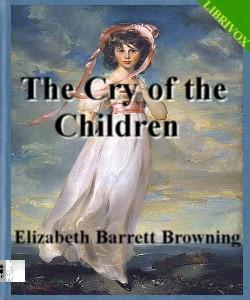
Elizabeth Barrett Browning's "The Cry of the Children" is a poem that summarizes child labor taking place in coal mines and factories. The conditions the children had to endure were horrific, ultimately leading to a death they knew was soon to come: "'True' say the children, 'it may happen That we die before our time," (Greenblatt et al, 2006). Each child would lead a short and brutal life in the poem, not even being allotted a proper funeral for their troubles: "Her grave is shapen like a snowball, in the rime," (Greenblatt et al, 2006).

Rudyard Kipling had strong feelings about imperialism and why he thought it was needed, and he let those feelings be known in his poem, "The White Man's Burden". "Fill full the mouth of famine/ And bid the sickness cease," (Greenblatt et al, 2006); Kipling had noble intentions about the savage countries he thought to be filled with "sullen peoples/ Half-devil and half-child," (Greenblatt et al, 2006). From a more objective view, his poem was more patronizing and oppressive than it was an ode to aide the needy impoverished.

The Victorian poets were creative, but they used their creativity in different ways compared to the Romantics. Victorians did not merely want to bring art and beauty to the world via prose; they wanted to change the world. It was an understandable perspective, considering the world around the Victorians was changing greatly. Technology was helping to reshape the world, making it a smaller and less mysterious place, and one worthy of critique.

Greenblatt, S., et al. (Eds.) (2006). The Norton anthology of English literature (8th ed., Vol.2). New York, NY: W. W. Norton & Company, Inc.

Friday, December 17, 2010

Honor in Poetry

Poems are written to affect different genres and different moods. Elegies, epigraphs, and friendship are common themes found in poetry. An elegy is a piece of prose that is designed to strike a sadder note, and it can be used at a funeral. Thomas Gray wrote an elegy entitled, “Elegy Written in a Country Churchyard”. Death is apparent throughout the lines of the poem, but is most affluent in lines 83-84, “In still small Accents whisp’ring from the Ground/ A grateful Earnest of eternal Peace,” (Greenblatt et al, 2006, p. A9).

Epigraphs are quotations, comments, or lead-ins to other literary works. An epigraph adds to a story or poem to sum up the overall theme, or it may relate to a previous work. “The Answer” is an epigraph Anne Finch wrote in response to Alexander Pope’s “Impromtu to Lady Winchilsea”. Pope’s poem makes fun of women, their wit, and most importantly, Finch’s writing capabilities: “Fate doomed the fall of every female wit,/ But doomed it then when first Ardelia [Finch’s pen name] writ,” (Greenblatt et al, 2006, p. 2596). To counter that, Finch’s poem consists of lines like, “Alexander! have a care,/ And shock the sex no more,” and, “We rule the world our life’s whole race,/ Men but assume that right,” (Greenblatt et al, 2006, p. 2596).

Friendship is a theme that is hard to discern, at least in Mary Wroth’s sonnet “103”. At first, the poem could be about love, or a lost love. When reading in between the lines, it becomes obvious that the narrator is describing a relationship beyond love; “Leave the discourse of Venus and her son/ To young beginners,” (Greenblatt et al, 2006, p. 1461). Wroth is perhaps saying that passion such as new lover’s experience is not a part of the relationship being depicted.

One common thread of these four poems is honor. In their own way, each poem mentions honor as it relates to the situation in the poem. For example, Gray’s elegy says “Large was his Bounty & his heart sincere;/ Heaven did a Recompence as largely send./ He gave to misery all he had, a Tear,” (Greenblatt et al, 2006, p. A11). The character being described is full of honor and misery, even shedding a tear in his sad state. Wroth’s form of honor in “The Answer” comes when she writes, “Our admiration you command/ For all that’s gone before,” (Greenblatt et al, 2006, p. 2597). “The Answer” is an epigraph that demands respect of women, or the same honor that is bestowed on any man. Wroth speaks of honorable traits in her poem, like “truth, which shall eternal goodness prove,” (Greenblatt et al, 2006, p. 1461).

Greenblatt, et al. [Eds]. (2006). The norton anthology english literature (8th ed.). New York, NY: W.W. Norton & Company, Inc.

Lyrical Love Poems of the Renaissance

Sonnets are poems comprised of fourteen lines. An essential part of a sonnet is the rhyme scheme, which can flow like song lyrics. Many poets from the Renaissance era created a lyrical flow from their sonnets to express their thoughts about love, or to idolize their love of a woman with the use of blazons.

Thomas Campion's poem, "There is a garden in her face" compares a woman's face to a garden. The narrator of the poem describes the aspects of the woman's face to coincide with different parts of a garden. For example, the line "Those cherries fairly do enclose/ Of orient pearl a double row," refers to the woman's mouth (Greenblatt et al, 2006, p. 1230). Her mouth serves as the cherries that house her pearly teeth. To make sure that the reader understands that the woman is of fair repute, the narrator says of her mouth, "There cherries grow, which none may buy/ Till 'Cherry ripe!' themselves do cry," (Greenblatt et al, 2006, p. 1230). Although the woman has a delectable cherry mouth, she is not willing to let just anyone taste them. Other parts of her face guard her honor, like "Her eyes like angels watch them still;/ Her brows like bended bows do stand," (Greenblatt et al, 2006, p. 1230).

Other poets like Sidney, Shakespeare, and Spenser during the Renaissance era appeared to be preoccupied with the idea of love, or the idea of being in love with someone. Women were often compared with facets of nature, such as flowers. Women in the Elizabethan era must have been thought of as beautiful, dainty, and fragile if they were always being compared to flowers. In contemporary society, comparable lyrics from love songs are also preoccupied with love. However, instead of honoring love, modern lyrics lament love. The sad love song is more common and interesting than an uplifting love song.

Greenblatt, et al. [Eds]. (2006). The norton anthology english literature (8th ed.). New York, NY: W.W. Norton & Company, Inc.

Thursday, September 9, 2010

Elements of Poetry

Symbolism and allegory are two intricately linked aspects of poetry. Symbolism is a tangible object that represents another aspect beyond its literal meaning, (DiYanni, 2008, p. 536). Allegory is when the events, characters, and places in the narrative contain a symbolic meaning, (DiYanni, 2008, p. 537). Emily Dickinson’s poem Because I could not Stop for Death is an example of an allegorical poem. It has plenty of instances of symbolism, but the places described in the poem and the personification of death are the two important symbols to consider, therefore setting it apart as an allegorical work of literature.

Lines 9-13 of the poem could be a representation of the narrator seeing all the central events of her life or human life in general before she dies, or before the narrator and death pass “the Setting Sun/Or rather—He passed Us.” One more example of the allegorical nature of Dickinson’s poem would be lines 17-20, when she describes “The cornice—in the Ground.” The cornice could represent her own grave.

Syntax is the grammatical way in which the words come together to create a feeling, (DiYanni, 2008, p. 542). Towhomitmayconcern by Sonia Sanchez is a poem brought to life because of the use of syntax. The words are spelled out how the narrator would sound them out; in effect the reader ‘hears’ the voice of the narrator with lines like “ima gonna stake you out”.

Rhythm and meter are two elements of poetry that both describe the flow and measure it as well. The prevailing meter in Her Kind is iambic pentameter. Most of the poem's lines contain ten syllables, with two syllables per foot. To keep the poem moving, the author Anne Sexton variegates from ten syllables per line, to eight, nine, and five. Altogether, the poem has a lilting quality to it, primarily due to the author's use of caesura and enjambment. The run-on lines pull the reader’s eye down to read more the poem, and each pause sets the necessary rhythm for the poem to follow.

Langston Hughes accents his poem I Too to create a pattern and tone in each line. Every line seems a proclamation and every important as the one the precedes it: “But I laugh/And eat well/And grow strong.”

DiYanni, R. (2008). Literature approaches to fiction, poetry, and drama [2nd Ed.]. New York: McGraw Hill