Showing posts with label Summary. Show all posts

Sunday, November 10, 2013

What's in a Name? A Summary of LeGuin's short, "She Unnames Them"

In this powerful short story by LeGuin, the lead character is never named, but it is inferred that it is Eve, as in Adam and Eve of the Garden. Eve narrates the story, telling of how she convinced the animals that names are unimportant. One by one, the animals agree to let go of their names, though the Yaks have trouble with this concept. The female Yaks hold a council, deciding to let their names go, and after awhile, the male Yaks agree.
Pets, specifically dogs and parrots, take great issue in letting go of their names. As pets are closer to man than wild animals, it is understandable that they would have a harder time in letting go of their identifiers. Yet, Eve makes the pets understand that they can hold onto their capitalized names, like Froo Froo, if only they let go of their generic monikers, like dog or parrot, and so the pets too shed their names.
Among each other, nameless and free, Eve feels a closeness with the animals of the garden that she has never felt before: “They seemed far closer than when their names had stood between myself and them like a clear barrier: so close that my fear of them and their fear of me became one same fear.” The giving back of names (“loss of names” would hold the wrong connotation) by the animals makes them equal to Eve, but she realizes that she is the last being in the garden with a name, and it is not fair of her to hold on to her name when she asked all the animals to give theirs back.
Eve goes to Adam to tell him that she is giving back the name bestowed by “you and your father […] It's been really useful, but it doesn't exactly seem to fit very well lately. But thanks very much! It's really been very useful." Though Eve’s actions are revelatory, Adam does not care. He is described as working on something, putting parts together, and overall he is only half-listening to what Eve is telling him. The reader (and Eve) know that Adam does not understand the import of what she has done by forgoing her name when he asks the stereotypical patriarchal question: “When’s dinner?”
Names can have power, and that power can be a divisive one, or at least that is what LeGuin insinuates with her short story. The binary names humans give to gender (man, woman), the names humans give to animals, or to objects, those are ways that humans seek to control what is around them, not to give meaning, but to separate themselves from nature, to say “I am better than you. I have control over you, and with that control, I will name you and distance you from me”. Eve, like other women in sf stories, does the opposite by placing herself in nature and making herself an equal part of nature. Again, the motif of a loss of identity is explored in this story, and again the author clearly states that one can be an individual while at the same time surrendering themselves to the communal way of living. It is an idea that humans struggle with, because humans only know individuality in the form that it has been handed to us for generations: it comes with separation from others, in the form of gender, class, or racial individual names and personalities.

With Adam’s response, and his lack of interest, LeGuin is stating that men may not be ready to be a part of nature. To be equal with women, and then to be equal with nature, is something men may not conceive of just yet.

Monday, June 10, 2013

What a Strange World We Live In- "Woman on the Edge of Time" by Marge Piercy

Source: Wikipedia
Marge Piercy creates a detailed portrait of a poor minority female who is constantly trying and hoping for a better life that never comes. For most of her life, Connie has been oppressed in every way imaginable. She has suffered at the hands of male and  government institutions. She has never known real power, not even over her own body.
During her second incarceration in a mental institution, visits from a time traveler become more insistent. At first, Connie is convinced the traveler is in her imagination, but as the visits transport her to an androgynous utopia in the future, the legitimacy of the traveler is indisputable, and it is the present which seems more like a surreal nightmare.
Luciente is the traveler that shows Connie another world, a better world. Luciente is described as a male, at least in Connie’s eyes. From Luciente’s movements, confidence, and attitude, Connie is sure she is dealing with a man. She even forms the beginnings of romantic feelings for Luciente, but they fade after she discovers Luciente is actually a woman.
While visiting the future with her time-traveling friend, Connie is confronted with other non-traditional forms of society. For example, men can petition to be mothers. Children in the future are no longer born, they are grown. As such, babies are assigned to those that request them, and men commonly request to be mothers alongside women. Each child has three mothers (male or female), and is separated from their mothers at age twelve to foster independence.
Towns are kept small, so as to remain self-sustainable. A town models itself after past cultures of a certain time. The town Luciente is a part of follows the traditions of the Wampanoag Native Americans, and different races are purposefully bred, with racism having been bred out of human beings.
Sexually, Luciente and her friends are quite liberal. Homosexual relationships are normal, as are polyamorous or monogamous relationships. When Luciente is recalling her most passionate relationship, she tells Connie it was with a woman, a concept Connie cannot grasp.
The separation of gender, especially through the eyes of the lead female character Connie, are analyzed throughout the novel. The validity of power structures in society (like police, social workers, and doctors) are also questioned, as all the structures Connie encounters only take advantage of her position in society as a female, low-income, minority citizen.

The capitalist life style Connie is on the fringes of seems barbaric in comparison with the rich and happy life Luciente exposes her to. Piercy brings a disconnect to the modern world, and certainly evokes Suvin’s infamous theory of “cognitive estrangement” in science fiction writing with Woman on the Edge of Time.

Sunday, May 12, 2013

The Brilliance of James Tiptree, Jr. (or as she was born, Alice Sheldon)

Found on outofeverywhere.wordpress.com

This is a collection of stories by Tiptree, collected before Tiptree was discovered to be a woman. The introduction by Robert Silverberg is almost comical, especially when he defends the questioned masculinity of Tiptree: "There is something ineluctably masculine about Tiptree's writing. I don't think the novels of Jane Austen could have been written by a man, nor the stories of Ernest Hemingway by a woman, and the same way I believe the author of James Tiptree stories is male" (xii). Silverberg's supposition calls into question the definition of male and female writing. If in his mind Austen is the quintessential female writer and Hemingway the male, then his radar concerning the gender of authors is seriously misguided, more notably when he compares Tiptree to Hemingway. Silverberg manages to unknowingly pen several sexist claims, like Tiptree must be male because he talks about things like fishing, hunting, travelling, and the government with such authority. Reading the introduction reminded me of LeGuin's article "The Carrier Bag of Fiction", where she talks about the origins of what is intrinsically human, and it turns out not to be violent (and supposed) male tendencies, but the ability to gather, (a supposed) female tendency. It seems as if Silverberg is trying to legitimize Tiptree's place in science fiction by insisting on Tiptree's maleness, as if the possibility of Tiptree's womanhood would do the opposite.
There are two short stories I read in the collection, starting with “The Girl Who Was Plugged In”. If anything, the story takes place in both a utopia and dystopia. The world as laid out by Tiptree has outlawed advertising. It was deemed immoral, and word of mouth is the only way companies have of getting their products sold. That’s where J. Burke comes in. She’s described as ugly, but company execs have their own ideas on how to make her pretty. After she attempts suicide, they know she is desperate enough to accept their offer: to plug her brainwaves into a beautiful humanoid. Through the new J. Burke (re-named Delphi when in humanoid form), the execs are able to wield an alluring and subtle spokesperson for their products. A man falls in love with Delphi, and discovers in part her secret. When he finally meets the real Delphi (J. Burke), he is disgusted at her appearance and accidentally kills her.
The story is a reminder of how humans will do their best to undermine the law, even when the law is put in place to enhance their rights. Another theme of Tiptree’s short is the lie women must keep up with their looks. J. Burke/Delphi could be an analogy for said lie, with J. Burke being how men view women without “cute” clothes/make-up on, and Delphi being how they view women in their costumed perfection. In the story, Delphi’s admirer was naïve in believing she was a paragon all the time, and he is disillusioned, even horrified, to discover his real love shares her likeness with a monster.
In “The Women Men Don’t See”, a group of people have to survive a plane crash on a sandbar in the Yucatan. Two women make up part of the group, and two men make up the other. The story is told from a male perspective, with the man constantly being surprised in the unflappable nature of the two women. When he expects them to complain, they remark on the scenery. When he expects them to make demands, they make kind concessions. This second story I read really had little to do with utopia/dystopias, and everything to do with how men expect women to act, versus how women can act.
Overall, the book is a great example of how women are seen not just in science fiction, but through the eyes of men. What’s ironic about it is that Tiptree managed to write from the male perspective so convincingly she had everyone believing she was a male, and they thought it patronizing and progressive of “him” to take small feminist stands in his writing. How must they have viewed Tiptree’s writing after discovering he was a she? I have an idea as to what they were thinking, because Silverberg puts a postscript at the end of his intro, describing the letter he received from Tiptree. She confessed to him her true sexuality, and of it, Silverberg wrote, “What I have learned is that there are some women who can write about traditionally male topics more knowledgeably than most men, and that the truly superior artist can adopt whatever tone is appropriate to the material and bring it off” (xviii).

Tiptree Jr., James. “The Girl Who Was Plugged In”.  Warm Worlds and Otherwise. New York: Doubleday, 1973. Print.

            -. “The Women Men Don’t See.” Warm Worlds and Otherwise. New York: Doubleday, 1973. Print.

Wednesday, April 17, 2013

When Women Rule the World: Sherri S. Tepper's "The Gate to Women's Country"

Image found on
www.eternalnight.co.uk 

From the onset, it's hard to tell The Gate to Women's Country apart from The Shore of Women. Both are stories featuring post-apocalyptic settings in which women preside over great, peaceful cities, whereas men are left out to be warriors amongst each other. The differences between the stories are minor: instead of women not caring about giving up their sons (like in Shore), Tepper brings the reader through an emotional process that is very real. Instead of procreating with the aids of science (like in Shore), women and men meet twice a year at carnivals. In Tepper's world, men may return to the female cities at age fifteen if they choose.
Tepper creates a dual-natured gender society, one in which the balance of power appears to be equal between men and women, with perhaps a bit more power going to the men. By the end of the book, the big reveal shows the true balance of power to be entirely in favor of the women. After a nuclear war three-hundred years before, women decided to take over and establish new cities. Like Shore, they wanted to keep men out, but they also wanted to create an illusion to keep them happy. Part of the illusion is letting the men in the garrisons believe that they father children from women inside of Women’s Country. Really, all babies are born from artificial insemination. Sperm is carefully selected from those men who live within Women’s Country, as they have no desire for violence. Violence is a trait the women are set on breeding out of the men, even if it takes centuries to do so. Every fifteen-year-old male who chooses to return to Women’s Country then becomes part of the breeding pool.
The entire set-up of Women’s Country is a large breeding program, which the men are completely unaware of. The women allow the garrisons from different towns to go to war with one another, and they allow it to control the male population, or to get rid of undesirables quickly. The reader comes to understand how the men are puppets, much like the men in Shore. However, unlike Shore, the women in Women’s Country hope to reconcile with men eventually, by breeding out their violent natures.
The entire novel is themed around power. In the beginning, women appear weak, deferring to the men, loving men, giving into them. The men seem strong, protecting the women. One might argue Tepper set up a conventional dual-natured society, with proper male/female gender roles. Later, the women are seen to hold all of the power, and the men (the ones in the garrisons at least) are seen as pathetic, almost like children playing their little war games, unaware of the secrets and power the women hold over them.
For a good part of the novel, the men in the garrisons are convinced the women have secrets, but they don’t know what they are. Some of the men plot to get at the secrets, to control the women. The novel got me thinking about life, how men may believe women have secrets, or believe childbirth to be a sort of secret (or power). Considering all the anti-abortion measures state legislatures have taken, it’s possible the men of these states are uncomfortable at the thought of women controlling their own secrets, their own power. Even if their ideas about abortion are steeped in their religion, their religion is steeped in male-powered rhetoric.
At times during the novel, the comparisons between Shore and The Handmaid’s Tale would prompt the reader to believe Tepper wrote it as a further exploration of the elements in both of those feminist utopian/dystopic novels. Unlike Shore or The Handmaid’s Tale, Women’s Country is trying to change, trying to become better than the status quo, and as H.G. Wells tells it, the mark of a modern utopia is one that is ever-changing (9).
Tepper implies that a male-dominated world revolves around violence and competition, and the only end-game to such a cycle is destruction through war. According to Tepper, in history, those who suffer most in war (without any real say) are women and children.
In Women’s Country, women and children are spared from senseless death. Tepper describes Women’s Country as a world in which women have complete control, and the results are for better, or as good as they can be in a post-nuclear age.
Even as Tepper creates a sort of utopia, there are several dystopic elements to her story, such as the war games the women allow the men to play out. It is viewed as an activity the men need to do, to channel their aggression and keep their illusion of power intact, but when the men are dying on the fields, they are not allowed help for their wounds. The smallest wound can fester, turn to blood poisoning, and kill the man weeks later, a horrific death Tepper describes of one of the men. Also, the men in the garrisons are not allowed to have or create any technological advances, not just in weaponry, but everyday items that might create a better life for them are also barred. Because of the way the men are bred, most of them don’t care about advancing anyway (only a few do), but the females in the city, the perceptive ones, feel it’s wrong to intentionally hold the men back. It’s comparable to holding a dog in a cage.
The major dystopic element of Tepper’s world is the fact that from five years of age on, little boys get sent out of the cities and into the garrisons. They are separated from their families, and it can sometimes be a traumatic separation. Just like in Shore, the position of the women are elevated (and if it were the other way around, it would be just as wrong), and men (no, little children) are made to suffer for the power-swap.
A side-note: The Gate to Women's Country is a good book, nearly as good or even better than A Handmaid's Tale in my view. It's written with the same weird displaced timeline as The Dispossessed, and the writing in it feels more like poetry (at times). While The Shore of Women is great, too, I found the writing style to be a bit too romanticized. With The Gate to Women's Country, Tepper tackles the male/female romantic dynamic, but with a more objective eye than Sargent. Then again, I've also considered Sargent's over-use of romantic language and phrasing may have been on purpose, as a parody of the way women and men view one another.

Tepper, Stewart, Sheri. The Gate to Women’s Country. New York: Bantam Spectra, 1989. Print.

Wells, George, Herbert. A Modern Utopia. London: Chapman & Hall, 1905. Print.


Saturday, March 9, 2013

New Teen Sci-Fi Novel "Empire State" by C.E. Smith

Empire State
Decades ago, a volcanic eruption covered the Earth in dust and ash. Tim Ackerman, who sometimes goes by Grim, is responsible for a group of young boys in the crumbling ruins of New York City. A young teen himself, Tim not only has to survive the harsh world, but he has to deal with his mutated abilities. Rival gang-leader, Sykes, is also a mutant of sorts, and when Tim is forced to trust Sykes, his entire world changes. 

Indie author C.E. Smith brings a new post-apocalyptic world full of danger, discovery, and heroes with the novel Empire State.

Read Empire State in its entirety free here.


Monday, February 25, 2013

"The Carrier Bag Theory of Fiction", a thought-provoking essay by Ursula K. LeGuin


LeGuin’s essay begins by explaining the gender dynamics of the early humans from the Paleolithic and Neolithic time periods. She describes the average life of an early human as one that began as gatherer, not hunter as many have assumed. As part of that description, she brings with her the theory that the first cultural device used by humans was a container (LeGuin 150). Again, it has been an assumption, an assumption perpetuated by the media (as LeGuin notes), that the first device used by humans had to be a weapon.
To LeGuin, the invention of the weapon was most likely a man-made invention, and one that men used to hold over women in a way, as to say, “Ha, look, men made the first invention that just happened to be violent, and women hate violence, therefore, women aren’t really human.” As Russ says of the men in her short story “When It Changed”, they didn’t consider the women they found on planet Whileaway to be human. They kept asking the women, “Where are all the people?” People, to them, meaning men.
Using the idea of the container as the first human invention, LeGuin goes on to say that finally, she can be counted as human now too: “If it is a human thing to do to put something you want […] into a bag […] and then take it home with you, home being another, larger kind of pouch or bag, a container for people, and then later on you take it out and eat it or share it […] and then next day you probably do much the same again, if to do that is human, if that’s what it takes, then I am a human being after all.” (LeGuin 152). What LeGuin is saying is that women invented the first relevant piece of culture, but I think it could have been both the container and the weapon, all at once. Human beings could have started out as both the hunter and the gatherer, as we also began as women and men. Still, the point that LeGuin makes is fascinating: the invention of the container is one of the most important inventions to man, and being an assumed female invention, it brings women into the arena of humanity in a way she wasn’t before.
The rest of the essay changes directions. LeGuin begins to equate the idea of grafting a good novel by using a container of words, instead of a spear of words. LeGuin mentions how some authors have described writing a book to be a mock-battle, when she believes it to be the lugging of a container full of words, thoughts, and story elements waiting to be used up.

LeGuin, Kroeber, Ursula. “The Carrier Bag Theory of Fiction.” The Ecocriticism Reader: Landmarks in Literacy Ecology. Ed. Cheryll Glotfelty, Harold Fromm. Athens, Georgia: University of Georgia Press, 1996. 149-154. Print.

Saturday, February 23, 2013

The Idea of Gender Divides in LeGuin's "The Dispossesed"

The Dispossesed (1st Ed. Hardcover)
1974, Harper & Row Cover
Source: Wikimedia

Somewhere in a similar galaxy is a planet much like Earth, called Urras. On Urras, a group of settlers were sent to colonize the moon, Anaress. Cut-off from their home planet, the Anarresti built a different society than the one they came from, one in which there is no central government, no real form of currency, and gender equality isn’t even a thought, it just is.
Shevek, a theoretician from the colonized moon, is invited by a university on the home planet to come and study. When he does, his entire worldview is shaken, as he is exposed to alien concepts, like class divides, crime, money, and ego. Once Shevek understands that the home planet society is driven by profits (i.e. capitalism), he chews on his assumption “that if you removed a human being’s natural incentive to work--his initiative, his spontaneous creative energy--and replaced it with external motivation and coercion, he would become a lazy and careless worker […] The lure and compulsion of profit was evidently a much more effective replacement of the natural initiative than he had been led to believe.” (82). LeGuin is answering  a central question here about the details of a utopian society quite simply: if a citizen is given all they need by the State, they will not become lazy, because their own creativity will be their drive. She also answers the question about innovation in an utopian society, a concept assumed to stagnate in any imagined utopia, because only suffering can foster innovation (the need to make something bad into something better), but if creativity is its own reward, then even in a utopian society citizens will know of and promote innovation.
There are many gender divides Shevek encounters on the home planet. He argues with many of the Urrasti about how they treat their women and why they feel the need to treat women differently at all. Several times, he asks the Urrasti men “Where are the women?” They are amused at the question, and they tell him that women make great wives, but terrible scientists: “[Women] can’t do the math; no head for abstract thought; don’t belong. You know how it is, what women call thinking is done with the uterus! Of course, they’re always a few exceptions, God-awful brainy women with vaginal atrophy.” (73).
When Shevek reveals that 50% of the scientists (and workers in all fields) on his world are women, the Urrasti men become very uncomfortable. They cannot imagine a world in which a man is not made to feel “manly” and a woman is not kept as a feminine object and an object alone.
At the end of one of these gender arguments, Shevek concludes “that he had touched in these men an impersonal animosity that went very deep. Apparently they, like the tables on the ship, contained a woman, a suppressed, silenced, bestialized woman, a fury in a cage. He had no right to tease them. They knew no relation but possession. They were possessed.” (74).
Soon, Shevek comes to realize that the very design of the planet Urras, and the syntax of the Urrasti speech, all help to maintain the binary gender divide, however unintentional (or intentional) the design might be. Aboard his first starship, Shevek notes that the curves and lines on the ship are soft, supple. Even his bunk bed on the star ship is soft and inviting, and he cannot help but have erotic thoughts of yielding women. The language of the Urrasti is as possessive as their nature, as they refer to things as “my hankerchief” or “my wife”, when an Anarresti would say “the hankerchief that I use” or “the woman I share life with”. Shevek does not know of a translation in his language for the possessive pro-nouns Urrasti people are so fond of using.
Overall, LeGuin uses the analogy of a visitor to an Earth-like world to illustrate the cognitive estrangement of Earth-like customs. Through Shevek’s eyes, the reader sees everything backwards, gender included. Everything that is “normal” is odd to Shevek, and the simple nature in which he explains his world makes it seem as real as the Earth-like planet of Urras.

LeGuin, Kroeber, Ursula. The Dispossessed. New York: Harper & Row, 1974. Print.

Monday, January 21, 2013

A Further Realization of Utopia: Edward Bellamy's "Equality"


Given ten years to reflect on his work, Bellamy was able to expand upon the thoughts and issues of the utopian society in Looking Backward. Equality is not so much a sequel to that novel than it is a continuation. There were questions in Looking Backward that went unanswered and that is where Equality comes up with the answers. For example, the gender gap is one that Bellamy took into account and remedied.
File:Edward Bellamy - photograph c.1889.jpg
A photo of Edward Bellamy,
as seen in the Libary of Congress,
(1889). Source: Wikimedia Commons
In the first novel, a woman’s role in the 20th century is not all that different from their role in the 19th century. The women West meets still dress relatively the same, and they seem to defer to their male counterparts, content in the role of daughter and mother. Bellamy explains this away by describing Letee’s need to make West comfortable in his first few weeks in the year 2000. He had his wife and daughter dress in a similar fashion to that of women in 1887 so that West would not be shocked to discover that women are allowed a more independent lifestyle, one that involves wearing pants and working any job they please.
A further explanation of the banking and work placement system are other issues tackled in Equality. West is allowed to open his own account, and he questions the teller about how the system works without capitalism. In summation, the teller recounts the old capitalist system and how it was designed to trick the consumer into thinking that capitalism and individual freedoms were synonymous, when in fact, the opposite was true. With the new system of the year 2000, many commodities are paid for by the government, like utilities, music, news, theater, postal and electronic communications, and transportation. Because of that, small stipends are awarded each citizen, totaling to around 7,000 dollars a year, enough so that they can still purchase the things that they would wish, like food, clothing, and rent. The new economic system was created under the mindset that “nobody owes anybody, or is owed by anybody, or has any contract with anybody, or any account of any sort with anybody, but is simply beholden to everybody for such kindly regard as his virtues may attract” (34).
The idea of the loss of individual liberty in a Marxist society is addressed and debunked by Bellamy in Equality. For decades, it has been assumed that if a government nationalized the banking and job systems, then that security is the trade people would have made in exchange for their independence.
However, West enters the nationalized workforce and learns that he can choose whichever profession he would like to study, and if that position is not available to him later on, he can transfer to another city where it is available, or make do with a second or third choice in his profession. The government does not assign professions to citizens, rather it assigns what hours each job receives for a day’s work (shorter work hours for more physically demanding jobs, like coal mining), and what pay each worker receives (each worker receives equal pay, be it a doctor or bookkeeper). When people receive different pay for different work, they begin to assume that they are better than others, and that is where class warfare really begins. Human beings that are working, regardless of the job, should be regarded with the same respect that everyone else receives. There are many that would find Bellamy’s Marxist society as distasteful or unnatural, but in retrospect, our Capitalist (not ‘free-market’ society as suggested by the media, but Capitalist) society is the unnatural one, as it fosters poverty, a feudal class system, and creates gods out of the top money-makers.

Bellamy, Edward. Equality. Boston: D. Appleton & Company, 1897. Print. 

Monday, November 19, 2012

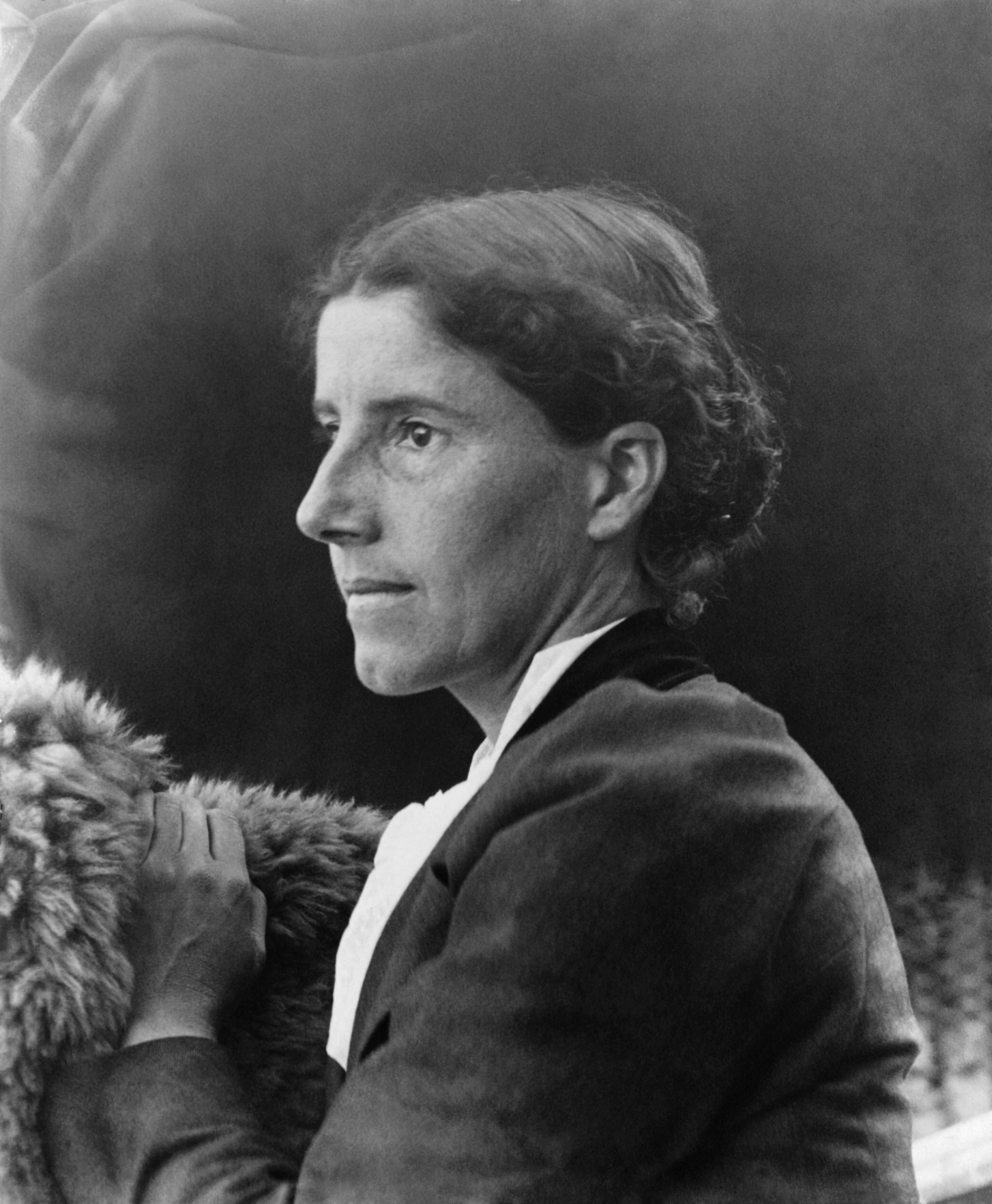
The Importance of Charlotte Perkins Gilman's "Herland"

Photographic portrait of Charlotte Perkins Gilman,
American author, c. 1900. This is a cropped version
of the digital image from the Library of Congress online
collection, as identified below. Copyright has expired on this image.
Source: Wikimedia Commons

Charlotte Perkins Gilman was many things: a writer, a feminist, and at times, fan of eugenics based on her staunch racism. Aside from her failings, Gliman managed to write a groundbreaking novel called Herland that went unnoticed until it gained popularity in the 1970's. First appearing as a serial in 1915, Herland is one of the first works of feminist Utopian fiction.
Three young students set out to explore a legend shared by the locals of the foreign country that they are residing in. The legend is of a hidden community comprised solely of women. Since the three students are also young men, their interest is more than piqued.
All three men have different views on women, ranging from the extreme to the sympathetic. Jeff  is the biologist, and an idolizer of women. The narrator, Van, stays neutral on most every subject as a sociology major. Terry is a geologist, and straddles the line between gentleman and chauvinist pig.
Before they find out that the legend of Herland is indeed true, the three men surmise on what sort of civilization could arise if maintained by only women. Their prejudices and sexist views come to the fore during these discussions; “We mustn’t look to find any sort of order and organization […] Also we mustn’t look for inventions and progress; it’ll be awfully primitive.” (p. 8-9).
The civilization the three men discover is far beyond anything they could have imagined. Herland is a beautiful country, with gardens and forests that are carefully tended to yield the most food (there is no room for crops or cattle in Herland's tiny strip of territory). Men are nowhere to be found. In fact, the arrival of Terry, Jeff, and Van mark the civilization’s first sighting of men in two-thousand years.
Though Herland is not a distant planet, it might as well be for the all the differences Van takes note of in his journal. At first, Van believes his ‘world’ to be more advanced, but as he learns more and more about the women of Herland, he becomes ashamed at the state of his world in comparison to their paradise.
Many notions of femininity come into question in this short novella from Charlotte Perkins Gilman. The women of Herland keep their hair cropped short, wear clothes free of adornment, are intelligent, and work hard doing things that the three men considered only for men. Not every woman is young, giggling, and beautiful: [Van’s perspective]- ‘Woman’ in the abstract is young, and, we assume, charming. […] Most men do think that way, I fancy.” (p. 21). By the end of the story, Van and Jeff come to see that Terry’s view about women is entirely wrong, that indeed all their thoughts about women are entirely based on their society’s perception of gender roles.

Gilman, Perkins, Charlotte. Herland. New York: Pantheon Books, 1979. Print.

Monday, November 5, 2012

"53% of the Brotherhood of Man is the Sisterhood of Woman", and other thoughts by Ursula K. LeGuin


The opening line of Ursula K. LeGuin's “America Sf & the Other” sums up the tone of the article perfectly: “One of the great early socialists said that the status of women in a society is a pretty reliable index of the degree of civilization of that society. If this is true, then the very low status of women in SF should make us ponder about whether SF is civilized at all”.
File:UrsulaLeGuin.01.jpg
Meet-the-author Q&A session;
Bookworks bookstore, Albuquerque, NM

Photo taken by Hajor, 15.Jul.2004.
Source: Wikimedia Commons
Much of LeGuin’s article makes an argument on behalf of all Others, as she acknowledges that there are many types of Others, such as sexual, racial, class, and cultural. She goes on to insist that the patriarchal SF establishment is the tip of the iceberg, not only in literature, but in society, leading to a greater ill: women are portrayed (and not just in SF) as LeGuin describes them, “squeaking dolls subject to instant rape by monsters”.
Real people, as in neighbors, teachers, the poor, and the like are rarely ever present in SF (or at least they weren't present in LeGuin’s generation of SF). People of LeGuin’s SF are simply masses, described as ‘they’, never as the individuals that they are. Thus, the reader is indoctrinated, becoming desensitized to the needs of the un-described and faceless ‘they’ that are constantly harmed in SF stories.
Another point LeGuin makes about the masses in SF is this: “The people, in SF, are not people. They are masses, existing for one purpose: to be led by their superiors.” Imperialism is a turn the article takes for the better, going on to compare Galactic Empires with Roman Empires. Early pulp SF always made sure to conquer the alien invaders and to never portray them in a sympathetic light. The problem with that, in LeGuin’s view, is that SF has not really strayed from that old pulp notion that ‘the only good alien is a dead alien’, creating the sense that anything unknown =something not good (kill it, kill it!).
What’s worse is the creation of the godlike aliens of SF, that come to Earth with wisdom to better our sorry species. It may seem better to revere a being rather than kill it, but either way, LeGuin suggests that these two ideals only serve to distance human consciousness from one another. Or, to put it more eloquently, LeGuin states that with the distance from the other entity, either through hate or reverence, “You have made it into a thing, to which the only possible relationship is a power relationship. And thus you have fatally impoverished your own reality. You have, in fact, alienated yourself.”
The article ends with LeGuin surmising on the state of a male-led SF community, and her call to readers and writers of SF alike to end their longing for a return to Victorian standards, and instead to remember that “53% of the Brotherhood of Man is the Sisterhood of Woman”.  

Tuesday, October 30, 2012

Mizora: The Secret Society Founded by Women


Mary Bradley's novel, Mizora: A Prophesy, reads like a less publicized and earlier version of Gilman's Herland. It is a country of women located in a hidden pocket of the Earth (the Arctic instead of Africa), discovered by a regular citizen. After that, comparisons between Mizora and Herland are not so easy to come by.
The explorer who stumbles upon Mizora is alone, Russian, and a woman. Through the narrator's perspective, the reader views gender hypocrisy in a new way. The female narrator time and time again cannot understand how a society of women can get along without men, beliefs that were enforced by her own binary culture.
Mizoran women raise their children themselves, like in “When It Changed”, but unlike the communal parenting seen both in Herland and A Princess of Mars. While Mizoran women value their children greatly, the thing they hold to the greatest esteem is education. They believe that when they made education (including college) free for all, many of their social problems solved themselves. For example, the poverty rate is extremely low. Due to an influx of students, more mathematicians and scientists graduated, producing people capable of engineering affordable food, fuel, and most any commodity. A Mizoran educated populace also saw a decline in crime, and by the time the narrator finds Mizora, the most heinous crime committed by a citizen was the striking of their child almost a century before.
While reading Mizora, the parallels between a strictly female society and a peaceful society are argued in detail. Once men are out of the equation, more important societal questions are pursued that aid in harmonizing a populace. One stark trait of the Mizorans is their exaggerated femininity. In Herland, the women are spoken of as being beautiful, but in a more neutral, androgynous way. In Mizora, their delicacy is emphasized. All Mizorans have blond hair, a product of the eugenics practice that was perfected centuries before. Silk, flowing dresses and artfully made up faces are staples among the Mizorans, though in other all-female (or androgynous) populations found in the Left Hand of Darkness and Herland, beauty is a natural part of the citizens, not something artificially constructed through the use of exaggerated clothing and make-up.
          While Bradley sought to undermine gender roles in Mizora, some parts of her novel only reinforce them. The most illuminating part of the novel is when the female narrator is in disbelief over the roles of women in Mizora, and her ideas of a woman’s place (below that of a man’s) as opposed to theirs (women as human beings, not as a separate entity from men). The narrator’s point of view about women is one that is still present today. Plenty of women believe that the station they are currently in, (whether it be mother, daughter, wife, sister) is a station they cannot ascend beyond, and that they in fact should not strive to ascend beyond that station. Men are not the only oppressors of women. As Bradley illustrates, women can be their own worst enemies in the fight for gender equality, especially when women believe that the fight is not a valid one.


Bradley, Mary. Mizora: A Prophesy. New York: G. W. Dillingham, 1890. Print.

Wednesday, October 10, 2012

"Nightfall"- An Illuminating Short Story by Issac Asimov


Source: UmMuseum.com
Writing legend Issac Asimov added to the genre of science fiction in a big way, most notably with his short story collection on robotic intelligence in I, Robot. One of his lesser known stories, "Nightfall" explores something entirely different: the limits of human knowledge.
On the distant planet, Kalgash, an eclipse is about to take place. The thought of an eclipse has the people of Kalgash in a panic.
Kalgash is a special planet, home to six suns. Six suns means that Kalgash is in a constant state of light. Darkness is a foreign concept to Kalgash citizens. They do not even fully realize what stars are, or that an eclipse is a natural occurrence, not a supernatural event to fear.
Every 2,049 years, Kalgash has an eclipse. With each eclipse, civilization collapses due to insanity born of the fear of darkness. The only people that survive the eclipses without going insane are children, the elderly, and drunkards.
The premise of the story seems ridiculous: one night of darkness is capable of collapsing 2,049 years of civilization? Yet, humans always fear what they cannot understand. Author Isaac Asimov takes note of this, and one of the characters in “Nightfall” says “[of the stars and darkness] You can’t conceive that! Your brain wasn’t built for the conception of infinity or of eternity. You can only talk about it. A fraction of the reality upsets you, and when the real thing comes, your brain is going to be presented with the phenomenon outside its limits of comprehension. You will go mad” (Asimov p. 8).
Stars, like infinity, are beyond the characters comprehension. One character has a ‘cute notion’ of the possible number of stars in the sky, stating there could only be a dozen or so, and no more. Another misconception shared by Kalgash citizens is the idea that a planet with only one sun would be uninhabitable because “Life--which is fundamentally dependent upon light---[cannot] develop under those conditions [of partial darkness]” (Asimov p. 17).
Religion is another part of the story that Asimov ridicules. The Cultists are a religious group founded around the worship of darkness and stars. They are the only people of Kalgash that long for the eclipse, as they believe that starlight will cleanse their immortal souls. There are Earthbound religions that share similar sentiments of a promised salvation that must always come hand-in-hand with apocalyptic prophesies.
Asimov’s story takes perceptions of what is possible and turns it on its head. From the perspective of an Earthling, Kalgash citizens are laughable in their ignorance. The scary thing is that we Earthlings have our own dangerous misconceptions.

“Nightfall” is a short story full of commentary on the true limits of human knowledge. In thinking that we know everything (Asimov is telling the reader), we know nothing. All of our petty reasonings designed to understand the scope of the universe and its inner workings are inadequate, especially when they’re founded on fear and superstition instead of fact.


Asimov, Isaac. “Nightfall”. Astounding Science Fiction (1941). Print .

Saturday, September 29, 2012

Orlando: The Man, The Woman

File:Portadaorlando.jpg
Original cover
User: El-luismi
Source: Wikimedia Commons

Orlando is a novel by Virginia Woolf that takes the idea of being a man and woman in one lifetime (or several lifetimes) and puts it to good use. The title character, Orlando, is a nobleman living in England during the Elizabethan period. He is content with his life except for the loneliness, having been engaged, married, or assumed to be engaged to four women in his lifetime. When he meets a Russian princess, he thinks that life has finally rewarded him with his one true love. Unfortunately, the princess does not reciprocate and leaves Orlando. Distraught, Orlando turns to his other passion: writing. He takes writing seriously, writing plays, poems, and stories, all odiously long. Away in his country manor he writes and writes, until he is visited by a famous writer Nicolas Green. Green reads Orlando's work and writes up a poem to satire it, thus making Orlando hate humans and turn even more inward while at his country estate.
Later on, Orlando visits other European countries, encountering gypsies as he does so. One night, he has a strange dream, and as a by-product, becomes a woman. There is no shocking reveal or loathing from Orlando at having turned into a woman, only acceptance. With his/her new worldview, Orlando comes to see how different her life will be as a woman. Her return to London is a lesson in women's rights, because she realizes that she can no longer own her land, manage her finances, or vote. Small things come to Orlando's attention now that she is a woman, like the fact that men cannot cry in front of an audience. A man falls in love with her, and when she refuses him, the man begins to cry, and though Orlando knows from experience that men cry just as women do, that they are not supposed to openly weep, and so she is shocked at the emotion display of her thwarted lover.
File:Orlandoasaboy.jpg
"Orlando as a boy"
paiting by Cornelious Nuie
(1650)
User: El-luismi
Source: Wikimedia Commons
Orlando life spans many generations. He/she goes into deeps slumbers every few years, almost like a bear hibernating, and this (or some other type of magic) prolongs Orlando's life from the 1500's, taking the story all the way to the 1920's.
As a man, Orlando never questioned his privilege or sexuality (believing himself to be inherently heterosexual and powerful). Yet, as a woman, Orlando's eyes open up to see that the world is often one-sided in its treatment of women. Orlando the man fought in wars and dueled men to the death, but he/she is aghast when a gentleman treats her like a dainty flower, as she feels much more capable than she is given credit for, not just as a woman, but as an equal division of humanity.

Woolf, Virginia. Orlando: A Biography. New York: Harcourt Brace & Company, 1956. Print. 

Wednesday, September 12, 2012

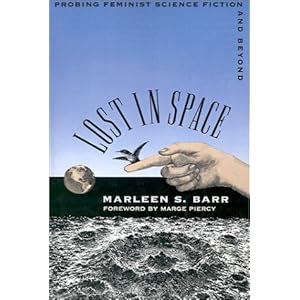
"The end of masculinity would also mean the end of femininity", and other thoughts from Marlene Barr

Source: Google Images

All female societies, pregnant nursing males, and the end of masculinity are only a few of the topics discussed by Marlene Barr in her book Lost in Space: Probing Feminist Science Fiction and Beyond. Through a series of essays, Barr comments on the equality (or disproportions) between men and women, using feminine sf stories as a basis of comparison. Authors like LeGuin, Russ, and Gilman are quoted by Barr, though she is fair in her feminist sf study by including male authors (an unwanted but undeniable presence in feminist sf).

In the introduction to her SF analysis, Barr shares the story of her academic rise. By choosing to study sf through a feminist lens, Barr says that many of her male colleagues were threatened and tried to negate the academic quality of sf for study. Sf writer Gary Westfahl is quoted by Barr, warning sf writers to “never conceal, compromise, or apologize for [your] interest in this field” (p. 2). If sf was a laughable avenue of study to her colleagues, Barr realizes that a feminist-led criticism sf might be met with greater laughter. Still, she forges ahead with the dismantling of patriarchal sf by comparing them to feminist sf stories of the same caliber.

Chapter 6 talks about the end of masculinity. At face value, the term ‘end of masculinity’ could be interpreted as a threat to men everywhere. What Barr means by the end of masculinity is to also end the other side of that particular coin, femininity. Like ying and yang, one cannot exist without the other. Without masculinity or femininity, men and women would unite under a singular definition of gender, one in which both men and women would be caregivers, providers, and valuable members of society. Barr's text is a valuable tool in the study of sf, especially given her gender critiques.

Barr, S., Marlene. Lost in Space: Probing Feminist Science Fiction and Beyond. North Carolina: The University of North Carolina Press, 1993. Print.

Wednesday, August 15, 2012

The Themes Found in "A Handmaid's Tale"

File:Atwood Handmaid.jpg
"Handmaid Under the Eye"
Created March 11, 2008
by Segeton
Source: Wikimedia Commons

According the timeline in A Handmaid's Tale, in the early 1970’s, radicals took over the United States, killing the President and all of Congress simultaneously. To erect their totalitarian regime, the country’s new founders suspended the Constitution to create their own laws. These laws are mostly anti-laws steeped in Christian sentiments, like pro-life, anti-sex (citizens are denied sex unless they are married, and even masturbating is a punishable offense), free speech censorship, and even laws prohibiting literacy (for women).
 Offred is a Handmaid of the Republic of Gilead. The remnants of the United States is formed into Gilead, and woman are no longer allowed to have a job or own property in the land of Gilead. A rise in sterile men and women has prompted the leaders of Gilead to promote the use of Handmaids. Handmaids like Offred are put into households of commanding army officers to do what their sterile wives cannot: produce a child. Often, a Commander is sterile (though it is treasonous to blame men for anything in Gilead), and a Handmaid must secretly turn elsewhere to become pregnant.
When Offred’s Commander begins a courtship with her, their forbidden affair is one she takes as  just another duty of her Handmaid status. Yet, the affair opens her up to another affair with the Commander’s chauffer, Nick, and she finds herself falling in love for the first time since the empire of the United States ended and the reign of Gilead began.
A Handmaid’s Tale reads like a series of diary entries, and the writing is just as intimate. Atwood is not afraid to make her characters real, even if sometimes that means their descriptions are crude beyond belief: “Below me, the Commander is fucking. What he is fucking is the lower part of my body. I do not say making love, because this is not what he’s doing. Copulating too would be inaccurate […]; Nor does rape cover it: nothing is going on here that I didn’t sign up for” (p. 121).
Female freedoms and male expectations are two large themes Atwood constantly revisits in her novel. Simple things women may take for granted like having a bank account, going where they please, reading a book, and having a job are all defining characteristics of female suffrage. Offred, and all women in Gilead, are denied these basic rights. Why? The founders of Gilead believe that by returning women to a more ‘traditional’ role (traditional role in the Christian or even Islamic sense), they can guarantee the happiness of most. Like other totalitarian governments, Gilead has achieved a few things that modern civilization has not: rape, murder, and theft have been eliminated (for the most part).
File:Margaret Atwood Eden Mills Writers Festival 2006.jpg
Author Margaret Atwood attends
 a reading at Eden Mills Writers'
Festival, Ontario, Canada in
September 2006.
By Vanwaffle
Source: Wikimedia Commons
Men of Gilead expect their women fill the role of the caretaker (cooking, cleaning, ect). In a way, women are natural caretakers as they give birth and instinctively feel the need to take care of their progeny. Does that mean that women should be responsible for taking care of all household duties, and nothing else? Well, in Gilead, that is exactly what being a woman means. Men of Gilead also expect their women to be natural sluts (but publicly, they denounce wanton sexual behavior). Gilead Commanders maintain a brothel outside of town, named the Jezebel. At Jezebel, women wear ‘retro’ costumes, like lingerie and cheerleading outfits. When Offred asks how a place like Jezebel is allowed, the Commander responds with “Everyone’s human […] you can’t cheat Nature. Nature demands variety, for men. It stands to reason, it’s part of the procreational strategy. It’s Nature’s plan. Women know that instinctively. Why did they buy so many different clothes, in the old days? To trick the men into thinking they were several different women” (p. 308). 

Saturday, July 28, 2012

"The men are coming! The men are coming!" A summary of "When It Changed" by Joanna Russ


File:Avon Science Fiction Reader 1.jpg
Cover of the fantasy fiction magazine Avon Science 
Fiction Reader no. 1 (1951) 
featuring "The War of the Sexes" 
by Edmond Hamilton.
Source: Wikimedia Commons
On the planet Whileaway, there are no men. The women hardly notice because they have learned to survive, thrive, and reproduce without penetrative intercourse. That is not to say the women of Whileaway do not enjoy intercourse, but they enjoy it with other women, who they take as wives in a marriage of equality.
The narrator, Janet, of Russ's short story appears from the beginning of the story to be a man. It is not until later that the reader understands that the main viewpoint is a woman, a woman speaking of winning duels, wielding guns, and loving her wife, Kate, and their three collective daughters.
Four male astronauts land on Whileaway, and interrogate Janet and her family. “Where are all the people?” the men keep asking. Janet does not understand why they keep asking that, but then she sees that when the astronauts say 'people' they really mean 'men'. She tells the astronauts that the men died out six-hundred years ago. At this news, one of the astronauts gives a teary sigh and then says, “We're here now.”
Kate believes the men to be dangerous, and even tries to shoot one of them but Janet stops her. Later, Janet wishes she would have followed Kate's instincts and gotten rid of the newcomers. It dawns on her that the men are going to take over the planet of Whileaway, especially after one of them tells her that they need 'the cells of Whileaway'. She tells him that he can have all the cells he needs, but he smiles and tells her they cannot just be given the cells, they must be given through the act of penetrative intercourse (though he doesn't quite say it like that). He tells Janet the Whileaway kind of life is 'unnatural', and to make it natural once again, a dual-natured society must reign again. When Janet tells him that she already has a wife in Kate, the astronaut smiles and assumes that their relationship is based off of a mutually agreed need to survive monetarily. Actual love between two women is beyond the astronaut's understanding.
To the Whileaway women, the astronauts seem more like apes than like human men. Janet, Kate, and their daughters do not even find the men attractive. Janet asks her daughter if she would kiss a man, and her daughter scoffs and says she'd sooner kiss a toad.
The women of Whileaway are already dual-natured, even if the astronauts cannot see it. Janet thinks wistfully of her daughter going off for the traditional bear-hunt, like a right of passage for a Whileaway woman to become an adult. And Janet shares many traits that would be considered manly as she seems to protect her family, know how to use a gun, and duel to the death with other Whileaway women. At the same time, Janet loves her daughter and loves being a mother. Kate is not a 'weak' woman either, though she seems gentler than Janet. She does not like guns, and so it is a surprise when she grabs Janet's gun with ease and tries to shoot the invaders.
Whileaway women defy common stereotypes of women in our culture, and the way they perceive men (though exaggerated) serves as a good example of the exact chasms that separate the two genders.


Russ, Joanna. “When It Changed”. New York: Doubleday, 1972. Print.      

Saturday, June 2, 2012

"A Princess of Mars"- A novel where being a princess means being helpless

File:John Carter.svg is a former Virginian confederate officer. Penniless after the end of the Civil War, Carter is not without courage, honor, and a friend: James Powell. When Powell is taken by a band of Native Americans, Carter follows and finds his friend dead. He later takes refuge in a cave and is almost overtaken by the same band of Native Americans. Though, some noise or presence scares them off (maybe a foreign spacecraft; Burroughs never says) and when Carter next awakes, he is on the planet Mars.
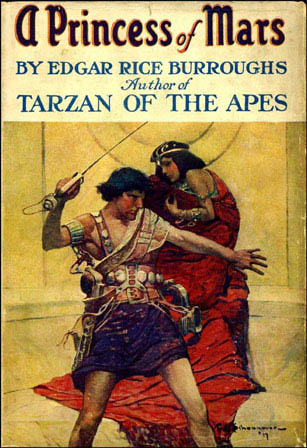
The first sign of life Carter is exposed to are green men called the Tharks. They are a harsh sort of civilization, comparable to the culture of Spartans. They relish brutality, respect violence, and laugh only when these two things occur. Carter is lucky because he kills two of their chieftains, and gains the Tharks esteem, becoming a chieftain himself. His female mentor (all Tharks are raised by female mentors, not mothers or fathers) is Sola, and she shows him compassion and kindness. Carter’s other companion on Barsoom (the Thark word for Mars) is his dog-like companion, Woola.
File:Princess of Mars.jpg
Cover art by Frank Earle Schoonover
AC McClurg Publishing, 1917
Source: Wikimedia Commons
Carter finds out that there are other humanoids on Barsoom when he meets Dejah, a captive of the Tharks. She looks like an Earthling, but for her copper skin. Through her, he learns that Barsoom thrived over a thousand years ago, but due to failing resources, it fell into a state of disrepair ruled by the warring Tharks and other creatures.
A constant theme (and perhaps even a fear held by Burroughs) is the unjust nature of a communal civilization, as displayed by the Tharks. Personal possession is unheard of, unless it is something consequential like a blanket. Children do not learn love or even who their parents are. From the first year, they are taught warrior codes, and always to fight for what they want. Tharks do not even recognize love or friendship when the concepts are presented to them by John Carter. “Friendship?” asked Tars Tarkas. “There is no such thing.” (p. 62). Dejah laments the loss of love from the Tharks, a race that once mixed with her own to create hybrid Barsoomians.
Burroughs chooses to make the female character of Sola independent, brave and strong (as she is a Thark). Yet, the more ‘civilized’ female character, Dejah (the Barsoomian Princess of Helium), is not either of those things. Carter thinks of her as ‘earthly womanly’, giving that comparison whenever Dejah displays affection, weakness, or abject stupidity (at least, she does not seem that bright to me, the reader). For example, when Dejah convinces herself that Carter is an alien, she does not do so from any deductive reasoning, but rather she says her conviction comes from “her heart telling her to believe because she wishes to believe it”, a logic that Carter deduces is a “good logic, good, earthly, feminine logic.” (p. 48-49).
It seems that Burroughs idea of a Communist society was one in which barbaric pleasures reigned, as the Tharks did nothing but create a menacing picture of a communal faction, unlike the Utopian commune depicted in Gilman’s Herland. Carter’s ideas on ‘real’ women are borderline offensive at times, but probably reflective of the decade in which the novel was written.

Burroughs, Rice, Edgar. A Princess of Mars. Chicago: AC McClurg Publishing. 1917. Print. 

Monday, May 14, 2012

Themes in Mary Shelley's "Frankenstein"


File:Frankenstein engraved.jpg
Frontpiece to Mary Shelley's "Frankenstein"
(1831)
By Theodor Von Holst
Source: Wikimedia Commons
Victor Frankenstein is a privileged, intelligent young man from Ingolstadt who is passionate about life and the mysteries of creation. Fueled by this passion, he creates a sentient being. The drawback of Victor’s creation is its visage; the creature is more hideous than any other living thing on Earth, and all who look upon it instinctually draw back in fear.

Loved by no one (especially not Victor), the creature flees to the woods of Germany. There, he becomes literate in both words and love. Though, when he approaches the humans whom he cares most about, they react with predictable horror upon seeing his hideous form. Abandonment and fear are the two constants in the creature’s life. Those two things shape the creature into a demon, one that wishes to visit agony upon his creator by murdering everyone Victor holds dear.

Major themes in this book include humanity’s ever-expanding reach in creating something greater than human. However, as Victor learns, once such a being is created, it cannot be undone as easily as it was put together. There are consequences to creating a creature with human parts, but lacking any other qualities of a human (emotions, sympathies, intelligence). Even when the creature acquires these other human traits, it doesn't make him human in the eyes of others (though he felt himself to be equal to humans).

Another theme in the book is man’s inability to accept that in which he does not understand. Immediately, those who behold the creature spot him as a demon, without even allowing him to speak or act. Even when the creature acts solicitously (replenishing food and firewood, saving a woman from drowning), his actions go unappreciated and are even met with brutal force. Of his personality forming the way it did, the creature says “I cannot believe that I am the same creature whose thoughts were once filled with […] visions of […] goodness. But it is even so; the fallen angel becomes a malignant devil. Yet, even that enemy of God and man had friends […]. I am alone.” (Shelley, p. 124). In a large way, the creature's creator and the world around him are responsible in creating a humanoid monster. 

Shelley, Wollstonecraft, Mary. Frankenstein. London: Lackington, Hughes, Harding, Mavor & Jones, 1818. Print.