Showing posts with label Moral themes. Show all posts

Wednesday, August 15, 2012

The Themes Found in "A Handmaid's Tale"

File:Atwood Handmaid.jpg
"Handmaid Under the Eye"
Created March 11, 2008
by Segeton
Source: Wikimedia Commons

According the timeline in A Handmaid's Tale, in the early 1970’s, radicals took over the United States, killing the President and all of Congress simultaneously. To erect their totalitarian regime, the country’s new founders suspended the Constitution to create their own laws. These laws are mostly anti-laws steeped in Christian sentiments, like pro-life, anti-sex (citizens are denied sex unless they are married, and even masturbating is a punishable offense), free speech censorship, and even laws prohibiting literacy (for women).
 Offred is a Handmaid of the Republic of Gilead. The remnants of the United States is formed into Gilead, and woman are no longer allowed to have a job or own property in the land of Gilead. A rise in sterile men and women has prompted the leaders of Gilead to promote the use of Handmaids. Handmaids like Offred are put into households of commanding army officers to do what their sterile wives cannot: produce a child. Often, a Commander is sterile (though it is treasonous to blame men for anything in Gilead), and a Handmaid must secretly turn elsewhere to become pregnant.
When Offred’s Commander begins a courtship with her, their forbidden affair is one she takes as  just another duty of her Handmaid status. Yet, the affair opens her up to another affair with the Commander’s chauffer, Nick, and she finds herself falling in love for the first time since the empire of the United States ended and the reign of Gilead began.
A Handmaid’s Tale reads like a series of diary entries, and the writing is just as intimate. Atwood is not afraid to make her characters real, even if sometimes that means their descriptions are crude beyond belief: “Below me, the Commander is fucking. What he is fucking is the lower part of my body. I do not say making love, because this is not what he’s doing. Copulating too would be inaccurate […]; Nor does rape cover it: nothing is going on here that I didn’t sign up for” (p. 121).
Female freedoms and male expectations are two large themes Atwood constantly revisits in her novel. Simple things women may take for granted like having a bank account, going where they please, reading a book, and having a job are all defining characteristics of female suffrage. Offred, and all women in Gilead, are denied these basic rights. Why? The founders of Gilead believe that by returning women to a more ‘traditional’ role (traditional role in the Christian or even Islamic sense), they can guarantee the happiness of most. Like other totalitarian governments, Gilead has achieved a few things that modern civilization has not: rape, murder, and theft have been eliminated (for the most part).
File:Margaret Atwood Eden Mills Writers Festival 2006.jpg
Author Margaret Atwood attends
 a reading at Eden Mills Writers'
Festival, Ontario, Canada in
September 2006.
By Vanwaffle
Source: Wikimedia Commons
Men of Gilead expect their women fill the role of the caretaker (cooking, cleaning, ect). In a way, women are natural caretakers as they give birth and instinctively feel the need to take care of their progeny. Does that mean that women should be responsible for taking care of all household duties, and nothing else? Well, in Gilead, that is exactly what being a woman means. Men of Gilead also expect their women to be natural sluts (but publicly, they denounce wanton sexual behavior). Gilead Commanders maintain a brothel outside of town, named the Jezebel. At Jezebel, women wear ‘retro’ costumes, like lingerie and cheerleading outfits. When Offred asks how a place like Jezebel is allowed, the Commander responds with “Everyone’s human […] you can’t cheat Nature. Nature demands variety, for men. It stands to reason, it’s part of the procreational strategy. It’s Nature’s plan. Women know that instinctively. Why did they buy so many different clothes, in the old days? To trick the men into thinking they were several different women” (p. 308). 

Thursday, June 21, 2012

Analyzing Philip K. Dick's "Do Androids Dream of Electric Sheep?"


The future of 2020 is a rather bleak one on Earth. World War Terminus has dissolved all living animals and plants, leaving only radioactive dust in its wake. To meet the demand for organic life forms, robotic animals were created, along with human androids. Androids are used in the off-world colonies, but since they are virtually undetectable from humans in most every way, they are banned from Earth. The only thing that sets an android apart from a human is empathy. Androids do not feel empathy for living things, not even other androids. However, is it possible for an unemotional robotic human to evolve into a higher life form? Is it possible that all living things, mechanical or organic, share a similar spark and thus the right to live?

These are questions that android-bounty hunter Rick Deckard asks himself while on the quest to ‘retire’ six Nexus-6 androids in a single day. When he meets Rachel Rosen, a Nexus-6 android, her ability to mimic human emotions makes Deckard question his entire profession, and really, his entire outlook on life. Though, in the end, Deckard realizes that the lack of empathy in androids runs too deep. Humans and their ability to empathize with living things are what sets them apart from the mechanical intelligence of androids.

Life on Earth is sacred, mostly because of the after affects of World War Terminus. A new religion has sprung up called Mercerism. Mercerism promotes unity among humans, citing empathy as the greatest link from one human to another. Murders are unheard of (except when androids kill humans in off-world colonies), and the death of an animal is cause for a serious depression. Even the idea of killing an insect like a spider would be abhorrent to the future citizens described by Dick.

In Phillip K. Dick’s novel, there are parallels with other SF futuristic novels, like Ray Bradbury’s Fahrenheit 451. Both men have wives that are unsatisfied with their lives. In fact, in both novels, the wives and their displeasure serve as an extension of the main male character’s own dissatisfaction, almost like a foreshadowing of the unpleasantness to come. In the beginning of Dick’s novel, Deckard is happier (well, happier than his wife) and trying his best to help his wife out of her depression, but by the end, she is the one taking care of her husband as he is a broken man after retiring six andys.

As for the theme of communal human emotions in the novel, it ran in the same strain of the communal telepathic climate found in Olaf Stapledon’s Star Maker. The Earth setting described in Dick’s novel is a mirror comparison of the Utopian worlds found by the protagonist in Star Maker; citizens of Deckard’s Earth share their emotions through an empathy box, fusing their minds and emotions together. When Deckard comes home in a good mood, his wife implores him to share his mood with the world, telling him that it would be immoral not to.

As a reader, I kept expecting the world described by Dick to be a dystopian one, and in a way it is. People are given health and IQ tests, and if they do not pass, they are labeled as ‘special’, a term that prohibits them from mating or immigrating to off-world colonies. Another flaw of the world is the eventual ruin of Earth, as the radioactive ash is slowly covering (and devouring) everything. Through all of the prejudice and physical ruin of the Earth, the people of this futuristic setting manage to live peacefully with one another. It is sad to think that it took a nuclear war to make them understand the true value of life, and of each other. 

Dick, K., Philip. Do Androids Dream of Electric Sheep? New York: Doubleday, 1968. Print. 

Monday, May 14, 2012

Themes in Mary Shelley's "Frankenstein"


File:Frankenstein engraved.jpg
Frontpiece to Mary Shelley's "Frankenstein"
(1831)
By Theodor Von Holst
Source: Wikimedia Commons
Victor Frankenstein is a privileged, intelligent young man from Ingolstadt who is passionate about life and the mysteries of creation. Fueled by this passion, he creates a sentient being. The drawback of Victor’s creation is its visage; the creature is more hideous than any other living thing on Earth, and all who look upon it instinctually draw back in fear.

Loved by no one (especially not Victor), the creature flees to the woods of Germany. There, he becomes literate in both words and love. Though, when he approaches the humans whom he cares most about, they react with predictable horror upon seeing his hideous form. Abandonment and fear are the two constants in the creature’s life. Those two things shape the creature into a demon, one that wishes to visit agony upon his creator by murdering everyone Victor holds dear.

Major themes in this book include humanity’s ever-expanding reach in creating something greater than human. However, as Victor learns, once such a being is created, it cannot be undone as easily as it was put together. There are consequences to creating a creature with human parts, but lacking any other qualities of a human (emotions, sympathies, intelligence). Even when the creature acquires these other human traits, it doesn't make him human in the eyes of others (though he felt himself to be equal to humans).

Another theme in the book is man’s inability to accept that in which he does not understand. Immediately, those who behold the creature spot him as a demon, without even allowing him to speak or act. Even when the creature acts solicitously (replenishing food and firewood, saving a woman from drowning), his actions go unappreciated and are even met with brutal force. Of his personality forming the way it did, the creature says “I cannot believe that I am the same creature whose thoughts were once filled with […] visions of […] goodness. But it is even so; the fallen angel becomes a malignant devil. Yet, even that enemy of God and man had friends […]. I am alone.” (Shelley, p. 124). In a large way, the creature's creator and the world around him are responsible in creating a humanoid monster. 

Shelley, Wollstonecraft, Mary. Frankenstein. London: Lackington, Hughes, Harding, Mavor & Jones, 1818. Print. 

Tuesday, September 6, 2011

Moral Themes in "The Fellowship of the Ring"

File:Hand of Sauron.jpg
The hand of Sauron, wearing the One Ring. 2005,
Author Katie Tegtmeyer.

Through the world of books, a reader can experience many things without leaving the comfort of their favorite chair. A book can take a reader to Phuket, Bath, or St. Louis. While reading, a person can meet new people, or imagine what it would be like to skydive, engage in espionage, or both at the same time.

Literature is far more important for another reason; it can guide a reader’s moral compass. Since long ago when fables and parafables were popular, literature and ethics were entwined. Stories like “The Tortoise and the Hare” and “Prodigal Son” explain to the reader life lessons in a simplistic way, much like the Bible. Somewhere along the years, literature and ethics began to part ways. 

According to Adia Mendelson-Maoz, the divide between ethics and literature began in the times of Aristotle and Plato, continuing on through the first half of the twentieth century, (112). Mendelson-Maoz takes a quote from writer Oscar Wilde in his preface to The Picture of Dorian Gray, which sums up the feelings echoed throughout the academic community about linking literature and ethics: “There is no such thing as a moral or immoral book. Books are well written, or badly written. That is all.”
Times have changed yet again, and the parallel concerning literature and ethics has seen a revival. James Adamson writes, “Although literature and ethics have different methods, strategies, and goals, they are both forms of writing which deal with human lives; they both can be viewed as models of moral attention” (92–93). There are many books that include ethics or morals as part of the story. In Stephen King’s novella The Body, the reader understands why the lead character Gordy feels it best to leave the body ‘unclaimed’ by either group; it is a question of what is really right and what is really wrong. Flashfoward by Robert J. Sawyer takes the reader through a world where fate does not govern all. Sawyer’s story illustrates to the reader that the future can be changed, based on our own actions and choices, right or wrong as those choices may be. Another perfect example of moral themes found in literature would be The Lord of the Rings (or LOTR). J.R.R. Tolkien’s three story arc is set in a fantastical world beyond the imagination of many, and yet, he still manages to convey moral concepts in each part of LOTR, many of them found in The Fellowship of the Ring.

Part one of LOTR, The Fellowship of the Ring, features many themes. None are as present as the theme of pity and mercy in the face of death. While Gandalf the Grey wizard is explaining to Frodo Baggins the origins of how the Ring came to rest in his fate, he describes the story of the creature Gollum. Gollum had the ring for 500 years, but the Ring chose to leave him. By chance, Bilbo Baggins finds the ring in Gollum’s cave and takes it for his own. Bilbo had the chance then to kill Gollum, who was a deranged and dangerous creature. Frodo wonders aloud at why his uncle did not, and he says to Gandalf, “What am I to do? What a pity that Bilbo did not stab that vile creature, when he had the chance!" Those words spark a conversation between the two that is as follows:
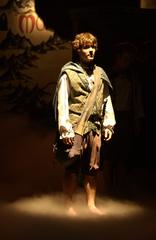
File:Frodo CSC pic.jpg
Joe Sofranko as Frodo, 2007
Theguyinblue 
           “Pity? It was Pity that stayed his hand. Pity, and Mercy: not to strike without need. And he has been well rewarded, Frodo. Be sure that he took so little hurt from the evil, and escaped in the end because he began his ownership of the Ring so. With Pity.”
            “I am sorry,” said Frodo. “But I am frightened; and I do not feel any pity for Gollum.”
            “You have not seen him,” Gandalf broke in.
            “No, and I don’t want to,” said Frodo. “I can’t understand you […] after he did all those horrible deeds […], he deserves death.”
           “Deserves it! I daresay he does. Many that live deserve death. And some that die deserve life. Can you give it to them? Then do not be too eager to deal out death in judgment. For even the very wise cannot see all ends. I have not much hope that Gollum can be cured before he dies, but there is a chance of it. And he is bound up with the fate of the Ring. My heart tells me that he has some party to play yet, for good or ill, before the end; and when that comes, the pity of Bilbo may rule the fate of many---yours not least.”-(Tolkien,  68-69).

Gandalf’s words suggest that a higher power may be at work, as he puts it “for good or ill". Even though Gollum is a reprehensible creature (a thief, traitor, and murderer), to decide his death or the death of others is not necessarily up to one person to deliver. Judgment in death must never be decided lightly, or (maybe as Tolkien believed) by human beings at all.

One of the recurring moral themes in The Fellowship of the Ring is the idea of temptation, and corruption from power. Several characters are offered the chance to have the Ring for themselves and do with it what they want, characters like Gandalf, Elrond, Tom Bombadil, Aragorn, and Galadriel. Though they may desire it, they do not accept the Ring because they know it has only the power to destroy.

Elrond is a very old elf, and saw the destruction Sauron wrought with the Ring during the Great War. For this reason, and others, he does not take the Ring. Men are easily drawn in by the power of the Ring; Aragorn almost could not resist Frodo’s offer to take the Ring from him. Aragorn is a hero of the story and displays more moral fiber than most, therefore he decides rather easily not to take the Ring.
File:Rivendell?.jpg
Depiction of "Rivendell": Jardim Tropical Monte Palace in 
Funchal, Madeira. 2009, Author Tim Walker. 
One of the members of the Fellowship has a harder time withstanding the call of the Ring: Boromir of Gondor.

From the very beginning of the quest, he thinks the Ring can be used as an instrument of good. He believes that it might save his kingdom, Gondor, from ruin. At the end of The Fellowship of the Ring, he tries to physically take the Ring from Frodo. But Frodo is able to escape. Later, Boromir is asked to help the two Halflings Merry and Pippin from a group of Uruk-hai. Perhaps because it was meant to be, or perhaps because Tolkien wanted to show that giving into temptation brings dire consequences, Boromir is slain while defending Merry and Pippin. One could argue that he sought repentance in trying to save the two Hobbits. Either way, Boromir’s moral compass led him astray and with his death, he may have been able to find redemption.  

The Fellowship of the Ring is full of moral themes, such as pity and mercy, judgment in death, temptation, and redemption. However, LOTR is not the only story worth analyzing for ties of literary and moral themes.  Ford Jameson believes that “every text contains traces of social, political, and ethical issues, whether in an overt form, or unconsciously.” Whether delving into a romance novel or science fiction, elements of ethics are bound to be identified. There does not have to be a separation between ethics and literature. Ethics and literature naturally go together, and that is not a bad thing. Literature is a kaleidoscope of knowledge, rife with teachings about every facet of life. Ethics has found a niche in literature (again), whether some agree with its place or not.


Works Cited
Adamson, James. Against Tidiness: Literature and/Versus Moral Philosophy. Cambridge: Cambridge University Press, 1998. Print.

Jameson, Ford. The Political Unconscious. Ithaca, New York: Cornell University Press, 1981. Print.

Mendelson-Maoz, Adia. “Ethics and Literature: Introduction”. Philosophia 35  (2007) 35:111–116. Web. 25 Aug. 2011.
            
           Tolkien, J.R.R. The Lord of the Rings, Part One: The Fellowship of the Ring. Toronto: Methuen, 1971. Print.