Showing posts with label men. Show all posts

Tuesday, April 8, 2014

One of the first (feminist) Utopian stories, "The Book of the City of Ladies"

In The Book of the City of Ladies, Christine de Pisan imagines she is transported into another world, a world in which women have rights they never had before. Given the year she penned her story was 1405, some of her ideas of freedom are limited, but they were a step in a much bigger direction.
Pisan starts her story by recalling male-penned stories and articles, all with one thing in common: their negative view of women. As the criticism and outright derision happens so often, Pisan shares her confusion. Surely, all of the men with their view on women couldn’t be wrong, especially since men of 1405 were allowed higher education and women were not, therefore they were considered to be smarter. A large collection of intelligent men could not be wrong, Pisan believed. It is only later when Pisan meets the three Ladies (Lady Reason, Lady Rectitude, Lady Justice)  that she rationalizes their views as wrong, citing details as to why men believe women to be inherently stupid and immoral (men are jealous, men are blind). One of the Lady’s puts things into perspective for Pisan through use of comparison. Men believe Eve, the first woman, was evil and she poisoned the whole of women for every generation to come. If men believe women to be inherently evil, why is it they also believe education will corrupt women? How can women be corrupted further if they are born corrupt? Lady Reason sums it up for Pisan, “Here  you can clearly see that not all opinions of men are based on reason and that these men are wrong” (para. 2).
Other parts of Pisan’s story tell of inventions and advantages by women, and other causes of misogyny.

While Pisan’s allegories strive to understand equality for women, there is still a patronizing tone to them throughout, almost an echo of the patriarchy still holding Pisan (and all women) back. She spoke of equality and education for women, but at the same time, the tone of her writing suggested she could never imagine a woman not being defined as a “lady” and a man not be defined as a “gentleman”. In Pisan’s equal world, woman probably would be educated but under male-supervision, and she could probably not have imagined women carrying out roles men traditionally held, such as going to war, being doctors, lawyers, and scientists. Again, in 1405, women had very little rights, and it is arguable that Pisan’s story was realistic in its outlook. 

Wednesday, August 15, 2012

The Themes Found in "A Handmaid's Tale"

File:Atwood Handmaid.jpg
"Handmaid Under the Eye"
Created March 11, 2008
by Segeton
Source: Wikimedia Commons

According the timeline in A Handmaid's Tale, in the early 1970’s, radicals took over the United States, killing the President and all of Congress simultaneously. To erect their totalitarian regime, the country’s new founders suspended the Constitution to create their own laws. These laws are mostly anti-laws steeped in Christian sentiments, like pro-life, anti-sex (citizens are denied sex unless they are married, and even masturbating is a punishable offense), free speech censorship, and even laws prohibiting literacy (for women).
 Offred is a Handmaid of the Republic of Gilead. The remnants of the United States is formed into Gilead, and woman are no longer allowed to have a job or own property in the land of Gilead. A rise in sterile men and women has prompted the leaders of Gilead to promote the use of Handmaids. Handmaids like Offred are put into households of commanding army officers to do what their sterile wives cannot: produce a child. Often, a Commander is sterile (though it is treasonous to blame men for anything in Gilead), and a Handmaid must secretly turn elsewhere to become pregnant.
When Offred’s Commander begins a courtship with her, their forbidden affair is one she takes as  just another duty of her Handmaid status. Yet, the affair opens her up to another affair with the Commander’s chauffer, Nick, and she finds herself falling in love for the first time since the empire of the United States ended and the reign of Gilead began.
A Handmaid’s Tale reads like a series of diary entries, and the writing is just as intimate. Atwood is not afraid to make her characters real, even if sometimes that means their descriptions are crude beyond belief: “Below me, the Commander is fucking. What he is fucking is the lower part of my body. I do not say making love, because this is not what he’s doing. Copulating too would be inaccurate […]; Nor does rape cover it: nothing is going on here that I didn’t sign up for” (p. 121).
Female freedoms and male expectations are two large themes Atwood constantly revisits in her novel. Simple things women may take for granted like having a bank account, going where they please, reading a book, and having a job are all defining characteristics of female suffrage. Offred, and all women in Gilead, are denied these basic rights. Why? The founders of Gilead believe that by returning women to a more ‘traditional’ role (traditional role in the Christian or even Islamic sense), they can guarantee the happiness of most. Like other totalitarian governments, Gilead has achieved a few things that modern civilization has not: rape, murder, and theft have been eliminated (for the most part).
File:Margaret Atwood Eden Mills Writers Festival 2006.jpg
Author Margaret Atwood attends
 a reading at Eden Mills Writers'
Festival, Ontario, Canada in
September 2006.
By Vanwaffle
Source: Wikimedia Commons
Men of Gilead expect their women fill the role of the caretaker (cooking, cleaning, ect). In a way, women are natural caretakers as they give birth and instinctively feel the need to take care of their progeny. Does that mean that women should be responsible for taking care of all household duties, and nothing else? Well, in Gilead, that is exactly what being a woman means. Men of Gilead also expect their women to be natural sluts (but publicly, they denounce wanton sexual behavior). Gilead Commanders maintain a brothel outside of town, named the Jezebel. At Jezebel, women wear ‘retro’ costumes, like lingerie and cheerleading outfits. When Offred asks how a place like Jezebel is allowed, the Commander responds with “Everyone’s human […] you can’t cheat Nature. Nature demands variety, for men. It stands to reason, it’s part of the procreational strategy. It’s Nature’s plan. Women know that instinctively. Why did they buy so many different clothes, in the old days? To trick the men into thinking they were several different women” (p. 308). 

Friday, January 27, 2012

An Analysis of Zora Neale Hurston's short story "Sweat"


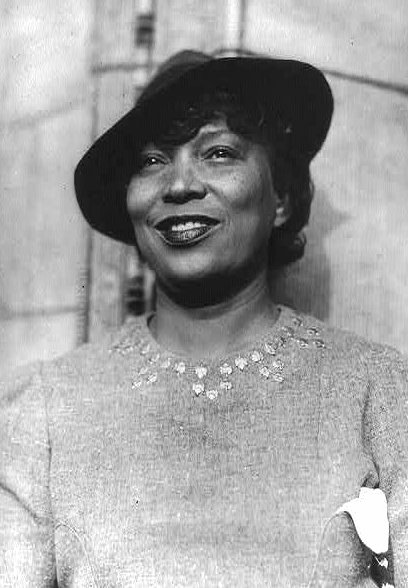
File:Hurston-Zora-Neale-LOC.jpg
Zora Neale Hurston-
American Author (1935)
By: Author unknown
Source: Wikimedia Commons


 Hurston's story "Sweat" depicts an abusive and selfish husband, Sykes. Delia, Sykes wife, has taken physical, emotional, and verbal abuse from Sykes for more than 15 years. Sykes treats his wife as a petulant teenager treats his mother: with little respect, but still expecting to be fully taken care of. Certainly, Sykes has some sort of mother-complex, even preferring big women to the skinny Delia. Though his mistress is described in an unflattering light ("a hunk uh liver wid hair on it"), it could be that Sykes finds bigger women attractive because he associates soft curves with a maternal figure.


Sykes is financially dependent upon his wife (since all he does with his own wages is gamble) and that makes him angry, angry enough to want to punish Delia, and even kill her. Though Delia's situation is not a happy one, it is not a rare one either. Any man is capable of the darkness found in Sykes. During the story, the other men in town describe the sort of man they believe Sykes to be: "There's plenty men dat takes a wife lak dey do a joint uh sugar-cane. It's round, juicy an' sweet when dey gits it. But dey squeeze an' grind, squeeze an' grind an' wring tell dey wring every drop uh pleasure dat's in 'em out. When dey's satisfied dat dey is wrung dry, dey treats 'em jes lak dey do a cane-chew. Dey throws em away." Many men, whether they are black, white, Asian or Hispanic, can treat women just as Sykes treats Delia.

All the same, Delia does seem somewhat stuck in her situation because of her race. The men in town gossip about Delia and Sykes, fully aware of how he has beat her for their entire marriage. Not one of the gossipers mentions aiding Delia, or calling the police on her behalf. The one thing that works as a temporary deterrent against Sykes is when Delia threatens to call "the white folks" on him. Would Delia have felt as helpless against an abusive husband had her character been white? I think so. Any woman who takes physical abuse for fifteen years might feel as though she had no other option but to take the abuse for the remainder of her marriage. However, this warrants repeating: Delia does seem somewhat stuck in her situation because of her race.