Showing posts with label husband. Show all posts

Friday, January 27, 2012

An Analysis of Zora Neale Hurston's short story "Sweat"


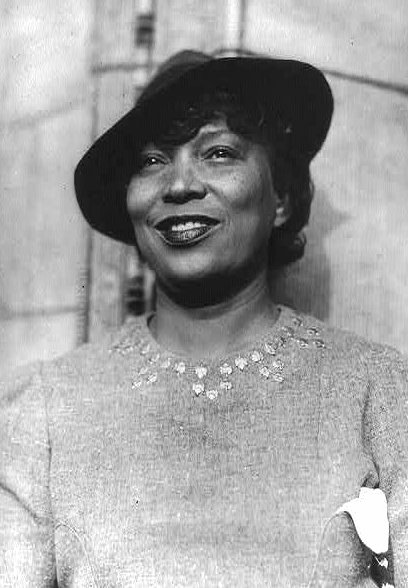
File:Hurston-Zora-Neale-LOC.jpg
Zora Neale Hurston-
American Author (1935)
By: Author unknown
Source: Wikimedia Commons


 Hurston's story "Sweat" depicts an abusive and selfish husband, Sykes. Delia, Sykes wife, has taken physical, emotional, and verbal abuse from Sykes for more than 15 years. Sykes treats his wife as a petulant teenager treats his mother: with little respect, but still expecting to be fully taken care of. Certainly, Sykes has some sort of mother-complex, even preferring big women to the skinny Delia. Though his mistress is described in an unflattering light ("a hunk uh liver wid hair on it"), it could be that Sykes finds bigger women attractive because he associates soft curves with a maternal figure.


Sykes is financially dependent upon his wife (since all he does with his own wages is gamble) and that makes him angry, angry enough to want to punish Delia, and even kill her. Though Delia's situation is not a happy one, it is not a rare one either. Any man is capable of the darkness found in Sykes. During the story, the other men in town describe the sort of man they believe Sykes to be: "There's plenty men dat takes a wife lak dey do a joint uh sugar-cane. It's round, juicy an' sweet when dey gits it. But dey squeeze an' grind, squeeze an' grind an' wring tell dey wring every drop uh pleasure dat's in 'em out. When dey's satisfied dat dey is wrung dry, dey treats 'em jes lak dey do a cane-chew. Dey throws em away." Many men, whether they are black, white, Asian or Hispanic, can treat women just as Sykes treats Delia.

All the same, Delia does seem somewhat stuck in her situation because of her race. The men in town gossip about Delia and Sykes, fully aware of how he has beat her for their entire marriage. Not one of the gossipers mentions aiding Delia, or calling the police on her behalf. The one thing that works as a temporary deterrent against Sykes is when Delia threatens to call "the white folks" on him. Would Delia have felt as helpless against an abusive husband had her character been white? I think so. Any woman who takes physical abuse for fifteen years might feel as though she had no other option but to take the abuse for the remainder of her marriage. However, this warrants repeating: Delia does seem somewhat stuck in her situation because of her race.

Thursday, November 18, 2010

Uses of Imagery in "The Wife of Bath"

While reading "The Wife of Bath's Prologue and Tale", many instances of imagery are apparent. Geoffrey Chaucer uses the narration of the wife of Bath to describe how men marginalize women unfairly. When speaking of her fourth husband, the wife says, "By God on earth, I was his purgatory/ for which I hope his soul lives now in glory,".

Earlier, she told of how he kept a mistress, therefore her allusion to maintaining a purgatory on earth was most likely revenge for his unchaste ways. Later, she goes on to say, 
"There was no one, save God and he, that knew/ How, in so many ways, I'd twist the screw,". In these lines of prose, the wife means that only she, her husband and the Divine Creator knew how she punished him for his adultery. Perhaps she did subtle things to make him sorry for what he had done, but they were humiliating nonetheless.

Lines and imagery like the ones mentioned give insights into the character the wife of Bath. While being married to her fourth husband, she described herself as 'young and full of passion'. Her naivety faded once she discovered her lascivious husband, and she hardened herself to make him suffer for hurting her. Overall, the insights from imagery in the story develop a plot that negates the chauvinistic view of women in society at the time. As a reader, the imagery evokes feelings of humor at the wife's approach to life, marriage and even virginity.

Greenblatt, et al. (Eds.). (2006). Teaching with the Norton Anthology of English Literature (8th ed.).New York, NY: W. W. Norton & Company

Friday, September 17, 2010

After reading "A Doll's House"....

In the play, A Doll House, one of the main character's Torvald Helmer, can be described as a husband who thinks he is above his wife, both in status and intelligence. Even in the early scenes of the play, it is clear he patronizes his wife, treating her like a child by referring to her as "my little lark" and "squirrel". He will not even allow her to eat macaroons, though she does in secret, because he believes it will ruin her teeth. That is the sort of admonishment a parent expresses to a child, not a spouse.

By the end of the play, Helmer has not changed in personality at all. If anything, his ugly nature is revealed once he learns of how his wife borrowed money without his consent. Though his wife did what she did to save his life and spare his pride, he was not anywhere near grateful. Instead, he was only worried about their reputation, his own predominantly. As he berated her, he painted a picture of how he really saw his wife, irresponsible and weak.

Nora decides to leave him and children to find out if she can be a person, not just a 'irresponsible and weak' wife and mother. The marriage she describes, one where both partners are not strangers, can discuss serious matters, and treat each other as equals is not one that Helmer would be capable of sharing. Perhaps, after a few months or years without his wife, he would come to see what it is he truly lost, and he would be willing to change.

While reading A Doll House, there were two symbols that I found predominant: money and the letter from Krogstad that sat in the mailbox. For the wife, Nora, money was an object symbolizing the love and easy life she wished on her husband and family. Her husband had received a prestigious raise at the bank, and soon their money woes were to be forgotten. Thus, the stress-free life Nora envisioned would finally come to fruition. Love was also equatable with money because Nora took out a loan for her dying husband in order to nurse him back to health. It was a loan she had no way to pay back at the time, but over the years, she worked hard to do just that.

The letter Krogstad left in the Helmer mailbox, detailing of Nora's loan and her forgery, was a symbol for the end of the Helmer marriage. Nora and her friend Mrs. Linde delayed Torvald from reading the letter for as long as they could, but it was a like a ticking timebomb in the mailbox, waiting to set off an emotional and truthful display of what the Helmer marriage was truly composed of.