Showing posts with label Feminism. Show all posts

Friday, February 14, 2014

Feminism and Utopian Theory are Nearly Intangible (According to Frances Bartkowski)

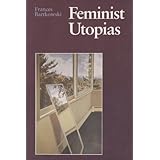
Feminist Utopias
by Frances Bartkowski
Image linked from:
http://www.amazon.com/
Frances-Bartkowski/e/B001IOHA3M
In so many utopian analytic texts, the tone is one of a jaded scholar, one who relies heavily in Suvin’s famous science fiction description of “cognitive estrangement”. Estrangement is surely at the heart of utopian texts, and yet, Frances Bartkowski takes Suvin’s description and pairs it with a more optimistic view, an echo of Karen Horney’s tone in Feminist Psychology.
Bartkowski’s definition of utopia is taken from William Morris’s News from Nowhere, as she believes “utopia is anywhere but here and now. It is alternatively the good place (eutopos) and no place (outopos) […] which could also be anywhere” (4). Her view of utopia is unique, but succinct.

As the text is named Feminist Utopias, Bartkowski delves into feminism: “Feminism has done much to bring together the theoretical differences and similarities of the struggles among classes and between sexes” (13). She is leading the reader to her conclusion, her conclusion being that utopian and feminist theory have deeper ties than most people realize, as utopian theory strives to better the human condition overall, much like feminism.
Bartkowski goes further in her comparison, stating utopian theory and feminist theory to be nearly inseparable, if not identical. What she is really saying is feminist theory is the ideal (the utopian ideal) as it encompasses many utopian elements and more in its definition. Of non-feminist utopians, Bartkowski summarizes the women in the stories, and how the creators of the utopias merely “made a place for women only to mask oppression while imagining patriarchal utopias” (14). Several science fiction and utopian writers are mentioned throughout the text, like Suvin, Russ, Butler, Bloch, Bellamy, and more. The chapters are made up of two feminist utopian works Bartkowski contrasts, comparisons, and analyzes. She includes novels such as The Female Man, Woman on the Edge of Time, and Herland.

Bartkowski, Frances. Feminist Utopias. Nebraska: University of Nebraska Press, 1989. Print.

Wednesday, July 17, 2013

Noah Bertlatsky: The (Short) History of Feminist Utopian Literature

"Nancy Porter"
Source: Wikimedia Commons
“Imagine there’s no gender: the long history of feminist utopian literature” is an article in The Atlantic highlighting the history of feminine utopian literature. However, writer Noah Bertlatsky does not delve far enough into said history. Based on Bertlatsky’s subtitle: "From Wonder Woman to Shulamith Firestone to Joanna Russ, visions of societies run by women or absent of gender altogether have existed for almost a century”, it’s obvious he either has decided to ignore earlier examples of feminine utopian literature, or he is unaware it exists.
The beginning of the article focuses on feminist writer Shulamith Firestone, and her views expressed in her text The Dialectic of Sex. Bertlatsky quotes Firestone as having said in 1970, “There is no feminine utopian literature in existence”. He believes the claim to be exaggerated, especially given the fact of several publications he cites, like The Left Hand of Darkness (1969), Herland (1915), and graphic novels like Wonder Woman (1941- ).
In Bertlatsky’s view, the most distinct part of Firestone’s philosophy is her description of feminism, which has roots in utopian theory: “[as radical feminists, we] are talking about changing a fundamental biological condition." Inequality, according to Firestone, is begot foremost by gender differences, and can be overcome when gender differences are gone (a notion shared by many a feminist, whether they be man or woman). Without gender to get in the way, Firestone imagined utopias in which technology would eliminate the need for work and even the need for live childbirth (an idea found in several utopian/dystopian novels, like Woman on the Edge of Time, The Shore of Women, and Brave New World).
Overall, it was refreshing to see an article on feminist utopian theory in the popular media, because it is not seen often. However, I feel like Bertlatsky deprived his readers by limiting his scope of feminist utopian history to a mere hundred years. He also displayed his male outlook on feminist utopian literature by including the Wonder Woman graphic novels. The world of graphic novels is notorious (much like science fiction) for being a good ol’ boys club, so to include any graphic novel (especially Wonder Woman, a graphic novel objectifying women on a grand scale) speaks volumes.
It saddens me that this article was written this past year, illustrating just how much further the world needs to progress to attain gender equality, which, consequentially, in the words of Marlene Barr, would bring an end to feminism.

Bertlatsky, Noah. “Imagine there’s no gender: the long history of feminist utopian literature”. The Atlantic. The Atlantic Mag., 15 April 2013. Web. 20 May 2013. http://www.theatlantic.com/sexes/archive/2013/04/imagine-theres-no-gender-the-long-history-of-feminist-utopian-literature/274993/

Sunday, May 12, 2013

The Brilliance of James Tiptree, Jr. (or as she was born, Alice Sheldon)

Found on outofeverywhere.wordpress.com

This is a collection of stories by Tiptree, collected before Tiptree was discovered to be a woman. The introduction by Robert Silverberg is almost comical, especially when he defends the questioned masculinity of Tiptree: "There is something ineluctably masculine about Tiptree's writing. I don't think the novels of Jane Austen could have been written by a man, nor the stories of Ernest Hemingway by a woman, and the same way I believe the author of James Tiptree stories is male" (xii). Silverberg's supposition calls into question the definition of male and female writing. If in his mind Austen is the quintessential female writer and Hemingway the male, then his radar concerning the gender of authors is seriously misguided, more notably when he compares Tiptree to Hemingway. Silverberg manages to unknowingly pen several sexist claims, like Tiptree must be male because he talks about things like fishing, hunting, travelling, and the government with such authority. Reading the introduction reminded me of LeGuin's article "The Carrier Bag of Fiction", where she talks about the origins of what is intrinsically human, and it turns out not to be violent (and supposed) male tendencies, but the ability to gather, (a supposed) female tendency. It seems as if Silverberg is trying to legitimize Tiptree's place in science fiction by insisting on Tiptree's maleness, as if the possibility of Tiptree's womanhood would do the opposite.
There are two short stories I read in the collection, starting with “The Girl Who Was Plugged In”. If anything, the story takes place in both a utopia and dystopia. The world as laid out by Tiptree has outlawed advertising. It was deemed immoral, and word of mouth is the only way companies have of getting their products sold. That’s where J. Burke comes in. She’s described as ugly, but company execs have their own ideas on how to make her pretty. After she attempts suicide, they know she is desperate enough to accept their offer: to plug her brainwaves into a beautiful humanoid. Through the new J. Burke (re-named Delphi when in humanoid form), the execs are able to wield an alluring and subtle spokesperson for their products. A man falls in love with Delphi, and discovers in part her secret. When he finally meets the real Delphi (J. Burke), he is disgusted at her appearance and accidentally kills her.
The story is a reminder of how humans will do their best to undermine the law, even when the law is put in place to enhance their rights. Another theme of Tiptree’s short is the lie women must keep up with their looks. J. Burke/Delphi could be an analogy for said lie, with J. Burke being how men view women without “cute” clothes/make-up on, and Delphi being how they view women in their costumed perfection. In the story, Delphi’s admirer was naïve in believing she was a paragon all the time, and he is disillusioned, even horrified, to discover his real love shares her likeness with a monster.
In “The Women Men Don’t See”, a group of people have to survive a plane crash on a sandbar in the Yucatan. Two women make up part of the group, and two men make up the other. The story is told from a male perspective, with the man constantly being surprised in the unflappable nature of the two women. When he expects them to complain, they remark on the scenery. When he expects them to make demands, they make kind concessions. This second story I read really had little to do with utopia/dystopias, and everything to do with how men expect women to act, versus how women can act.
Overall, the book is a great example of how women are seen not just in science fiction, but through the eyes of men. What’s ironic about it is that Tiptree managed to write from the male perspective so convincingly she had everyone believing she was a male, and they thought it patronizing and progressive of “him” to take small feminist stands in his writing. How must they have viewed Tiptree’s writing after discovering he was a she? I have an idea as to what they were thinking, because Silverberg puts a postscript at the end of his intro, describing the letter he received from Tiptree. She confessed to him her true sexuality, and of it, Silverberg wrote, “What I have learned is that there are some women who can write about traditionally male topics more knowledgeably than most men, and that the truly superior artist can adopt whatever tone is appropriate to the material and bring it off” (xviii).

Tiptree Jr., James. “The Girl Who Was Plugged In”.  Warm Worlds and Otherwise. New York: Doubleday, 1973. Print.

            -. “The Women Men Don’t See.” Warm Worlds and Otherwise. New York: Doubleday, 1973. Print.

Monday, November 19, 2012

The Importance of Charlotte Perkins Gilman's "Herland"

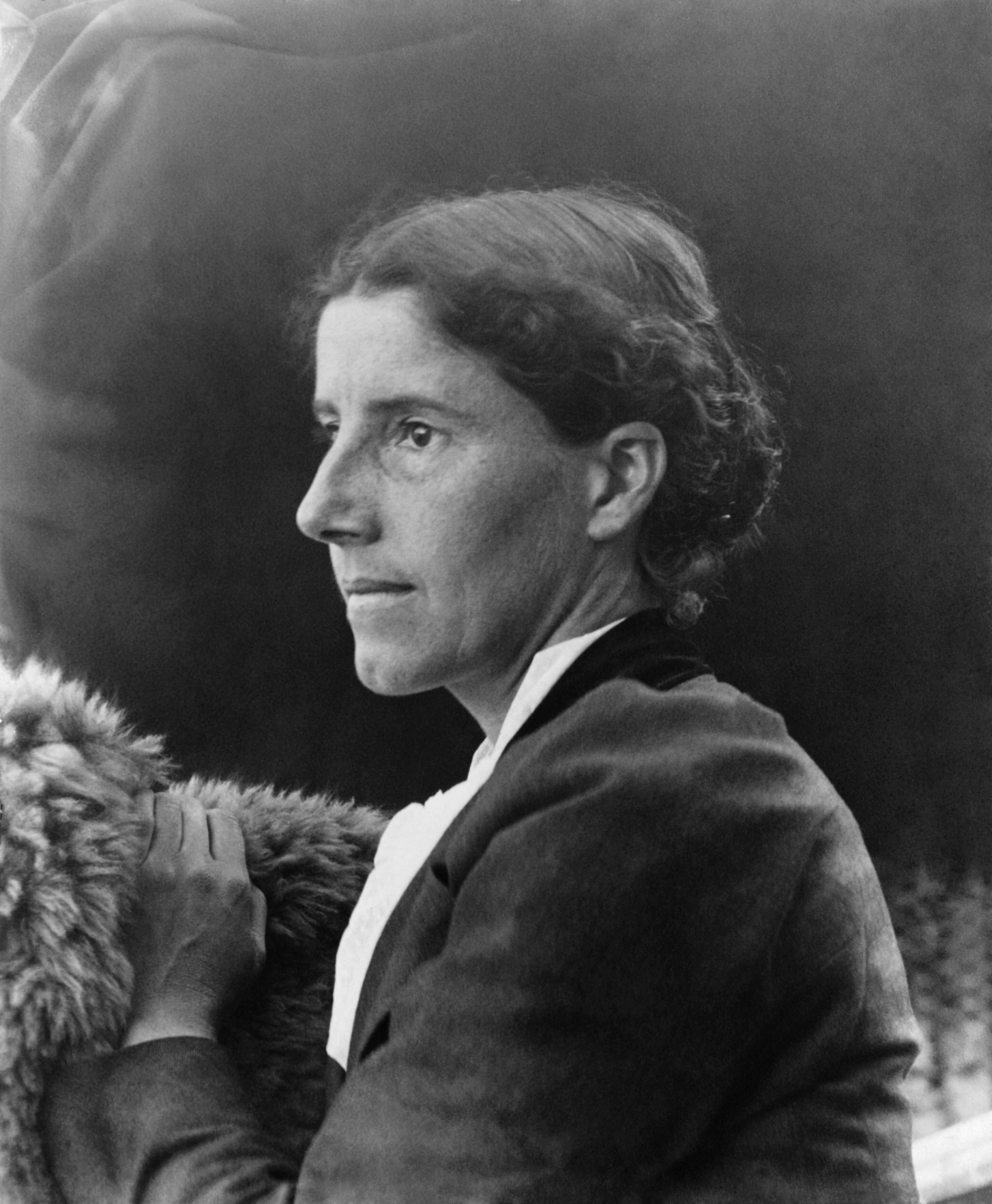
Photographic portrait of Charlotte Perkins Gilman,
American author, c. 1900. This is a cropped version
of the digital image from the Library of Congress online
collection, as identified below. Copyright has expired on this image.
Source: Wikimedia Commons

Charlotte Perkins Gilman was many things: a writer, a feminist, and at times, fan of eugenics based on her staunch racism. Aside from her failings, Gliman managed to write a groundbreaking novel called Herland that went unnoticed until it gained popularity in the 1970's. First appearing as a serial in 1915, Herland is one of the first works of feminist Utopian fiction.
Three young students set out to explore a legend shared by the locals of the foreign country that they are residing in. The legend is of a hidden community comprised solely of women. Since the three students are also young men, their interest is more than piqued.
All three men have different views on women, ranging from the extreme to the sympathetic. Jeff  is the biologist, and an idolizer of women. The narrator, Van, stays neutral on most every subject as a sociology major. Terry is a geologist, and straddles the line between gentleman and chauvinist pig.
Before they find out that the legend of Herland is indeed true, the three men surmise on what sort of civilization could arise if maintained by only women. Their prejudices and sexist views come to the fore during these discussions; “We mustn’t look to find any sort of order and organization […] Also we mustn’t look for inventions and progress; it’ll be awfully primitive.” (p. 8-9).
The civilization the three men discover is far beyond anything they could have imagined. Herland is a beautiful country, with gardens and forests that are carefully tended to yield the most food (there is no room for crops or cattle in Herland's tiny strip of territory). Men are nowhere to be found. In fact, the arrival of Terry, Jeff, and Van mark the civilization’s first sighting of men in two-thousand years.
Though Herland is not a distant planet, it might as well be for the all the differences Van takes note of in his journal. At first, Van believes his ‘world’ to be more advanced, but as he learns more and more about the women of Herland, he becomes ashamed at the state of his world in comparison to their paradise.
Many notions of femininity come into question in this short novella from Charlotte Perkins Gilman. The women of Herland keep their hair cropped short, wear clothes free of adornment, are intelligent, and work hard doing things that the three men considered only for men. Not every woman is young, giggling, and beautiful: [Van’s perspective]- ‘Woman’ in the abstract is young, and, we assume, charming. […] Most men do think that way, I fancy.” (p. 21). By the end of the story, Van and Jeff come to see that Terry’s view about women is entirely wrong, that indeed all their thoughts about women are entirely based on their society’s perception of gender roles.

Gilman, Perkins, Charlotte. Herland. New York: Pantheon Books, 1979. Print.

Monday, November 5, 2012

"53% of the Brotherhood of Man is the Sisterhood of Woman", and other thoughts by Ursula K. LeGuin


The opening line of Ursula K. LeGuin's “America Sf & the Other” sums up the tone of the article perfectly: “One of the great early socialists said that the status of women in a society is a pretty reliable index of the degree of civilization of that society. If this is true, then the very low status of women in SF should make us ponder about whether SF is civilized at all”.
File:UrsulaLeGuin.01.jpg
Meet-the-author Q&A session;
Bookworks bookstore, Albuquerque, NM

Photo taken by Hajor, 15.Jul.2004.
Source: Wikimedia Commons
Much of LeGuin’s article makes an argument on behalf of all Others, as she acknowledges that there are many types of Others, such as sexual, racial, class, and cultural. She goes on to insist that the patriarchal SF establishment is the tip of the iceberg, not only in literature, but in society, leading to a greater ill: women are portrayed (and not just in SF) as LeGuin describes them, “squeaking dolls subject to instant rape by monsters”.
Real people, as in neighbors, teachers, the poor, and the like are rarely ever present in SF (or at least they weren't present in LeGuin’s generation of SF). People of LeGuin’s SF are simply masses, described as ‘they’, never as the individuals that they are. Thus, the reader is indoctrinated, becoming desensitized to the needs of the un-described and faceless ‘they’ that are constantly harmed in SF stories.
Another point LeGuin makes about the masses in SF is this: “The people, in SF, are not people. They are masses, existing for one purpose: to be led by their superiors.” Imperialism is a turn the article takes for the better, going on to compare Galactic Empires with Roman Empires. Early pulp SF always made sure to conquer the alien invaders and to never portray them in a sympathetic light. The problem with that, in LeGuin’s view, is that SF has not really strayed from that old pulp notion that ‘the only good alien is a dead alien’, creating the sense that anything unknown =something not good (kill it, kill it!).
What’s worse is the creation of the godlike aliens of SF, that come to Earth with wisdom to better our sorry species. It may seem better to revere a being rather than kill it, but either way, LeGuin suggests that these two ideals only serve to distance human consciousness from one another. Or, to put it more eloquently, LeGuin states that with the distance from the other entity, either through hate or reverence, “You have made it into a thing, to which the only possible relationship is a power relationship. And thus you have fatally impoverished your own reality. You have, in fact, alienated yourself.”
The article ends with LeGuin surmising on the state of a male-led SF community, and her call to readers and writers of SF alike to end their longing for a return to Victorian standards, and instead to remember that “53% of the Brotherhood of Man is the Sisterhood of Woman”.  

Tuesday, October 30, 2012

Mizora: The Secret Society Founded by Women


Mary Bradley's novel, Mizora: A Prophesy, reads like a less publicized and earlier version of Gilman's Herland. It is a country of women located in a hidden pocket of the Earth (the Arctic instead of Africa), discovered by a regular citizen. After that, comparisons between Mizora and Herland are not so easy to come by.
The explorer who stumbles upon Mizora is alone, Russian, and a woman. Through the narrator's perspective, the reader views gender hypocrisy in a new way. The female narrator time and time again cannot understand how a society of women can get along without men, beliefs that were enforced by her own binary culture.
Mizoran women raise their children themselves, like in “When It Changed”, but unlike the communal parenting seen both in Herland and A Princess of Mars. While Mizoran women value their children greatly, the thing they hold to the greatest esteem is education. They believe that when they made education (including college) free for all, many of their social problems solved themselves. For example, the poverty rate is extremely low. Due to an influx of students, more mathematicians and scientists graduated, producing people capable of engineering affordable food, fuel, and most any commodity. A Mizoran educated populace also saw a decline in crime, and by the time the narrator finds Mizora, the most heinous crime committed by a citizen was the striking of their child almost a century before.
While reading Mizora, the parallels between a strictly female society and a peaceful society are argued in detail. Once men are out of the equation, more important societal questions are pursued that aid in harmonizing a populace. One stark trait of the Mizorans is their exaggerated femininity. In Herland, the women are spoken of as being beautiful, but in a more neutral, androgynous way. In Mizora, their delicacy is emphasized. All Mizorans have blond hair, a product of the eugenics practice that was perfected centuries before. Silk, flowing dresses and artfully made up faces are staples among the Mizorans, though in other all-female (or androgynous) populations found in the Left Hand of Darkness and Herland, beauty is a natural part of the citizens, not something artificially constructed through the use of exaggerated clothing and make-up.
          While Bradley sought to undermine gender roles in Mizora, some parts of her novel only reinforce them. The most illuminating part of the novel is when the female narrator is in disbelief over the roles of women in Mizora, and her ideas of a woman’s place (below that of a man’s) as opposed to theirs (women as human beings, not as a separate entity from men). The narrator’s point of view about women is one that is still present today. Plenty of women believe that the station they are currently in, (whether it be mother, daughter, wife, sister) is a station they cannot ascend beyond, and that they in fact should not strive to ascend beyond that station. Men are not the only oppressors of women. As Bradley illustrates, women can be their own worst enemies in the fight for gender equality, especially when women believe that the fight is not a valid one.


Bradley, Mary. Mizora: A Prophesy. New York: G. W. Dillingham, 1890. Print.

Saturday, September 29, 2012

Orlando: The Man, The Woman

File:Portadaorlando.jpg
Original cover
User: El-luismi
Source: Wikimedia Commons

Orlando is a novel by Virginia Woolf that takes the idea of being a man and woman in one lifetime (or several lifetimes) and puts it to good use. The title character, Orlando, is a nobleman living in England during the Elizabethan period. He is content with his life except for the loneliness, having been engaged, married, or assumed to be engaged to four women in his lifetime. When he meets a Russian princess, he thinks that life has finally rewarded him with his one true love. Unfortunately, the princess does not reciprocate and leaves Orlando. Distraught, Orlando turns to his other passion: writing. He takes writing seriously, writing plays, poems, and stories, all odiously long. Away in his country manor he writes and writes, until he is visited by a famous writer Nicolas Green. Green reads Orlando's work and writes up a poem to satire it, thus making Orlando hate humans and turn even more inward while at his country estate.
Later on, Orlando visits other European countries, encountering gypsies as he does so. One night, he has a strange dream, and as a by-product, becomes a woman. There is no shocking reveal or loathing from Orlando at having turned into a woman, only acceptance. With his/her new worldview, Orlando comes to see how different her life will be as a woman. Her return to London is a lesson in women's rights, because she realizes that she can no longer own her land, manage her finances, or vote. Small things come to Orlando's attention now that she is a woman, like the fact that men cannot cry in front of an audience. A man falls in love with her, and when she refuses him, the man begins to cry, and though Orlando knows from experience that men cry just as women do, that they are not supposed to openly weep, and so she is shocked at the emotion display of her thwarted lover.
File:Orlandoasaboy.jpg
"Orlando as a boy"
paiting by Cornelious Nuie
(1650)
User: El-luismi
Source: Wikimedia Commons
Orlando life spans many generations. He/she goes into deeps slumbers every few years, almost like a bear hibernating, and this (or some other type of magic) prolongs Orlando's life from the 1500's, taking the story all the way to the 1920's.
As a man, Orlando never questioned his privilege or sexuality (believing himself to be inherently heterosexual and powerful). Yet, as a woman, Orlando's eyes open up to see that the world is often one-sided in its treatment of women. Orlando the man fought in wars and dueled men to the death, but he/she is aghast when a gentleman treats her like a dainty flower, as she feels much more capable than she is given credit for, not just as a woman, but as an equal division of humanity.

Woolf, Virginia. Orlando: A Biography. New York: Harcourt Brace & Company, 1956. Print. 

Wednesday, September 12, 2012

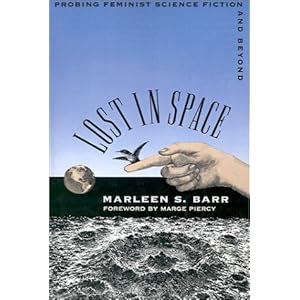
"The end of masculinity would also mean the end of femininity", and other thoughts from Marlene Barr

Source: Google Images

All female societies, pregnant nursing males, and the end of masculinity are only a few of the topics discussed by Marlene Barr in her book Lost in Space: Probing Feminist Science Fiction and Beyond. Through a series of essays, Barr comments on the equality (or disproportions) between men and women, using feminine sf stories as a basis of comparison. Authors like LeGuin, Russ, and Gilman are quoted by Barr, though she is fair in her feminist sf study by including male authors (an unwanted but undeniable presence in feminist sf).

In the introduction to her SF analysis, Barr shares the story of her academic rise. By choosing to study sf through a feminist lens, Barr says that many of her male colleagues were threatened and tried to negate the academic quality of sf for study. Sf writer Gary Westfahl is quoted by Barr, warning sf writers to “never conceal, compromise, or apologize for [your] interest in this field” (p. 2). If sf was a laughable avenue of study to her colleagues, Barr realizes that a feminist-led criticism sf might be met with greater laughter. Still, she forges ahead with the dismantling of patriarchal sf by comparing them to feminist sf stories of the same caliber.

Chapter 6 talks about the end of masculinity. At face value, the term ‘end of masculinity’ could be interpreted as a threat to men everywhere. What Barr means by the end of masculinity is to also end the other side of that particular coin, femininity. Like ying and yang, one cannot exist without the other. Without masculinity or femininity, men and women would unite under a singular definition of gender, one in which both men and women would be caregivers, providers, and valuable members of society. Barr's text is a valuable tool in the study of sf, especially given her gender critiques.

Barr, S., Marlene. Lost in Space: Probing Feminist Science Fiction and Beyond. North Carolina: The University of North Carolina Press, 1993. Print.

Wednesday, August 15, 2012

The Themes Found in "A Handmaid's Tale"

File:Atwood Handmaid.jpg
"Handmaid Under the Eye"
Created March 11, 2008
by Segeton
Source: Wikimedia Commons

According the timeline in A Handmaid's Tale, in the early 1970’s, radicals took over the United States, killing the President and all of Congress simultaneously. To erect their totalitarian regime, the country’s new founders suspended the Constitution to create their own laws. These laws are mostly anti-laws steeped in Christian sentiments, like pro-life, anti-sex (citizens are denied sex unless they are married, and even masturbating is a punishable offense), free speech censorship, and even laws prohibiting literacy (for women).
 Offred is a Handmaid of the Republic of Gilead. The remnants of the United States is formed into Gilead, and woman are no longer allowed to have a job or own property in the land of Gilead. A rise in sterile men and women has prompted the leaders of Gilead to promote the use of Handmaids. Handmaids like Offred are put into households of commanding army officers to do what their sterile wives cannot: produce a child. Often, a Commander is sterile (though it is treasonous to blame men for anything in Gilead), and a Handmaid must secretly turn elsewhere to become pregnant.
When Offred’s Commander begins a courtship with her, their forbidden affair is one she takes as  just another duty of her Handmaid status. Yet, the affair opens her up to another affair with the Commander’s chauffer, Nick, and she finds herself falling in love for the first time since the empire of the United States ended and the reign of Gilead began.
A Handmaid’s Tale reads like a series of diary entries, and the writing is just as intimate. Atwood is not afraid to make her characters real, even if sometimes that means their descriptions are crude beyond belief: “Below me, the Commander is fucking. What he is fucking is the lower part of my body. I do not say making love, because this is not what he’s doing. Copulating too would be inaccurate […]; Nor does rape cover it: nothing is going on here that I didn’t sign up for” (p. 121).
Female freedoms and male expectations are two large themes Atwood constantly revisits in her novel. Simple things women may take for granted like having a bank account, going where they please, reading a book, and having a job are all defining characteristics of female suffrage. Offred, and all women in Gilead, are denied these basic rights. Why? The founders of Gilead believe that by returning women to a more ‘traditional’ role (traditional role in the Christian or even Islamic sense), they can guarantee the happiness of most. Like other totalitarian governments, Gilead has achieved a few things that modern civilization has not: rape, murder, and theft have been eliminated (for the most part).
File:Margaret Atwood Eden Mills Writers Festival 2006.jpg
Author Margaret Atwood attends
 a reading at Eden Mills Writers'
Festival, Ontario, Canada in
September 2006.
By Vanwaffle
Source: Wikimedia Commons
Men of Gilead expect their women fill the role of the caretaker (cooking, cleaning, ect). In a way, women are natural caretakers as they give birth and instinctively feel the need to take care of their progeny. Does that mean that women should be responsible for taking care of all household duties, and nothing else? Well, in Gilead, that is exactly what being a woman means. Men of Gilead also expect their women to be natural sluts (but publicly, they denounce wanton sexual behavior). Gilead Commanders maintain a brothel outside of town, named the Jezebel. At Jezebel, women wear ‘retro’ costumes, like lingerie and cheerleading outfits. When Offred asks how a place like Jezebel is allowed, the Commander responds with “Everyone’s human […] you can’t cheat Nature. Nature demands variety, for men. It stands to reason, it’s part of the procreational strategy. It’s Nature’s plan. Women know that instinctively. Why did they buy so many different clothes, in the old days? To trick the men into thinking they were several different women” (p. 308). 

Saturday, July 28, 2012

"The men are coming! The men are coming!" A summary of "When It Changed" by Joanna Russ


File:Avon Science Fiction Reader 1.jpg
Cover of the fantasy fiction magazine Avon Science 
Fiction Reader no. 1 (1951) 
featuring "The War of the Sexes" 
by Edmond Hamilton.
Source: Wikimedia Commons
On the planet Whileaway, there are no men. The women hardly notice because they have learned to survive, thrive, and reproduce without penetrative intercourse. That is not to say the women of Whileaway do not enjoy intercourse, but they enjoy it with other women, who they take as wives in a marriage of equality.
The narrator, Janet, of Russ's short story appears from the beginning of the story to be a man. It is not until later that the reader understands that the main viewpoint is a woman, a woman speaking of winning duels, wielding guns, and loving her wife, Kate, and their three collective daughters.
Four male astronauts land on Whileaway, and interrogate Janet and her family. “Where are all the people?” the men keep asking. Janet does not understand why they keep asking that, but then she sees that when the astronauts say 'people' they really mean 'men'. She tells the astronauts that the men died out six-hundred years ago. At this news, one of the astronauts gives a teary sigh and then says, “We're here now.”
Kate believes the men to be dangerous, and even tries to shoot one of them but Janet stops her. Later, Janet wishes she would have followed Kate's instincts and gotten rid of the newcomers. It dawns on her that the men are going to take over the planet of Whileaway, especially after one of them tells her that they need 'the cells of Whileaway'. She tells him that he can have all the cells he needs, but he smiles and tells her they cannot just be given the cells, they must be given through the act of penetrative intercourse (though he doesn't quite say it like that). He tells Janet the Whileaway kind of life is 'unnatural', and to make it natural once again, a dual-natured society must reign again. When Janet tells him that she already has a wife in Kate, the astronaut smiles and assumes that their relationship is based off of a mutually agreed need to survive monetarily. Actual love between two women is beyond the astronaut's understanding.
To the Whileaway women, the astronauts seem more like apes than like human men. Janet, Kate, and their daughters do not even find the men attractive. Janet asks her daughter if she would kiss a man, and her daughter scoffs and says she'd sooner kiss a toad.
The women of Whileaway are already dual-natured, even if the astronauts cannot see it. Janet thinks wistfully of her daughter going off for the traditional bear-hunt, like a right of passage for a Whileaway woman to become an adult. And Janet shares many traits that would be considered manly as she seems to protect her family, know how to use a gun, and duel to the death with other Whileaway women. At the same time, Janet loves her daughter and loves being a mother. Kate is not a 'weak' woman either, though she seems gentler than Janet. She does not like guns, and so it is a surprise when she grabs Janet's gun with ease and tries to shoot the invaders.
Whileaway women defy common stereotypes of women in our culture, and the way they perceive men (though exaggerated) serves as a good example of the exact chasms that separate the two genders.


Russ, Joanna. “When It Changed”. New York: Doubleday, 1972. Print.      

Saturday, June 2, 2012

"A Princess of Mars"- A novel where being a princess means being helpless

File:John Carter.svg is a former Virginian confederate officer. Penniless after the end of the Civil War, Carter is not without courage, honor, and a friend: James Powell. When Powell is taken by a band of Native Americans, Carter follows and finds his friend dead. He later takes refuge in a cave and is almost overtaken by the same band of Native Americans. Though, some noise or presence scares them off (maybe a foreign spacecraft; Burroughs never says) and when Carter next awakes, he is on the planet Mars.
The first sign of life Carter is exposed to are green men called the Tharks. They are a harsh sort of civilization, comparable to the culture of Spartans. They relish brutality, respect violence, and laugh only when these two things occur. Carter is lucky because he kills two of their chieftains, and gains the Tharks esteem, becoming a chieftain himself. His female mentor (all Tharks are raised by female mentors, not mothers or fathers) is Sola, and she shows him compassion and kindness. Carter’s other companion on Barsoom (the Thark word for Mars) is his dog-like companion, Woola.
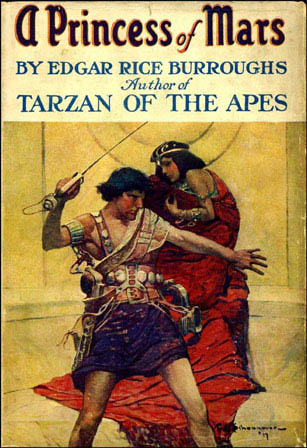
File:Princess of Mars.jpg
Cover art by Frank Earle Schoonover
AC McClurg Publishing, 1917
Source: Wikimedia Commons
Carter finds out that there are other humanoids on Barsoom when he meets Dejah, a captive of the Tharks. She looks like an Earthling, but for her copper skin. Through her, he learns that Barsoom thrived over a thousand years ago, but due to failing resources, it fell into a state of disrepair ruled by the warring Tharks and other creatures.
A constant theme (and perhaps even a fear held by Burroughs) is the unjust nature of a communal civilization, as displayed by the Tharks. Personal possession is unheard of, unless it is something consequential like a blanket. Children do not learn love or even who their parents are. From the first year, they are taught warrior codes, and always to fight for what they want. Tharks do not even recognize love or friendship when the concepts are presented to them by John Carter. “Friendship?” asked Tars Tarkas. “There is no such thing.” (p. 62). Dejah laments the loss of love from the Tharks, a race that once mixed with her own to create hybrid Barsoomians.
Burroughs chooses to make the female character of Sola independent, brave and strong (as she is a Thark). Yet, the more ‘civilized’ female character, Dejah (the Barsoomian Princess of Helium), is not either of those things. Carter thinks of her as ‘earthly womanly’, giving that comparison whenever Dejah displays affection, weakness, or abject stupidity (at least, she does not seem that bright to me, the reader). For example, when Dejah convinces herself that Carter is an alien, she does not do so from any deductive reasoning, but rather she says her conviction comes from “her heart telling her to believe because she wishes to believe it”, a logic that Carter deduces is a “good logic, good, earthly, feminine logic.” (p. 48-49).
It seems that Burroughs idea of a Communist society was one in which barbaric pleasures reigned, as the Tharks did nothing but create a menacing picture of a communal faction, unlike the Utopian commune depicted in Gilman’s Herland. Carter’s ideas on ‘real’ women are borderline offensive at times, but probably reflective of the decade in which the novel was written.

Burroughs, Rice, Edgar. A Princess of Mars. Chicago: AC McClurg Publishing. 1917. Print. 

Monday, May 14, 2012

A SF Literary Study isn't complete without "Critical Theory and Science Fiction". And here's why.


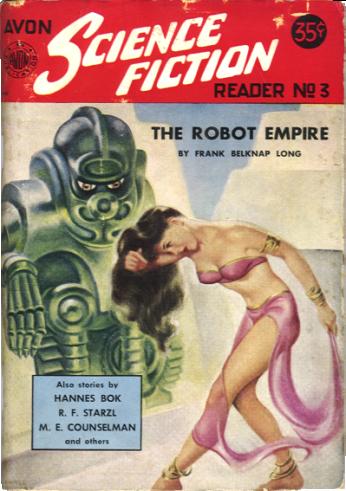
File:Avon Science Fiction Reader 3.jpg
An idealized version of what the SF genre is (or was).
Cover of the fantasy fiction magazine

             Avon Science Fiction Reader no. 3 (1952)

           by Frank Belknap Long 

Source: Wikimedia Commons
A comprehensive (and often) exhaustive study on the validity of science fiction in the literary canon. In fact, author Carl Freedman dedicates an entire section of the book to the description, history, and importance of the literary canon and why science fiction works are to be included in the canon.

Freedman’s text redefines science fiction as ‘cognitive estrangement’, as coined by author Darko Suvian. To better understand Suvian’s meaning, a quote is rather necessary: “estrangement ‘differentiates [science fiction] from the realistic literary mainstream’, while cognition differentiates it from myth, the folk tale, and fantasy […] science fiction is determined by the dialectic between estrangement and cognition” (p. 16).

To Freedman, the genre of science fiction is constantly evolving, and it is hard to pinpoint what exactly constitutes the epitome of science fictional text. Freedman’s views of science fiction are so broad (or maybe so idealized) that he believes all general fiction to be a sub-category of science fiction, and not the other way around (p. 20). The expansive reach of the science fiction genre in Freedman’s eyes is boggling. Freedman believes that every fictional text ever written is a sort of science fictional story as well, because some apt descriptions of science fiction say it is the creation of a new world. Arguably, every fictional novel is a ‘new world’ created by the author and the characters that populate it.

In three not-so-short chapters, Freedman takes the reader on a new expedition into the academic world of science fiction. Chapter one is titled “Definitions”, and it does just that; chapter one defines critical theory and science fiction, melding the two together with Freedman’s conclusions (juxtaposed with other academic opinion of course). Chapter Two, “Articulations”, first discusses genre, literary canon, and theory. Then, science fiction is measured against three critical dynamics: style, the historical novel, and utopia. Chapter three, “Excursuses”, give detailed overviews of Solaris, The Dispossessed, The Two of Them, Stars in My Pocket, and The Man in the High Castle.

Lastly, Freedman includes a section that explores critical theory and science fiction and how it may later evolve, as Freedman concedes that “it is in the nature of critical fiction and science fiction to speculate about the future” (p. 181).

Freedman’s section on utopias and feminism make a nice addition to the academic conversation. In that same section, authors Ursula Le Guin and Joanna Russ are compared and contrasted in a very satirical manner: “The basic contrast frequently adduced is between the gentleness of Le Guin’s feminism and the angry militancy of Russ’s” (p. 129). Freedman makes fun of such comparisons, stating that they are responsible for creating further rifts for women in science fiction (or in society in general). He also muses on the fact that for early pulp science fiction of the 1900’s, it was hard for the genre to recognize able-bodied women, or admit the fallacy of phallic dominance (p. 129).

Throughout the book, Freedman’s tone is one that strives to reach the reader, but always falls a little bit short with a myriad of unknown adjectives and a mountain of footnotes on almost every page (even though in the preface Freedman expresses his own dislike of footnotes, on the grounds that it is a ‘pseudoscholarly practice of citing works in order to suggest, truthfully or not, that one has read them’ [p. xx]). Despite that, once the reader is able to follow Freedman’s ideas and take hold of them, his tone is suggestive, humorous, and down-to-earth.

Critical Theory and Science Fiction was published in 2000. That fact only becomes evident in the last section which mentions the evolutionary pattern that will take hold of science fiction, namely, cyberpunk. To an extent, Freedman is correct, so it is a forgivable error in his effort to create a timeless account of the science fiction genre. Since his studies in the book mention books in the literary canon from 1818 until the late 1980’s, the year of publication is nominal in this instance.

Generally, I prefer not to read academic texts unless they are strictly related to what I am studying. Freedman’s book was one that did not let me forget what I was studying, and it was an academic text that I highlighted like a lunatic, madly muttering to myself things like “yes….and yes…” and “of course!”. If future readers can get over the flowery detailed language in the preface, then they will count themselves lucky to have stumbled upon the fascinating overviews provided by Freedman in his three, seventy-five-page chapters.

Freedman is an associate professor of English at Louisiana State University. He is the author of several articles and four non-fiction texts. An excerpt from his book Critical Theory and Science Fiction was chosen as featured text for discussion at the Theory Roundtable of the International Conference on the Fantastic in the Arts in 2002. 

Freedman, Carl. Critical Theory and Science Fiction. Middletown, Connecticut: Weslayen University Press, 2000. Print.
Friday, January 27, 2012

An Analysis of Zora Neale Hurston's short story "Sweat"


File:Hurston-Zora-Neale-LOC.jpg
Zora Neale Hurston-
American Author (1935)
By: Author unknown
Source: Wikimedia Commons


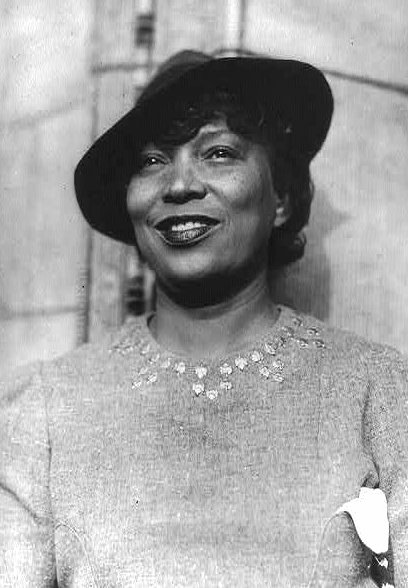
 Hurston's story "Sweat" depicts an abusive and selfish husband, Sykes. Delia, Sykes wife, has taken physical, emotional, and verbal abuse from Sykes for more than 15 years. Sykes treats his wife as a petulant teenager treats his mother: with little respect, but still expecting to be fully taken care of. Certainly, Sykes has some sort of mother-complex, even preferring big women to the skinny Delia. Though his mistress is described in an unflattering light ("a hunk uh liver wid hair on it"), it could be that Sykes finds bigger women attractive because he associates soft curves with a maternal figure.


Sykes is financially dependent upon his wife (since all he does with his own wages is gamble) and that makes him angry, angry enough to want to punish Delia, and even kill her. Though Delia's situation is not a happy one, it is not a rare one either. Any man is capable of the darkness found in Sykes. During the story, the other men in town describe the sort of man they believe Sykes to be: "There's plenty men dat takes a wife lak dey do a joint uh sugar-cane. It's round, juicy an' sweet when dey gits it. But dey squeeze an' grind, squeeze an' grind an' wring tell dey wring every drop uh pleasure dat's in 'em out. When dey's satisfied dat dey is wrung dry, dey treats 'em jes lak dey do a cane-chew. Dey throws em away." Many men, whether they are black, white, Asian or Hispanic, can treat women just as Sykes treats Delia.

All the same, Delia does seem somewhat stuck in her situation because of her race. The men in town gossip about Delia and Sykes, fully aware of how he has beat her for their entire marriage. Not one of the gossipers mentions aiding Delia, or calling the police on her behalf. The one thing that works as a temporary deterrent against Sykes is when Delia threatens to call "the white folks" on him. Would Delia have felt as helpless against an abusive husband had her character been white? I think so. Any woman who takes physical abuse for fifteen years might feel as though she had no other option but to take the abuse for the remainder of her marriage. However, this warrants repeating: Delia does seem somewhat stuck in her situation because of her race.

Friday, July 22, 2011

Global Perspectives in the Development of Gender Studies

File:A woman's eye.JPGElizabeth Cady Stanton and Susan B. Anthony are two names synonymous with women’s suffrage in history. They are two women who made a difference in the world of women’s rights, but at the same time, their experiences make up only a small part of women in society. 

When most people think of gender studies, they think of women’s suffrage. However, there are many other important facets of feminist history and societal impacts that make up gender studies; “The history of notable women is the history of exceptional, even deviant women, and does not describe the experience and history of the mass of women,” (Lerner, 1975, p. 5).

Gender studies was once referred to as women’s studies. However, many universities on an international scale felt the term turned students off and so women’s studies changed to gender studies. By using ‘gender studies’ as opposed to ‘women’s studies’, universities in Mexico and the U.K. were able to legitimize the study of gender and feminism, (Stromquist, 2001, p. 375). Stereotypes about gender studies have slowly begun to fade. While there are still many pre-conceived notions regarding the main points of gender studies (feminism, female history, and women’s roles), global perspectives have helped to change the field of gender studies.

            The term ‘global perspectives’ can be described as the collective voice of the international academic community on any given subject. For example, it is how the study of gender studies would differ in the U.S. and in Spain. Women are regarded differently in both countries; both countries have a different status for women, and show their expectations for women through media or cultural forms. Religious views in either country, along with the roles of high officials (queens, politicians) compared with that of other women (artisans, teachers) can produce new insights. When both the American and Spainish perspectives on gender studies are analyzed together, they can complement one another to create new schools of thought. Global perspectives in the field of gender studies has raised new questions and shaped new theories. 

File:Knut Ekwall-Frieriet.jpg
As observed by Nelly Stromquist, gender studies were once generalized by the following sub-topics: family, work, motherhood, marriage, science, the state, power, law, social class, and ethnicity. In more recent applications of gender studies, it has become apparent that there are more complex sub-topics that made up gender studies. New questions have been raised and changes in gender studies include: “marriage and divorce, educational opportunities, economic struggles of working women, female sexuality, the subordinate position of women,” (Lerner, 1975, p. 7). A big part of creating new and varied perspectives on gender studies is  remembering that while women have been largely victimized throughout history, that should not be the central theme when relating their experiences, thoughts, and roles to society.

In literature and other forms of mass media, women’s roles have been generalized. At times, it is hard to set women apart from their described roles in media from their actual lives. Though mass media is an ethereal part of life, it can sometimes infiltrate conceptualized versions of reality.  In the Victorian era, society’s expectations of women dictated a woman’s place.

Mass media is not the only hindrance to gender studies; racial inequalities in gender studies can create generalizations as well. White women do not have the market on gender studies, nor do African Americans. There are other marginalized groups like Native Americans, Asians, and Hispanics that were almost ignored in relation to gender studies up until the 1990’s (Dubois, 2003). Marginalized views are necessary to the diversification of gender studies. At the same time, Ellen Carol Dubois feels there is a danger in creating a narrow lens that focuses on the racism of early white feminist, and how feminism can be inherently racist in and of itself. Again, that is an unfortunate part of gender studies, (much like women’s suffrage and victimization), but by no means should it become the core of any gender studies curriculum.
File:Ach bitte sitzt meinHut gut.png            
One more assumption of gender studies that has been renewed is the belief that U.S. gender studies have been internationalized successfully. Dubois strongly believes that that is not the case. She believes that U.S. women’s history has failed to include anything beyond our own national interests. Dubois feels that scholars in continents like Europe, Asia, and Africa will shape the perspectives needed to open up American gender studies to a fuller extent.

Gender studies is still a new field, even though it was introduced into the university system in the 1970’s. Forty years for an academic interdisciplinary field is not that impressive when traditional disciplines like history, philosophy, and literature have been part of the academic world for centuries. Given that gender studies is still in its infancy, it is changing everyday and global perspectives has a lot to do with said changes. When society is analyzed from only one nationalized perspective, the study itself becomes severely limited. In the United States, there are so many classes to be studied, both by race and class. There is much to be gained by looking at gender studies through the kaleidoscope of a larger worldview. The understanding of women evolves as each international school of thought is added to the mix. Gender studies will continue to adjust to the changes brought on by global perspectives and marginalized voices.    

Dubois, E, C. (2003, May 16). “Three decades of women’s history”. Women's Studies, 35(1).
Retrieved on July 17, 2011 from the Utrecht American Studies Network.
Lerner, G. (1975, Autumn). “Placing women in history".  Feminist Studies, 3, (1/2), 5-14.
Retrieved on July 17, 2011 from JSTOR Database.

Stromquist, N., P. (2001, June). “Gender studies: a global perspective of their evolution,


contribution, and challenges to comparative higher education”. Higher Education, 41,


(4), 373-387. Retrieved on July 17, 2011 from the JSTOR Database.  

Sunday, February 6, 2011

Feminism Through the Eyes of Woolf and Loy

Feminism was never better defined than it was by two women: Virginia Woolf and Mina Loy. Both women wanted more freedom and independence for women during a time when women were still held back by the confines of society. However, both women differed in opinion on the definition of feminism and how said independence should be obtained.

Virginia Woolf defines feminism as a woman that could secure financial means for herself, effectively gaining a space for herself, or, as the title of her famous essay suggests, "A Room of One's Own", (Greenblatt et al, 2006). In her collective narrative, she tries to come to terms with how it would be possible for a woman to be financially independent, because women could not own property and were considered property themselves.

Mina Loy believes that woman should not only have their own money and place to live, but that they should own the entire world. She wanted women to "be brave and deny at the outset--that pathetic clap-trap war cry woman is the equal of man---she is not!" (Greenblatt et al, 2006). To Loy, women and men are equal; women are above men and should shove their way to the top.

Woolf asserts her standpoint quietly, while Loy presents her ideas with passionate abandon. Loy seems almost angry at times during her manifesto, and perhaps she has a right to be. Woolf may have been angry internally, but her writing style is objective, if not a bit depressed.

The sometimes tedious diction of Woolf made it hard to follow sometimes. It is as if she wrote down her thoughts themselves, and as thoughts do, her sentences became run-on sentences that had many different avenues for the reader to follow. Loy's style made it a bit easier to read, because she was so direct. There was no mistaking her views, or her disdain for all men.
One thing that both of the writers seemed to agree on was the "effect of tradition and of the lack of tradition upon the mind of a writer," (Greenblatt et al, 2006).

References:
Greenblatt, et al. [Eds]. (2006). The Norton Anthology of English Literature: The Romantic
Period Through the Twentieth Century [vol. 2] (8th ed.). New York,
NY: W.W. Norton & Company, Inc.