Showing posts with label Analysis. Show all posts

Wednesday, July 17, 2013

Noah Bertlatsky: The (Short) History of Feminist Utopian Literature

"Nancy Porter"
Source: Wikimedia Commons
“Imagine there’s no gender: the long history of feminist utopian literature” is an article in The Atlantic highlighting the history of feminine utopian literature. However, writer Noah Bertlatsky does not delve far enough into said history. Based on Bertlatsky’s subtitle: "From Wonder Woman to Shulamith Firestone to Joanna Russ, visions of societies run by women or absent of gender altogether have existed for almost a century”, it’s obvious he either has decided to ignore earlier examples of feminine utopian literature, or he is unaware it exists.
The beginning of the article focuses on feminist writer Shulamith Firestone, and her views expressed in her text The Dialectic of Sex. Bertlatsky quotes Firestone as having said in 1970, “There is no feminine utopian literature in existence”. He believes the claim to be exaggerated, especially given the fact of several publications he cites, like The Left Hand of Darkness (1969), Herland (1915), and graphic novels like Wonder Woman (1941- ).
In Bertlatsky’s view, the most distinct part of Firestone’s philosophy is her description of feminism, which has roots in utopian theory: “[as radical feminists, we] are talking about changing a fundamental biological condition." Inequality, according to Firestone, is begot foremost by gender differences, and can be overcome when gender differences are gone (a notion shared by many a feminist, whether they be man or woman). Without gender to get in the way, Firestone imagined utopias in which technology would eliminate the need for work and even the need for live childbirth (an idea found in several utopian/dystopian novels, like Woman on the Edge of Time, The Shore of Women, and Brave New World).
Overall, it was refreshing to see an article on feminist utopian theory in the popular media, because it is not seen often. However, I feel like Bertlatsky deprived his readers by limiting his scope of feminist utopian history to a mere hundred years. He also displayed his male outlook on feminist utopian literature by including the Wonder Woman graphic novels. The world of graphic novels is notorious (much like science fiction) for being a good ol’ boys club, so to include any graphic novel (especially Wonder Woman, a graphic novel objectifying women on a grand scale) speaks volumes.
It saddens me that this article was written this past year, illustrating just how much further the world needs to progress to attain gender equality, which, consequentially, in the words of Marlene Barr, would bring an end to feminism.

Bertlatsky, Noah. “Imagine there’s no gender: the long history of feminist utopian literature”. The Atlantic. The Atlantic Mag., 15 April 2013. Web. 20 May 2013. http://www.theatlantic.com/sexes/archive/2013/04/imagine-theres-no-gender-the-long-history-of-feminist-utopian-literature/274993/

Monday, February 25, 2013

"The Carrier Bag Theory of Fiction", a thought-provoking essay by Ursula K. LeGuin


LeGuin’s essay begins by explaining the gender dynamics of the early humans from the Paleolithic and Neolithic time periods. She describes the average life of an early human as one that began as gatherer, not hunter as many have assumed. As part of that description, she brings with her the theory that the first cultural device used by humans was a container (LeGuin 150). Again, it has been an assumption, an assumption perpetuated by the media (as LeGuin notes), that the first device used by humans had to be a weapon.
To LeGuin, the invention of the weapon was most likely a man-made invention, and one that men used to hold over women in a way, as to say, “Ha, look, men made the first invention that just happened to be violent, and women hate violence, therefore, women aren’t really human.” As Russ says of the men in her short story “When It Changed”, they didn’t consider the women they found on planet Whileaway to be human. They kept asking the women, “Where are all the people?” People, to them, meaning men.
Using the idea of the container as the first human invention, LeGuin goes on to say that finally, she can be counted as human now too: “If it is a human thing to do to put something you want […] into a bag […] and then take it home with you, home being another, larger kind of pouch or bag, a container for people, and then later on you take it out and eat it or share it […] and then next day you probably do much the same again, if to do that is human, if that’s what it takes, then I am a human being after all.” (LeGuin 152). What LeGuin is saying is that women invented the first relevant piece of culture, but I think it could have been both the container and the weapon, all at once. Human beings could have started out as both the hunter and the gatherer, as we also began as women and men. Still, the point that LeGuin makes is fascinating: the invention of the container is one of the most important inventions to man, and being an assumed female invention, it brings women into the arena of humanity in a way she wasn’t before.
The rest of the essay changes directions. LeGuin begins to equate the idea of grafting a good novel by using a container of words, instead of a spear of words. LeGuin mentions how some authors have described writing a book to be a mock-battle, when she believes it to be the lugging of a container full of words, thoughts, and story elements waiting to be used up.

LeGuin, Kroeber, Ursula. “The Carrier Bag Theory of Fiction.” The Ecocriticism Reader: Landmarks in Literacy Ecology. Ed. Cheryll Glotfelty, Harold Fromm. Athens, Georgia: University of Georgia Press, 1996. 149-154. Print.

Saturday, February 23, 2013

The Idea of Gender Divides in LeGuin's "The Dispossesed"

The Dispossesed (1st Ed. Hardcover)
1974, Harper & Row Cover
Source: Wikimedia

Somewhere in a similar galaxy is a planet much like Earth, called Urras. On Urras, a group of settlers were sent to colonize the moon, Anaress. Cut-off from their home planet, the Anarresti built a different society than the one they came from, one in which there is no central government, no real form of currency, and gender equality isn’t even a thought, it just is.
Shevek, a theoretician from the colonized moon, is invited by a university on the home planet to come and study. When he does, his entire worldview is shaken, as he is exposed to alien concepts, like class divides, crime, money, and ego. Once Shevek understands that the home planet society is driven by profits (i.e. capitalism), he chews on his assumption “that if you removed a human being’s natural incentive to work--his initiative, his spontaneous creative energy--and replaced it with external motivation and coercion, he would become a lazy and careless worker […] The lure and compulsion of profit was evidently a much more effective replacement of the natural initiative than he had been led to believe.” (82). LeGuin is answering  a central question here about the details of a utopian society quite simply: if a citizen is given all they need by the State, they will not become lazy, because their own creativity will be their drive. She also answers the question about innovation in an utopian society, a concept assumed to stagnate in any imagined utopia, because only suffering can foster innovation (the need to make something bad into something better), but if creativity is its own reward, then even in a utopian society citizens will know of and promote innovation.
There are many gender divides Shevek encounters on the home planet. He argues with many of the Urrasti about how they treat their women and why they feel the need to treat women differently at all. Several times, he asks the Urrasti men “Where are the women?” They are amused at the question, and they tell him that women make great wives, but terrible scientists: “[Women] can’t do the math; no head for abstract thought; don’t belong. You know how it is, what women call thinking is done with the uterus! Of course, they’re always a few exceptions, God-awful brainy women with vaginal atrophy.” (73).
When Shevek reveals that 50% of the scientists (and workers in all fields) on his world are women, the Urrasti men become very uncomfortable. They cannot imagine a world in which a man is not made to feel “manly” and a woman is not kept as a feminine object and an object alone.
At the end of one of these gender arguments, Shevek concludes “that he had touched in these men an impersonal animosity that went very deep. Apparently they, like the tables on the ship, contained a woman, a suppressed, silenced, bestialized woman, a fury in a cage. He had no right to tease them. They knew no relation but possession. They were possessed.” (74).
Soon, Shevek comes to realize that the very design of the planet Urras, and the syntax of the Urrasti speech, all help to maintain the binary gender divide, however unintentional (or intentional) the design might be. Aboard his first starship, Shevek notes that the curves and lines on the ship are soft, supple. Even his bunk bed on the star ship is soft and inviting, and he cannot help but have erotic thoughts of yielding women. The language of the Urrasti is as possessive as their nature, as they refer to things as “my hankerchief” or “my wife”, when an Anarresti would say “the hankerchief that I use” or “the woman I share life with”. Shevek does not know of a translation in his language for the possessive pro-nouns Urrasti people are so fond of using.
Overall, LeGuin uses the analogy of a visitor to an Earth-like world to illustrate the cognitive estrangement of Earth-like customs. Through Shevek’s eyes, the reader sees everything backwards, gender included. Everything that is “normal” is odd to Shevek, and the simple nature in which he explains his world makes it seem as real as the Earth-like planet of Urras.

LeGuin, Kroeber, Ursula. The Dispossessed. New York: Harper & Row, 1974. Print.

Monday, January 21, 2013

A Further Realization of Utopia: Edward Bellamy's "Equality"


Given ten years to reflect on his work, Bellamy was able to expand upon the thoughts and issues of the utopian society in Looking Backward. Equality is not so much a sequel to that novel than it is a continuation. There were questions in Looking Backward that went unanswered and that is where Equality comes up with the answers. For example, the gender gap is one that Bellamy took into account and remedied.
File:Edward Bellamy - photograph c.1889.jpg
A photo of Edward Bellamy,
as seen in the Libary of Congress,
(1889). Source: Wikimedia Commons
In the first novel, a woman’s role in the 20th century is not all that different from their role in the 19th century. The women West meets still dress relatively the same, and they seem to defer to their male counterparts, content in the role of daughter and mother. Bellamy explains this away by describing Letee’s need to make West comfortable in his first few weeks in the year 2000. He had his wife and daughter dress in a similar fashion to that of women in 1887 so that West would not be shocked to discover that women are allowed a more independent lifestyle, one that involves wearing pants and working any job they please.
A further explanation of the banking and work placement system are other issues tackled in Equality. West is allowed to open his own account, and he questions the teller about how the system works without capitalism. In summation, the teller recounts the old capitalist system and how it was designed to trick the consumer into thinking that capitalism and individual freedoms were synonymous, when in fact, the opposite was true. With the new system of the year 2000, many commodities are paid for by the government, like utilities, music, news, theater, postal and electronic communications, and transportation. Because of that, small stipends are awarded each citizen, totaling to around 7,000 dollars a year, enough so that they can still purchase the things that they would wish, like food, clothing, and rent. The new economic system was created under the mindset that “nobody owes anybody, or is owed by anybody, or has any contract with anybody, or any account of any sort with anybody, but is simply beholden to everybody for such kindly regard as his virtues may attract” (34).
The idea of the loss of individual liberty in a Marxist society is addressed and debunked by Bellamy in Equality. For decades, it has been assumed that if a government nationalized the banking and job systems, then that security is the trade people would have made in exchange for their independence.
However, West enters the nationalized workforce and learns that he can choose whichever profession he would like to study, and if that position is not available to him later on, he can transfer to another city where it is available, or make do with a second or third choice in his profession. The government does not assign professions to citizens, rather it assigns what hours each job receives for a day’s work (shorter work hours for more physically demanding jobs, like coal mining), and what pay each worker receives (each worker receives equal pay, be it a doctor or bookkeeper). When people receive different pay for different work, they begin to assume that they are better than others, and that is where class warfare really begins. Human beings that are working, regardless of the job, should be regarded with the same respect that everyone else receives. There are many that would find Bellamy’s Marxist society as distasteful or unnatural, but in retrospect, our Capitalist (not ‘free-market’ society as suggested by the media, but Capitalist) society is the unnatural one, as it fosters poverty, a feudal class system, and creates gods out of the top money-makers.

Bellamy, Edward. Equality. Boston: D. Appleton & Company, 1897. Print. 

Thursday, November 29, 2012

The pre-writing stage and why every writer needs it


When searching for a prompt on teaching composition, I thought of the few friends I have tutored over the years. One of the main things my friends seemed to struggle with the most was getting their inspiration, getting their start. They would always turn to me and ask, "What should I write about"? After I considered their question, I would suggest using the internet, annotating articles, considering the subjects that they felt passionate about, or just debating with one another on the subject of the paper until a prompt came into being. While I thought myself to be an adequate impromptu tutor, I had yet to pick up the book A Writer’s Reference, or read any articles on composition theory. Still, I was not off to a bad start, as many of the pre-writing tools I mentioned are in Diane Hacker and Nancy Sommers A Writer’s Reference, but there were plenty more that I had not explored. In order to write an efficient and articulate academic paper, it is necessary to try one or many of the pre-writing tools found in Hacker’s, and to remember that writing tools are not rules, they are loose steps intended as stones for you to create your own pathway.
Every writer has their own method, and usually that method works for them. There is no problem in using your own writing method, so long as your method is evolved from established methods. Some writing methods involve writing a first draft the night before the paper is due and riding off the C or even B that is awarded. Notice how pre-writing did not occur in that example, and pre-writing could have made the difference between an average quality paper and a great paper. Even before writing this very paper, I was going to begin without using any pre-writing methods. I was going to commit the ultimate form of hypocrisy by lecturing on the necessity of writing steps without first taking any of them myself. However, I paused before writing this paper, reminding myself to utilize a few of the pre-writing methods outlined in pages 1-64 of A Writer’s Reference.
To start, I re-read parts of Hacker’s and other articles on composition. Next, I thought about what interested me most about the texts I had read. What was in those texts that inspired me to write? After narrowing down my focus, I drafted a thesis. Thus far, the steps I took to in writing this paper are all steps one can find in Hackers, beginning on page 3, titled “Planning”. The planning, or pre-writing stage of writing, is where ideas are hatched, nurtured, and finally given freedom. Though I had my thesis, I was not ready to move on to the writing stage, not at full-blast. What I needed next was a place to put those ideas in neat rows where I could get at them, critique them, and add to them. I decided to write out an informal outline.
What is an informal outline you say, and how does it differ from a formal outline? First, an informal outline is a great way to list your ideas quickly, aligning them so that they make sense to your chosen thesis, whereas Hackers says that “a formal outline may be useful later in the writing process, after you have written your rough draft […to] help you see whether the parts of your essay work together” (12).
The writing tools I used as part of my planning stage are not the only ones available. In fact, Hackers lists a number of pre-writing ideas, such as free-writing, clustering, and asking questions. Many writers scoff at the idea of using pre-writing tools, and most of the time they have never tried them. Pre-writing tools do work, if only to calm the jumble of the many thoughts racing through a person’s mind while writing. A case study in Sondra Perl’s article “Understanding Composing”, talks about the distractible quality that is always present while writing: “My mind leaps from the task at hand to what I need at the vegetable stand for tonight’s soup to the threatening rain outside to ideas voiced in my writing group this morning, but in between ‘distractions’ I hear myself trying out words I might use” (363). Thus, think of pre-writing as a way to muddle through the myriad of thoughts that bombard your brain. From the grocery list to the weather, pre-writing is the glue that brings the important thoughts of writing together in a meaningful way.
It is easy to think of writing as a fluid process, one that begins with pre-writing and ends with revisions, but that is not always the case. Writing is a messy process, even when one follows the loose guidelines set forth by teachers and composition books. Writing is what Sondra Perl believes to be a recursive process. A recursive writing process is one that is far from a continuous process, and as the writer puts words down on paper (either during pre-writing or beyond), he or she is constantly going back to look over their words, re-reading for context and understanding, mentally deciding what needs to written next. Writing as a muddied process is a sentiment echoed by composition theorist Donald M. Murray, in his article “Making Meaning Clear: The Logic of Revision”: “The writer’s meaning rarely arrives by room-service, all neatly laid out on the tray. Meaning is usually discovered and clarified as the writer makes hundreds of small decisions, each on igniting a sequence of consideration and reconsideration” (88). Recursive writing is not wrong, and one does not need to bury the recursive writing habit to write an academic paper. However, to write a great academic paper, it helps to train your brain to use pre-writing tools during that recursive process.
Another way to increase your quality of writing is to harness what Perl calls the ‘felt sense’. The description of felt sense is powerful, because for some, it describes what writing is: "The move [or felt sense] draws on sense experience, and it can be observed if one pays close attention to what happens when writers pause and seem to listen or otherwise react to what is inside of them" (365). Part of what Perl is saying is that all writers experience physical feelings as they are writing, and as they are trying to describe a particular scene, place, or emotion, they should draw on their own inner emotions to fully convey their meaning through prose. In other words, when writers say they have a muse, that muse can be a place or a person, but the way that the writer translates their feelings for that particular muse onto paper is the writing process known as felt sense. Felt sense can be a pre-writing tool because if a writer can learn how to recognize their felt sense, they can take advantage of that to create clear and concise text.
Pre-writing tools are not the necessary evils that they have at times been painted to be, rather they are simply necessary. It is also important to remember that writing is a process full of varied steps that can be utilized in different ways, so long as they are utilized. Writing is a large contradiction to itself, being at once a process that requires certain steps and at the same time, a process that seeks to avoid those steps and create new ones. Academic writing, while different in many ways from fictional writing, is not the large boot that stomps on creative writing as so many fear it is. Rather, one may keep their own tone throughout the body of an academic paper, as long as the paper retains structure, attention to detail, and clarity, all the perks that pre-writing has to offer.

Works Cited
Hacker, Dianne & Sommers, Nancy. A Writer’s Reference. Boston: Bedford/St.Martins, 2011. Print.
Murray, M., Donald. Learning by Teaching. Montclair: Boyton, 1982. Print.
Perl, Sondra. “Understanding Composing”. College Composition and Communication 31.4 (Dec., 1980): 363-69. JSTOR Online Database. Web. 14 Nov. 2012. 

Wednesday, October 10, 2012

"Nightfall"- An Illuminating Short Story by Issac Asimov


Source: UmMuseum.com
Writing legend Issac Asimov added to the genre of science fiction in a big way, most notably with his short story collection on robotic intelligence in I, Robot. One of his lesser known stories, "Nightfall" explores something entirely different: the limits of human knowledge.
On the distant planet, Kalgash, an eclipse is about to take place. The thought of an eclipse has the people of Kalgash in a panic.
Kalgash is a special planet, home to six suns. Six suns means that Kalgash is in a constant state of light. Darkness is a foreign concept to Kalgash citizens. They do not even fully realize what stars are, or that an eclipse is a natural occurrence, not a supernatural event to fear.
Every 2,049 years, Kalgash has an eclipse. With each eclipse, civilization collapses due to insanity born of the fear of darkness. The only people that survive the eclipses without going insane are children, the elderly, and drunkards.
The premise of the story seems ridiculous: one night of darkness is capable of collapsing 2,049 years of civilization? Yet, humans always fear what they cannot understand. Author Isaac Asimov takes note of this, and one of the characters in “Nightfall” says “[of the stars and darkness] You can’t conceive that! Your brain wasn’t built for the conception of infinity or of eternity. You can only talk about it. A fraction of the reality upsets you, and when the real thing comes, your brain is going to be presented with the phenomenon outside its limits of comprehension. You will go mad” (Asimov p. 8).
Stars, like infinity, are beyond the characters comprehension. One character has a ‘cute notion’ of the possible number of stars in the sky, stating there could only be a dozen or so, and no more. Another misconception shared by Kalgash citizens is the idea that a planet with only one sun would be uninhabitable because “Life--which is fundamentally dependent upon light---[cannot] develop under those conditions [of partial darkness]” (Asimov p. 17).
Religion is another part of the story that Asimov ridicules. The Cultists are a religious group founded around the worship of darkness and stars. They are the only people of Kalgash that long for the eclipse, as they believe that starlight will cleanse their immortal souls. There are Earthbound religions that share similar sentiments of a promised salvation that must always come hand-in-hand with apocalyptic prophesies.
Asimov’s story takes perceptions of what is possible and turns it on its head. From the perspective of an Earthling, Kalgash citizens are laughable in their ignorance. The scary thing is that we Earthlings have our own dangerous misconceptions.

“Nightfall” is a short story full of commentary on the true limits of human knowledge. In thinking that we know everything (Asimov is telling the reader), we know nothing. All of our petty reasonings designed to understand the scope of the universe and its inner workings are inadequate, especially when they’re founded on fear and superstition instead of fact.


Asimov, Isaac. “Nightfall”. Astounding Science Fiction (1941). Print .

Saturday, September 29, 2012

Orlando: The Man, The Woman

File:Portadaorlando.jpg
Original cover
User: El-luismi
Source: Wikimedia Commons

Orlando is a novel by Virginia Woolf that takes the idea of being a man and woman in one lifetime (or several lifetimes) and puts it to good use. The title character, Orlando, is a nobleman living in England during the Elizabethan period. He is content with his life except for the loneliness, having been engaged, married, or assumed to be engaged to four women in his lifetime. When he meets a Russian princess, he thinks that life has finally rewarded him with his one true love. Unfortunately, the princess does not reciprocate and leaves Orlando. Distraught, Orlando turns to his other passion: writing. He takes writing seriously, writing plays, poems, and stories, all odiously long. Away in his country manor he writes and writes, until he is visited by a famous writer Nicolas Green. Green reads Orlando's work and writes up a poem to satire it, thus making Orlando hate humans and turn even more inward while at his country estate.
Later on, Orlando visits other European countries, encountering gypsies as he does so. One night, he has a strange dream, and as a by-product, becomes a woman. There is no shocking reveal or loathing from Orlando at having turned into a woman, only acceptance. With his/her new worldview, Orlando comes to see how different her life will be as a woman. Her return to London is a lesson in women's rights, because she realizes that she can no longer own her land, manage her finances, or vote. Small things come to Orlando's attention now that she is a woman, like the fact that men cannot cry in front of an audience. A man falls in love with her, and when she refuses him, the man begins to cry, and though Orlando knows from experience that men cry just as women do, that they are not supposed to openly weep, and so she is shocked at the emotion display of her thwarted lover.
File:Orlandoasaboy.jpg
"Orlando as a boy"
paiting by Cornelious Nuie
(1650)
User: El-luismi
Source: Wikimedia Commons
Orlando life spans many generations. He/she goes into deeps slumbers every few years, almost like a bear hibernating, and this (or some other type of magic) prolongs Orlando's life from the 1500's, taking the story all the way to the 1920's.
As a man, Orlando never questioned his privilege or sexuality (believing himself to be inherently heterosexual and powerful). Yet, as a woman, Orlando's eyes open up to see that the world is often one-sided in its treatment of women. Orlando the man fought in wars and dueled men to the death, but he/she is aghast when a gentleman treats her like a dainty flower, as she feels much more capable than she is given credit for, not just as a woman, but as an equal division of humanity.

Woolf, Virginia. Orlando: A Biography. New York: Harcourt Brace & Company, 1956. Print. 

Wednesday, September 12, 2012

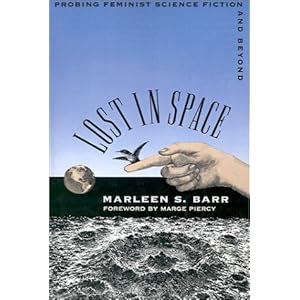
"The end of masculinity would also mean the end of femininity", and other thoughts from Marlene Barr

Source: Google Images

All female societies, pregnant nursing males, and the end of masculinity are only a few of the topics discussed by Marlene Barr in her book Lost in Space: Probing Feminist Science Fiction and Beyond. Through a series of essays, Barr comments on the equality (or disproportions) between men and women, using feminine sf stories as a basis of comparison. Authors like LeGuin, Russ, and Gilman are quoted by Barr, though she is fair in her feminist sf study by including male authors (an unwanted but undeniable presence in feminist sf).

In the introduction to her SF analysis, Barr shares the story of her academic rise. By choosing to study sf through a feminist lens, Barr says that many of her male colleagues were threatened and tried to negate the academic quality of sf for study. Sf writer Gary Westfahl is quoted by Barr, warning sf writers to “never conceal, compromise, or apologize for [your] interest in this field” (p. 2). If sf was a laughable avenue of study to her colleagues, Barr realizes that a feminist-led criticism sf might be met with greater laughter. Still, she forges ahead with the dismantling of patriarchal sf by comparing them to feminist sf stories of the same caliber.

Chapter 6 talks about the end of masculinity. At face value, the term ‘end of masculinity’ could be interpreted as a threat to men everywhere. What Barr means by the end of masculinity is to also end the other side of that particular coin, femininity. Like ying and yang, one cannot exist without the other. Without masculinity or femininity, men and women would unite under a singular definition of gender, one in which both men and women would be caregivers, providers, and valuable members of society. Barr's text is a valuable tool in the study of sf, especially given her gender critiques.

Barr, S., Marlene. Lost in Space: Probing Feminist Science Fiction and Beyond. North Carolina: The University of North Carolina Press, 1993. Print.

Saturday, July 28, 2012

"The men are coming! The men are coming!" A summary of "When It Changed" by Joanna Russ


File:Avon Science Fiction Reader 1.jpg
Cover of the fantasy fiction magazine Avon Science 
Fiction Reader no. 1 (1951) 
featuring "The War of the Sexes" 
by Edmond Hamilton.
Source: Wikimedia Commons
On the planet Whileaway, there are no men. The women hardly notice because they have learned to survive, thrive, and reproduce without penetrative intercourse. That is not to say the women of Whileaway do not enjoy intercourse, but they enjoy it with other women, who they take as wives in a marriage of equality.
The narrator, Janet, of Russ's short story appears from the beginning of the story to be a man. It is not until later that the reader understands that the main viewpoint is a woman, a woman speaking of winning duels, wielding guns, and loving her wife, Kate, and their three collective daughters.
Four male astronauts land on Whileaway, and interrogate Janet and her family. “Where are all the people?” the men keep asking. Janet does not understand why they keep asking that, but then she sees that when the astronauts say 'people' they really mean 'men'. She tells the astronauts that the men died out six-hundred years ago. At this news, one of the astronauts gives a teary sigh and then says, “We're here now.”
Kate believes the men to be dangerous, and even tries to shoot one of them but Janet stops her. Later, Janet wishes she would have followed Kate's instincts and gotten rid of the newcomers. It dawns on her that the men are going to take over the planet of Whileaway, especially after one of them tells her that they need 'the cells of Whileaway'. She tells him that he can have all the cells he needs, but he smiles and tells her they cannot just be given the cells, they must be given through the act of penetrative intercourse (though he doesn't quite say it like that). He tells Janet the Whileaway kind of life is 'unnatural', and to make it natural once again, a dual-natured society must reign again. When Janet tells him that she already has a wife in Kate, the astronaut smiles and assumes that their relationship is based off of a mutually agreed need to survive monetarily. Actual love between two women is beyond the astronaut's understanding.
To the Whileaway women, the astronauts seem more like apes than like human men. Janet, Kate, and their daughters do not even find the men attractive. Janet asks her daughter if she would kiss a man, and her daughter scoffs and says she'd sooner kiss a toad.
The women of Whileaway are already dual-natured, even if the astronauts cannot see it. Janet thinks wistfully of her daughter going off for the traditional bear-hunt, like a right of passage for a Whileaway woman to become an adult. And Janet shares many traits that would be considered manly as she seems to protect her family, know how to use a gun, and duel to the death with other Whileaway women. At the same time, Janet loves her daughter and loves being a mother. Kate is not a 'weak' woman either, though she seems gentler than Janet. She does not like guns, and so it is a surprise when she grabs Janet's gun with ease and tries to shoot the invaders.
Whileaway women defy common stereotypes of women in our culture, and the way they perceive men (though exaggerated) serves as a good example of the exact chasms that separate the two genders.


Russ, Joanna. “When It Changed”. New York: Doubleday, 1972. Print.      

Monday, August 2, 2010

Babies Have Another Way to Communicate: Sign Language!

Until they are about 8-12 months of age, babies only have one sure way of communicating: crying. Other subtle signs babies communicate like yawns, wetting their lips, or wiping their eyes can also cue a parent in to issues of hunger or sleepiness. However, babies begin to understand the cadence of language and meanings of words well before their first birthday, (Babies, 2006 ). Therefore, a baby might have more complex desires beyond that of the standard clean diaper, full tummy, and well-rested body. For instance, a baby might want to cuddle with their favorite stuffed animal or blanket, be read a story, or inform the parent that they are feeling too hot. In order to harness the full communication potential in an infant, a parent can utilize the power of sign language.

“Signing with babies, whether hearing or deaf, has proven to be beneficial,” (Berke, 2009). Not only will a baby or young toddler be able to let a parent know that they want their blue socks instead of their red socks, but American Sign Language is the 3rd most common language in the United States. That means, “Should your baby continue to learn American Sign Language past his or her 3rd year, she will have acquired a 2nd or even 3rd language,” (Babies, 2006). When a child cannot verbalize exactly what they want, a tantrum can occur. To avoid frustration, a parent can show their child the hand signs for common words used on a daily basis, like “milk”, “water”, “teddy bear”, “blanket”, “sleep”, “more”, “hug”, and others. Another benefit of teaching an infant sign language is the improved relationship between parent and child.

References:
Babies. (2006, n.d.). Baby sign language with your infant or toddler. Retrieved on August 2, 2010, from http://www.babies-and-sign-language.com/

Berke, J. (2009, July 14). Using baby sign language with your baby. Retrieved on August 2, 2010, fromhttp://deafness.about.com/cs/signfeats1/a/babysigning.htm