Showing posts with label feminist utopia. Show all posts

Tuesday, April 8, 2014

One of the first (feminist) Utopian stories, "The Book of the City of Ladies"

In The Book of the City of Ladies, Christine de Pisan imagines she is transported into another world, a world in which women have rights they never had before. Given the year she penned her story was 1405, some of her ideas of freedom are limited, but they were a step in a much bigger direction.
Pisan starts her story by recalling male-penned stories and articles, all with one thing in common: their negative view of women. As the criticism and outright derision happens so often, Pisan shares her confusion. Surely, all of the men with their view on women couldn’t be wrong, especially since men of 1405 were allowed higher education and women were not, therefore they were considered to be smarter. A large collection of intelligent men could not be wrong, Pisan believed. It is only later when Pisan meets the three Ladies (Lady Reason, Lady Rectitude, Lady Justice)  that she rationalizes their views as wrong, citing details as to why men believe women to be inherently stupid and immoral (men are jealous, men are blind). One of the Lady’s puts things into perspective for Pisan through use of comparison. Men believe Eve, the first woman, was evil and she poisoned the whole of women for every generation to come. If men believe women to be inherently evil, why is it they also believe education will corrupt women? How can women be corrupted further if they are born corrupt? Lady Reason sums it up for Pisan, “Here  you can clearly see that not all opinions of men are based on reason and that these men are wrong” (para. 2).
Other parts of Pisan’s story tell of inventions and advantages by women, and other causes of misogyny.

While Pisan’s allegories strive to understand equality for women, there is still a patronizing tone to them throughout, almost an echo of the patriarchy still holding Pisan (and all women) back. She spoke of equality and education for women, but at the same time, the tone of her writing suggested she could never imagine a woman not being defined as a “lady” and a man not be defined as a “gentleman”. In Pisan’s equal world, woman probably would be educated but under male-supervision, and she could probably not have imagined women carrying out roles men traditionally held, such as going to war, being doctors, lawyers, and scientists. Again, in 1405, women had very little rights, and it is arguable that Pisan’s story was realistic in its outlook. 

Sunday, November 10, 2013

What's in a Name? A Summary of LeGuin's short, "She Unnames Them"

In this powerful short story by LeGuin, the lead character is never named, but it is inferred that it is Eve, as in Adam and Eve of the Garden. Eve narrates the story, telling of how she convinced the animals that names are unimportant. One by one, the animals agree to let go of their names, though the Yaks have trouble with this concept. The female Yaks hold a council, deciding to let their names go, and after awhile, the male Yaks agree.
Pets, specifically dogs and parrots, take great issue in letting go of their names. As pets are closer to man than wild animals, it is understandable that they would have a harder time in letting go of their identifiers. Yet, Eve makes the pets understand that they can hold onto their capitalized names, like Froo Froo, if only they let go of their generic monikers, like dog or parrot, and so the pets too shed their names.
Among each other, nameless and free, Eve feels a closeness with the animals of the garden that she has never felt before: “They seemed far closer than when their names had stood between myself and them like a clear barrier: so close that my fear of them and their fear of me became one same fear.” The giving back of names (“loss of names” would hold the wrong connotation) by the animals makes them equal to Eve, but she realizes that she is the last being in the garden with a name, and it is not fair of her to hold on to her name when she asked all the animals to give theirs back.
Eve goes to Adam to tell him that she is giving back the name bestowed by “you and your father […] It's been really useful, but it doesn't exactly seem to fit very well lately. But thanks very much! It's really been very useful." Though Eve’s actions are revelatory, Adam does not care. He is described as working on something, putting parts together, and overall he is only half-listening to what Eve is telling him. The reader (and Eve) know that Adam does not understand the import of what she has done by forgoing her name when he asks the stereotypical patriarchal question: “When’s dinner?”
Names can have power, and that power can be a divisive one, or at least that is what LeGuin insinuates with her short story. The binary names humans give to gender (man, woman), the names humans give to animals, or to objects, those are ways that humans seek to control what is around them, not to give meaning, but to separate themselves from nature, to say “I am better than you. I have control over you, and with that control, I will name you and distance you from me”. Eve, like other women in sf stories, does the opposite by placing herself in nature and making herself an equal part of nature. Again, the motif of a loss of identity is explored in this story, and again the author clearly states that one can be an individual while at the same time surrendering themselves to the communal way of living. It is an idea that humans struggle with, because humans only know individuality in the form that it has been handed to us for generations: it comes with separation from others, in the form of gender, class, or racial individual names and personalities.

With Adam’s response, and his lack of interest, LeGuin is stating that men may not be ready to be a part of nature. To be equal with women, and then to be equal with nature, is something men may not conceive of just yet.

Wednesday, July 17, 2013

Noah Bertlatsky: The (Short) History of Feminist Utopian Literature

"Nancy Porter"
Source: Wikimedia Commons
“Imagine there’s no gender: the long history of feminist utopian literature” is an article in The Atlantic highlighting the history of feminine utopian literature. However, writer Noah Bertlatsky does not delve far enough into said history. Based on Bertlatsky’s subtitle: "From Wonder Woman to Shulamith Firestone to Joanna Russ, visions of societies run by women or absent of gender altogether have existed for almost a century”, it’s obvious he either has decided to ignore earlier examples of feminine utopian literature, or he is unaware it exists.
The beginning of the article focuses on feminist writer Shulamith Firestone, and her views expressed in her text The Dialectic of Sex. Bertlatsky quotes Firestone as having said in 1970, “There is no feminine utopian literature in existence”. He believes the claim to be exaggerated, especially given the fact of several publications he cites, like The Left Hand of Darkness (1969), Herland (1915), and graphic novels like Wonder Woman (1941- ).
In Bertlatsky’s view, the most distinct part of Firestone’s philosophy is her description of feminism, which has roots in utopian theory: “[as radical feminists, we] are talking about changing a fundamental biological condition." Inequality, according to Firestone, is begot foremost by gender differences, and can be overcome when gender differences are gone (a notion shared by many a feminist, whether they be man or woman). Without gender to get in the way, Firestone imagined utopias in which technology would eliminate the need for work and even the need for live childbirth (an idea found in several utopian/dystopian novels, like Woman on the Edge of Time, The Shore of Women, and Brave New World).
Overall, it was refreshing to see an article on feminist utopian theory in the popular media, because it is not seen often. However, I feel like Bertlatsky deprived his readers by limiting his scope of feminist utopian history to a mere hundred years. He also displayed his male outlook on feminist utopian literature by including the Wonder Woman graphic novels. The world of graphic novels is notorious (much like science fiction) for being a good ol’ boys club, so to include any graphic novel (especially Wonder Woman, a graphic novel objectifying women on a grand scale) speaks volumes.
It saddens me that this article was written this past year, illustrating just how much further the world needs to progress to attain gender equality, which, consequentially, in the words of Marlene Barr, would bring an end to feminism.

Bertlatsky, Noah. “Imagine there’s no gender: the long history of feminist utopian literature”. The Atlantic. The Atlantic Mag., 15 April 2013. Web. 20 May 2013. http://www.theatlantic.com/sexes/archive/2013/04/imagine-theres-no-gender-the-long-history-of-feminist-utopian-literature/274993/

Monday, June 10, 2013

What a Strange World We Live In- "Woman on the Edge of Time" by Marge Piercy

Source: Wikipedia
Marge Piercy creates a detailed portrait of a poor minority female who is constantly trying and hoping for a better life that never comes. For most of her life, Connie has been oppressed in every way imaginable. She has suffered at the hands of male and  government institutions. She has never known real power, not even over her own body.
During her second incarceration in a mental institution, visits from a time traveler become more insistent. At first, Connie is convinced the traveler is in her imagination, but as the visits transport her to an androgynous utopia in the future, the legitimacy of the traveler is indisputable, and it is the present which seems more like a surreal nightmare.
Luciente is the traveler that shows Connie another world, a better world. Luciente is described as a male, at least in Connie’s eyes. From Luciente’s movements, confidence, and attitude, Connie is sure she is dealing with a man. She even forms the beginnings of romantic feelings for Luciente, but they fade after she discovers Luciente is actually a woman.
While visiting the future with her time-traveling friend, Connie is confronted with other non-traditional forms of society. For example, men can petition to be mothers. Children in the future are no longer born, they are grown. As such, babies are assigned to those that request them, and men commonly request to be mothers alongside women. Each child has three mothers (male or female), and is separated from their mothers at age twelve to foster independence.
Towns are kept small, so as to remain self-sustainable. A town models itself after past cultures of a certain time. The town Luciente is a part of follows the traditions of the Wampanoag Native Americans, and different races are purposefully bred, with racism having been bred out of human beings.
Sexually, Luciente and her friends are quite liberal. Homosexual relationships are normal, as are polyamorous or monogamous relationships. When Luciente is recalling her most passionate relationship, she tells Connie it was with a woman, a concept Connie cannot grasp.
The separation of gender, especially through the eyes of the lead female character Connie, are analyzed throughout the novel. The validity of power structures in society (like police, social workers, and doctors) are also questioned, as all the structures Connie encounters only take advantage of her position in society as a female, low-income, minority citizen.

The capitalist life style Connie is on the fringes of seems barbaric in comparison with the rich and happy life Luciente exposes her to. Piercy brings a disconnect to the modern world, and certainly evokes Suvin’s infamous theory of “cognitive estrangement” in science fiction writing with Woman on the Edge of Time.

Wednesday, April 17, 2013

When Women Rule the World: Sherri S. Tepper's "The Gate to Women's Country"

Image found on
www.eternalnight.co.uk 

From the onset, it's hard to tell The Gate to Women's Country apart from The Shore of Women. Both are stories featuring post-apocalyptic settings in which women preside over great, peaceful cities, whereas men are left out to be warriors amongst each other. The differences between the stories are minor: instead of women not caring about giving up their sons (like in Shore), Tepper brings the reader through an emotional process that is very real. Instead of procreating with the aids of science (like in Shore), women and men meet twice a year at carnivals. In Tepper's world, men may return to the female cities at age fifteen if they choose.
Tepper creates a dual-natured gender society, one in which the balance of power appears to be equal between men and women, with perhaps a bit more power going to the men. By the end of the book, the big reveal shows the true balance of power to be entirely in favor of the women. After a nuclear war three-hundred years before, women decided to take over and establish new cities. Like Shore, they wanted to keep men out, but they also wanted to create an illusion to keep them happy. Part of the illusion is letting the men in the garrisons believe that they father children from women inside of Women’s Country. Really, all babies are born from artificial insemination. Sperm is carefully selected from those men who live within Women’s Country, as they have no desire for violence. Violence is a trait the women are set on breeding out of the men, even if it takes centuries to do so. Every fifteen-year-old male who chooses to return to Women’s Country then becomes part of the breeding pool.
The entire set-up of Women’s Country is a large breeding program, which the men are completely unaware of. The women allow the garrisons from different towns to go to war with one another, and they allow it to control the male population, or to get rid of undesirables quickly. The reader comes to understand how the men are puppets, much like the men in Shore. However, unlike Shore, the women in Women’s Country hope to reconcile with men eventually, by breeding out their violent natures.
The entire novel is themed around power. In the beginning, women appear weak, deferring to the men, loving men, giving into them. The men seem strong, protecting the women. One might argue Tepper set up a conventional dual-natured society, with proper male/female gender roles. Later, the women are seen to hold all of the power, and the men (the ones in the garrisons at least) are seen as pathetic, almost like children playing their little war games, unaware of the secrets and power the women hold over them.
For a good part of the novel, the men in the garrisons are convinced the women have secrets, but they don’t know what they are. Some of the men plot to get at the secrets, to control the women. The novel got me thinking about life, how men may believe women have secrets, or believe childbirth to be a sort of secret (or power). Considering all the anti-abortion measures state legislatures have taken, it’s possible the men of these states are uncomfortable at the thought of women controlling their own secrets, their own power. Even if their ideas about abortion are steeped in their religion, their religion is steeped in male-powered rhetoric.
At times during the novel, the comparisons between Shore and The Handmaid’s Tale would prompt the reader to believe Tepper wrote it as a further exploration of the elements in both of those feminist utopian/dystopic novels. Unlike Shore or The Handmaid’s Tale, Women’s Country is trying to change, trying to become better than the status quo, and as H.G. Wells tells it, the mark of a modern utopia is one that is ever-changing (9).
Tepper implies that a male-dominated world revolves around violence and competition, and the only end-game to such a cycle is destruction through war. According to Tepper, in history, those who suffer most in war (without any real say) are women and children.
In Women’s Country, women and children are spared from senseless death. Tepper describes Women’s Country as a world in which women have complete control, and the results are for better, or as good as they can be in a post-nuclear age.
Even as Tepper creates a sort of utopia, there are several dystopic elements to her story, such as the war games the women allow the men to play out. It is viewed as an activity the men need to do, to channel their aggression and keep their illusion of power intact, but when the men are dying on the fields, they are not allowed help for their wounds. The smallest wound can fester, turn to blood poisoning, and kill the man weeks later, a horrific death Tepper describes of one of the men. Also, the men in the garrisons are not allowed to have or create any technological advances, not just in weaponry, but everyday items that might create a better life for them are also barred. Because of the way the men are bred, most of them don’t care about advancing anyway (only a few do), but the females in the city, the perceptive ones, feel it’s wrong to intentionally hold the men back. It’s comparable to holding a dog in a cage.
The major dystopic element of Tepper’s world is the fact that from five years of age on, little boys get sent out of the cities and into the garrisons. They are separated from their families, and it can sometimes be a traumatic separation. Just like in Shore, the position of the women are elevated (and if it were the other way around, it would be just as wrong), and men (no, little children) are made to suffer for the power-swap.
A side-note: The Gate to Women's Country is a good book, nearly as good or even better than A Handmaid's Tale in my view. It's written with the same weird displaced timeline as The Dispossessed, and the writing in it feels more like poetry (at times). While The Shore of Women is great, too, I found the writing style to be a bit too romanticized. With The Gate to Women's Country, Tepper tackles the male/female romantic dynamic, but with a more objective eye than Sargent. Then again, I've also considered Sargent's over-use of romantic language and phrasing may have been on purpose, as a parody of the way women and men view one another.

Tepper, Stewart, Sheri. The Gate to Women’s Country. New York: Bantam Spectra, 1989. Print.

Wells, George, Herbert. A Modern Utopia. London: Chapman & Hall, 1905. Print.


Monday, November 19, 2012

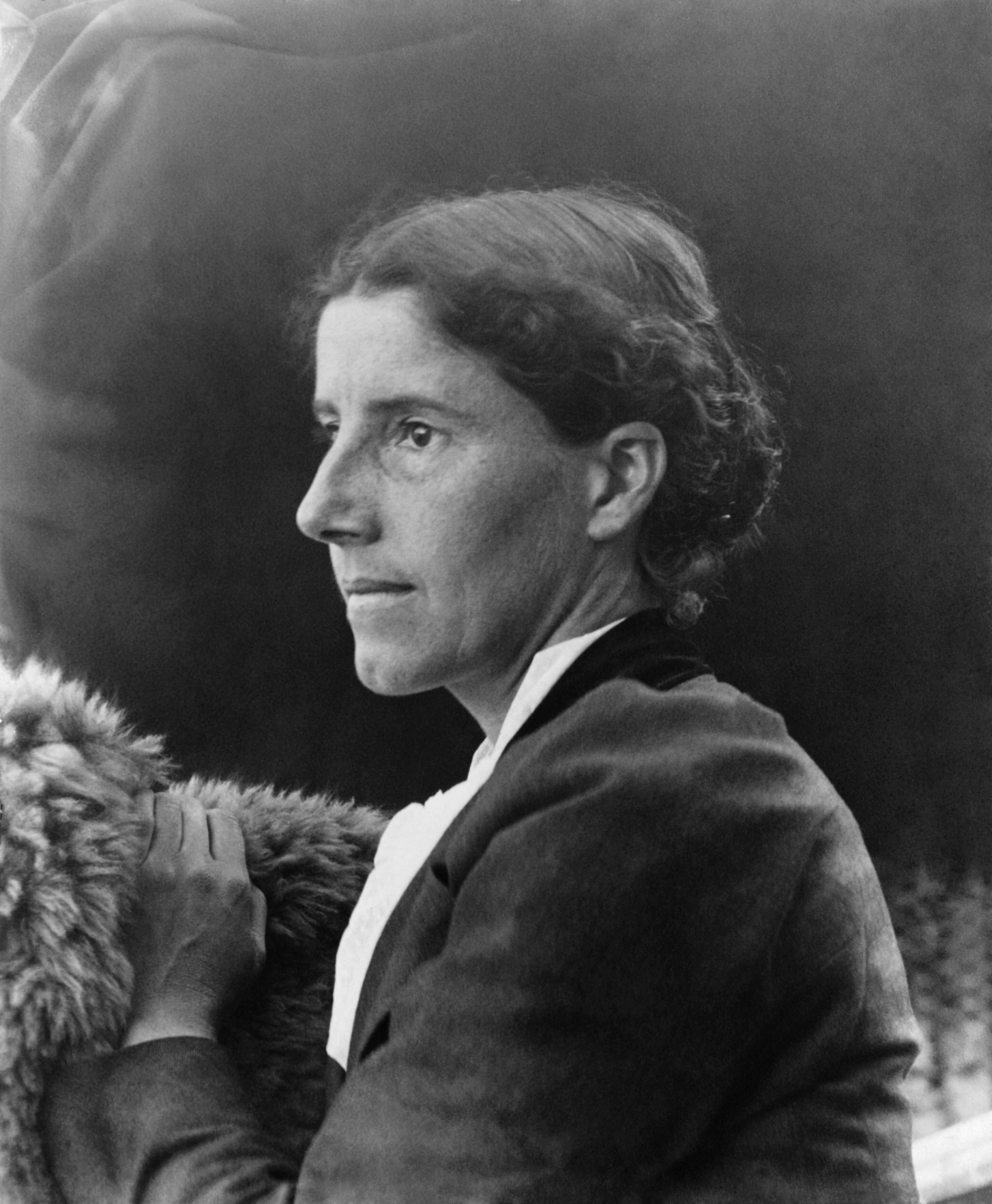
The Importance of Charlotte Perkins Gilman's "Herland"

Photographic portrait of Charlotte Perkins Gilman,
American author, c. 1900. This is a cropped version
of the digital image from the Library of Congress online
collection, as identified below. Copyright has expired on this image.
Source: Wikimedia Commons

Charlotte Perkins Gilman was many things: a writer, a feminist, and at times, fan of eugenics based on her staunch racism. Aside from her failings, Gliman managed to write a groundbreaking novel called Herland that went unnoticed until it gained popularity in the 1970's. First appearing as a serial in 1915, Herland is one of the first works of feminist Utopian fiction.
Three young students set out to explore a legend shared by the locals of the foreign country that they are residing in. The legend is of a hidden community comprised solely of women. Since the three students are also young men, their interest is more than piqued.
All three men have different views on women, ranging from the extreme to the sympathetic. Jeff  is the biologist, and an idolizer of women. The narrator, Van, stays neutral on most every subject as a sociology major. Terry is a geologist, and straddles the line between gentleman and chauvinist pig.
Before they find out that the legend of Herland is indeed true, the three men surmise on what sort of civilization could arise if maintained by only women. Their prejudices and sexist views come to the fore during these discussions; “We mustn’t look to find any sort of order and organization […] Also we mustn’t look for inventions and progress; it’ll be awfully primitive.” (p. 8-9).
The civilization the three men discover is far beyond anything they could have imagined. Herland is a beautiful country, with gardens and forests that are carefully tended to yield the most food (there is no room for crops or cattle in Herland's tiny strip of territory). Men are nowhere to be found. In fact, the arrival of Terry, Jeff, and Van mark the civilization’s first sighting of men in two-thousand years.
Though Herland is not a distant planet, it might as well be for the all the differences Van takes note of in his journal. At first, Van believes his ‘world’ to be more advanced, but as he learns more and more about the women of Herland, he becomes ashamed at the state of his world in comparison to their paradise.
Many notions of femininity come into question in this short novella from Charlotte Perkins Gilman. The women of Herland keep their hair cropped short, wear clothes free of adornment, are intelligent, and work hard doing things that the three men considered only for men. Not every woman is young, giggling, and beautiful: [Van’s perspective]- ‘Woman’ in the abstract is young, and, we assume, charming. […] Most men do think that way, I fancy.” (p. 21). By the end of the story, Van and Jeff come to see that Terry’s view about women is entirely wrong, that indeed all their thoughts about women are entirely based on their society’s perception of gender roles.

Gilman, Perkins, Charlotte. Herland. New York: Pantheon Books, 1979. Print.