Showing posts with label civilization. Show all posts

Monday, November 19, 2012

The Importance of Charlotte Perkins Gilman's "Herland"

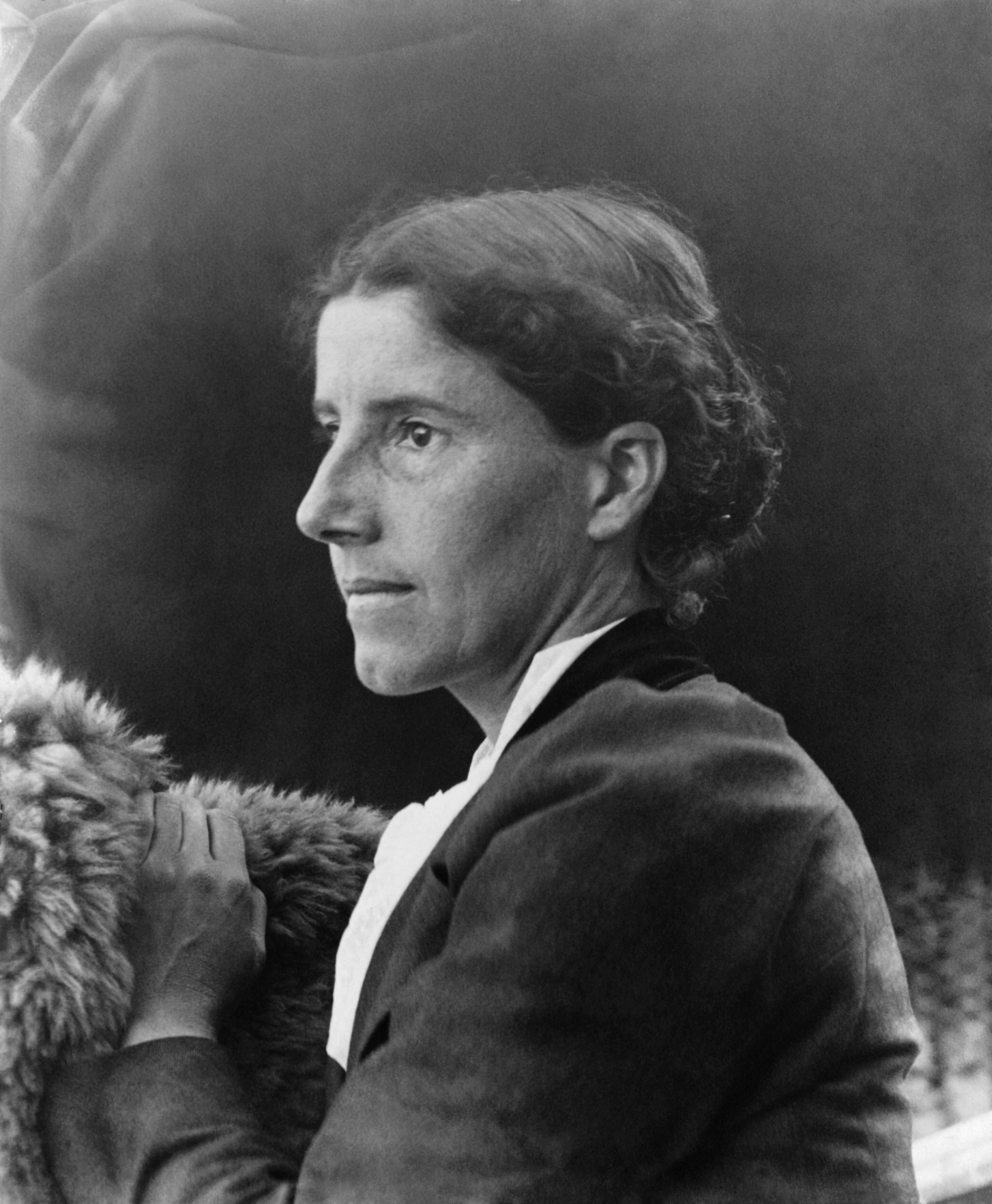
Photographic portrait of Charlotte Perkins Gilman,
American author, c. 1900. This is a cropped version
of the digital image from the Library of Congress online
collection, as identified below. Copyright has expired on this image.
Source: Wikimedia Commons

Charlotte Perkins Gilman was many things: a writer, a feminist, and at times, fan of eugenics based on her staunch racism. Aside from her failings, Gliman managed to write a groundbreaking novel called Herland that went unnoticed until it gained popularity in the 1970's. First appearing as a serial in 1915, Herland is one of the first works of feminist Utopian fiction.
Three young students set out to explore a legend shared by the locals of the foreign country that they are residing in. The legend is of a hidden community comprised solely of women. Since the three students are also young men, their interest is more than piqued.
All three men have different views on women, ranging from the extreme to the sympathetic. Jeff  is the biologist, and an idolizer of women. The narrator, Van, stays neutral on most every subject as a sociology major. Terry is a geologist, and straddles the line between gentleman and chauvinist pig.
Before they find out that the legend of Herland is indeed true, the three men surmise on what sort of civilization could arise if maintained by only women. Their prejudices and sexist views come to the fore during these discussions; “We mustn’t look to find any sort of order and organization […] Also we mustn’t look for inventions and progress; it’ll be awfully primitive.” (p. 8-9).
The civilization the three men discover is far beyond anything they could have imagined. Herland is a beautiful country, with gardens and forests that are carefully tended to yield the most food (there is no room for crops or cattle in Herland's tiny strip of territory). Men are nowhere to be found. In fact, the arrival of Terry, Jeff, and Van mark the civilization’s first sighting of men in two-thousand years.
Though Herland is not a distant planet, it might as well be for the all the differences Van takes note of in his journal. At first, Van believes his ‘world’ to be more advanced, but as he learns more and more about the women of Herland, he becomes ashamed at the state of his world in comparison to their paradise.
Many notions of femininity come into question in this short novella from Charlotte Perkins Gilman. The women of Herland keep their hair cropped short, wear clothes free of adornment, are intelligent, and work hard doing things that the three men considered only for men. Not every woman is young, giggling, and beautiful: [Van’s perspective]- ‘Woman’ in the abstract is young, and, we assume, charming. […] Most men do think that way, I fancy.” (p. 21). By the end of the story, Van and Jeff come to see that Terry’s view about women is entirely wrong, that indeed all their thoughts about women are entirely based on their society’s perception of gender roles.

Gilman, Perkins, Charlotte. Herland. New York: Pantheon Books, 1979. Print.

Wednesday, October 10, 2012

"Nightfall"- An Illuminating Short Story by Issac Asimov


Source: UmMuseum.com
Writing legend Issac Asimov added to the genre of science fiction in a big way, most notably with his short story collection on robotic intelligence in I, Robot. One of his lesser known stories, "Nightfall" explores something entirely different: the limits of human knowledge.
On the distant planet, Kalgash, an eclipse is about to take place. The thought of an eclipse has the people of Kalgash in a panic.
Kalgash is a special planet, home to six suns. Six suns means that Kalgash is in a constant state of light. Darkness is a foreign concept to Kalgash citizens. They do not even fully realize what stars are, or that an eclipse is a natural occurrence, not a supernatural event to fear.
Every 2,049 years, Kalgash has an eclipse. With each eclipse, civilization collapses due to insanity born of the fear of darkness. The only people that survive the eclipses without going insane are children, the elderly, and drunkards.
The premise of the story seems ridiculous: one night of darkness is capable of collapsing 2,049 years of civilization? Yet, humans always fear what they cannot understand. Author Isaac Asimov takes note of this, and one of the characters in “Nightfall” says “[of the stars and darkness] You can’t conceive that! Your brain wasn’t built for the conception of infinity or of eternity. You can only talk about it. A fraction of the reality upsets you, and when the real thing comes, your brain is going to be presented with the phenomenon outside its limits of comprehension. You will go mad” (Asimov p. 8).
Stars, like infinity, are beyond the characters comprehension. One character has a ‘cute notion’ of the possible number of stars in the sky, stating there could only be a dozen or so, and no more. Another misconception shared by Kalgash citizens is the idea that a planet with only one sun would be uninhabitable because “Life--which is fundamentally dependent upon light---[cannot] develop under those conditions [of partial darkness]” (Asimov p. 17).
Religion is another part of the story that Asimov ridicules. The Cultists are a religious group founded around the worship of darkness and stars. They are the only people of Kalgash that long for the eclipse, as they believe that starlight will cleanse their immortal souls. There are Earthbound religions that share similar sentiments of a promised salvation that must always come hand-in-hand with apocalyptic prophesies.
Asimov’s story takes perceptions of what is possible and turns it on its head. From the perspective of an Earthling, Kalgash citizens are laughable in their ignorance. The scary thing is that we Earthlings have our own dangerous misconceptions.

“Nightfall” is a short story full of commentary on the true limits of human knowledge. In thinking that we know everything (Asimov is telling the reader), we know nothing. All of our petty reasonings designed to understand the scope of the universe and its inner workings are inadequate, especially when they’re founded on fear and superstition instead of fact.


Asimov, Isaac. “Nightfall”. Astounding Science Fiction (1941). Print .