Showing posts with label Joanna Russ. Show all posts

Monday, February 24, 2014

Women Can Be Strong, Peaceful, and Violent in Sally Gearheart's "The Wanderground"


Through a series of short stories, Gearheart tells the stories of the Hill Women. The Hill Women live in serene world, communing with nature at every turn. Their world seems to have reached the apex of peaceful living, until the reader learns why the women live in the forests: they are forced to. Men have taken over the cities, and control every facet of a woman’s life. The women that rebelled fled the cities and learned to live among the trees and animals. In doing so, they developed psychic abilities, like “speaking” with animals, astral projection, and telepathy to name a few.

While the comparisons between the Hill Women and Gilman’s Herlanders are strong, Gearheart brings realism to the Hill Women by depicting them in the throes of irrational, or even violent fits of anger. One thing which seems to be reiterated in feminist utopian fiction novels is the lack of physical violence in women, but Gearheart is not afraid to admit her peaceful characters are still human, and within their range of human emotions, anger can be counted among them. Russ and Tepper bring similar elements to their female characters in The Female Man and The Shore of Women. In both novels, the female characters are part of war-less societies, but they are still capable of individual acts of violence.

Gearheart, Sally. The Wanderground: Stories of Hill Women. New York: Alyson Books, 1978. Print.

Picture linked from:
http://www.amazon.com/The-Wanderground-Sally-Miller-Gearhart-ebook/dp/B009XIDI4K

Saturday, July 28, 2012

"The men are coming! The men are coming!" A summary of "When It Changed" by Joanna Russ


File:Avon Science Fiction Reader 1.jpg
Cover of the fantasy fiction magazine Avon Science 
Fiction Reader no. 1 (1951) 
featuring "The War of the Sexes" 
by Edmond Hamilton.
Source: Wikimedia Commons
On the planet Whileaway, there are no men. The women hardly notice because they have learned to survive, thrive, and reproduce without penetrative intercourse. That is not to say the women of Whileaway do not enjoy intercourse, but they enjoy it with other women, who they take as wives in a marriage of equality.
The narrator, Janet, of Russ's short story appears from the beginning of the story to be a man. It is not until later that the reader understands that the main viewpoint is a woman, a woman speaking of winning duels, wielding guns, and loving her wife, Kate, and their three collective daughters.
Four male astronauts land on Whileaway, and interrogate Janet and her family. “Where are all the people?” the men keep asking. Janet does not understand why they keep asking that, but then she sees that when the astronauts say 'people' they really mean 'men'. She tells the astronauts that the men died out six-hundred years ago. At this news, one of the astronauts gives a teary sigh and then says, “We're here now.”
Kate believes the men to be dangerous, and even tries to shoot one of them but Janet stops her. Later, Janet wishes she would have followed Kate's instincts and gotten rid of the newcomers. It dawns on her that the men are going to take over the planet of Whileaway, especially after one of them tells her that they need 'the cells of Whileaway'. She tells him that he can have all the cells he needs, but he smiles and tells her they cannot just be given the cells, they must be given through the act of penetrative intercourse (though he doesn't quite say it like that). He tells Janet the Whileaway kind of life is 'unnatural', and to make it natural once again, a dual-natured society must reign again. When Janet tells him that she already has a wife in Kate, the astronaut smiles and assumes that their relationship is based off of a mutually agreed need to survive monetarily. Actual love between two women is beyond the astronaut's understanding.
To the Whileaway women, the astronauts seem more like apes than like human men. Janet, Kate, and their daughters do not even find the men attractive. Janet asks her daughter if she would kiss a man, and her daughter scoffs and says she'd sooner kiss a toad.
The women of Whileaway are already dual-natured, even if the astronauts cannot see it. Janet thinks wistfully of her daughter going off for the traditional bear-hunt, like a right of passage for a Whileaway woman to become an adult. And Janet shares many traits that would be considered manly as she seems to protect her family, know how to use a gun, and duel to the death with other Whileaway women. At the same time, Janet loves her daughter and loves being a mother. Kate is not a 'weak' woman either, though she seems gentler than Janet. She does not like guns, and so it is a surprise when she grabs Janet's gun with ease and tries to shoot the invaders.
Whileaway women defy common stereotypes of women in our culture, and the way they perceive men (though exaggerated) serves as a good example of the exact chasms that separate the two genders.


Russ, Joanna. “When It Changed”. New York: Doubleday, 1972. Print.      

Monday, May 14, 2012

A SF Literary Study isn't complete without "Critical Theory and Science Fiction". And here's why.


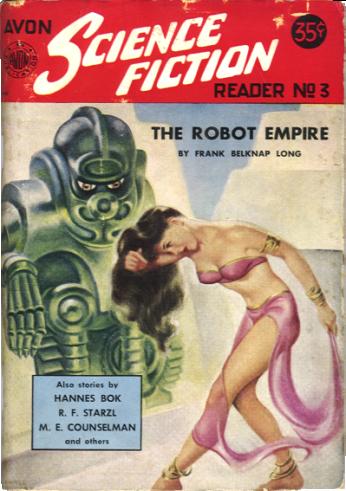
File:Avon Science Fiction Reader 3.jpg
An idealized version of what the SF genre is (or was).
Cover of the fantasy fiction magazine

             Avon Science Fiction Reader no. 3 (1952)

           by Frank Belknap Long 

Source: Wikimedia Commons
A comprehensive (and often) exhaustive study on the validity of science fiction in the literary canon. In fact, author Carl Freedman dedicates an entire section of the book to the description, history, and importance of the literary canon and why science fiction works are to be included in the canon.

Freedman’s text redefines science fiction as ‘cognitive estrangement’, as coined by author Darko Suvian. To better understand Suvian’s meaning, a quote is rather necessary: “estrangement ‘differentiates [science fiction] from the realistic literary mainstream’, while cognition differentiates it from myth, the folk tale, and fantasy […] science fiction is determined by the dialectic between estrangement and cognition” (p. 16).

To Freedman, the genre of science fiction is constantly evolving, and it is hard to pinpoint what exactly constitutes the epitome of science fictional text. Freedman’s views of science fiction are so broad (or maybe so idealized) that he believes all general fiction to be a sub-category of science fiction, and not the other way around (p. 20). The expansive reach of the science fiction genre in Freedman’s eyes is boggling. Freedman believes that every fictional text ever written is a sort of science fictional story as well, because some apt descriptions of science fiction say it is the creation of a new world. Arguably, every fictional novel is a ‘new world’ created by the author and the characters that populate it.

In three not-so-short chapters, Freedman takes the reader on a new expedition into the academic world of science fiction. Chapter one is titled “Definitions”, and it does just that; chapter one defines critical theory and science fiction, melding the two together with Freedman’s conclusions (juxtaposed with other academic opinion of course). Chapter Two, “Articulations”, first discusses genre, literary canon, and theory. Then, science fiction is measured against three critical dynamics: style, the historical novel, and utopia. Chapter three, “Excursuses”, give detailed overviews of Solaris, The Dispossessed, The Two of Them, Stars in My Pocket, and The Man in the High Castle.

Lastly, Freedman includes a section that explores critical theory and science fiction and how it may later evolve, as Freedman concedes that “it is in the nature of critical fiction and science fiction to speculate about the future” (p. 181).

Freedman’s section on utopias and feminism make a nice addition to the academic conversation. In that same section, authors Ursula Le Guin and Joanna Russ are compared and contrasted in a very satirical manner: “The basic contrast frequently adduced is between the gentleness of Le Guin’s feminism and the angry militancy of Russ’s” (p. 129). Freedman makes fun of such comparisons, stating that they are responsible for creating further rifts for women in science fiction (or in society in general). He also muses on the fact that for early pulp science fiction of the 1900’s, it was hard for the genre to recognize able-bodied women, or admit the fallacy of phallic dominance (p. 129).

Throughout the book, Freedman’s tone is one that strives to reach the reader, but always falls a little bit short with a myriad of unknown adjectives and a mountain of footnotes on almost every page (even though in the preface Freedman expresses his own dislike of footnotes, on the grounds that it is a ‘pseudoscholarly practice of citing works in order to suggest, truthfully or not, that one has read them’ [p. xx]). Despite that, once the reader is able to follow Freedman’s ideas and take hold of them, his tone is suggestive, humorous, and down-to-earth.

Critical Theory and Science Fiction was published in 2000. That fact only becomes evident in the last section which mentions the evolutionary pattern that will take hold of science fiction, namely, cyberpunk. To an extent, Freedman is correct, so it is a forgivable error in his effort to create a timeless account of the science fiction genre. Since his studies in the book mention books in the literary canon from 1818 until the late 1980’s, the year of publication is nominal in this instance.

Generally, I prefer not to read academic texts unless they are strictly related to what I am studying. Freedman’s book was one that did not let me forget what I was studying, and it was an academic text that I highlighted like a lunatic, madly muttering to myself things like “yes….and yes…” and “of course!”. If future readers can get over the flowery detailed language in the preface, then they will count themselves lucky to have stumbled upon the fascinating overviews provided by Freedman in his three, seventy-five-page chapters.

Freedman is an associate professor of English at Louisiana State University. He is the author of several articles and four non-fiction texts. An excerpt from his book Critical Theory and Science Fiction was chosen as featured text for discussion at the Theory Roundtable of the International Conference on the Fantastic in the Arts in 2002. 

Freedman, Carl. Critical Theory and Science Fiction. Middletown, Connecticut: Weslayen University Press, 2000. Print.