Showing posts with label utopia. Show all posts

Tuesday, April 8, 2014

One of the first (feminist) Utopian stories, "The Book of the City of Ladies"

In The Book of the City of Ladies, Christine de Pisan imagines she is transported into another world, a world in which women have rights they never had before. Given the year she penned her story was 1405, some of her ideas of freedom are limited, but they were a step in a much bigger direction.
Pisan starts her story by recalling male-penned stories and articles, all with one thing in common: their negative view of women. As the criticism and outright derision happens so often, Pisan shares her confusion. Surely, all of the men with their view on women couldn’t be wrong, especially since men of 1405 were allowed higher education and women were not, therefore they were considered to be smarter. A large collection of intelligent men could not be wrong, Pisan believed. It is only later when Pisan meets the three Ladies (Lady Reason, Lady Rectitude, Lady Justice)  that she rationalizes their views as wrong, citing details as to why men believe women to be inherently stupid and immoral (men are jealous, men are blind). One of the Lady’s puts things into perspective for Pisan through use of comparison. Men believe Eve, the first woman, was evil and she poisoned the whole of women for every generation to come. If men believe women to be inherently evil, why is it they also believe education will corrupt women? How can women be corrupted further if they are born corrupt? Lady Reason sums it up for Pisan, “Here  you can clearly see that not all opinions of men are based on reason and that these men are wrong” (para. 2).
Other parts of Pisan’s story tell of inventions and advantages by women, and other causes of misogyny.

While Pisan’s allegories strive to understand equality for women, there is still a patronizing tone to them throughout, almost an echo of the patriarchy still holding Pisan (and all women) back. She spoke of equality and education for women, but at the same time, the tone of her writing suggested she could never imagine a woman not being defined as a “lady” and a man not be defined as a “gentleman”. In Pisan’s equal world, woman probably would be educated but under male-supervision, and she could probably not have imagined women carrying out roles men traditionally held, such as going to war, being doctors, lawyers, and scientists. Again, in 1405, women had very little rights, and it is arguable that Pisan’s story was realistic in its outlook. 

Friday, February 14, 2014

Feminism and Utopian Theory are Nearly Intangible (According to Frances Bartkowski)

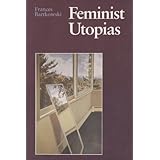
Feminist Utopias
by Frances Bartkowski
Image linked from:
http://www.amazon.com/
Frances-Bartkowski/e/B001IOHA3M
In so many utopian analytic texts, the tone is one of a jaded scholar, one who relies heavily in Suvin’s famous science fiction description of “cognitive estrangement”. Estrangement is surely at the heart of utopian texts, and yet, Frances Bartkowski takes Suvin’s description and pairs it with a more optimistic view, an echo of Karen Horney’s tone in Feminist Psychology.
Bartkowski’s definition of utopia is taken from William Morris’s News from Nowhere, as she believes “utopia is anywhere but here and now. It is alternatively the good place (eutopos) and no place (outopos) […] which could also be anywhere” (4). Her view of utopia is unique, but succinct.

As the text is named Feminist Utopias, Bartkowski delves into feminism: “Feminism has done much to bring together the theoretical differences and similarities of the struggles among classes and between sexes” (13). She is leading the reader to her conclusion, her conclusion being that utopian and feminist theory have deeper ties than most people realize, as utopian theory strives to better the human condition overall, much like feminism.
Bartkowski goes further in her comparison, stating utopian theory and feminist theory to be nearly inseparable, if not identical. What she is really saying is feminist theory is the ideal (the utopian ideal) as it encompasses many utopian elements and more in its definition. Of non-feminist utopians, Bartkowski summarizes the women in the stories, and how the creators of the utopias merely “made a place for women only to mask oppression while imagining patriarchal utopias” (14). Several science fiction and utopian writers are mentioned throughout the text, like Suvin, Russ, Butler, Bloch, Bellamy, and more. The chapters are made up of two feminist utopian works Bartkowski contrasts, comparisons, and analyzes. She includes novels such as The Female Man, Woman on the Edge of Time, and Herland.

Bartkowski, Frances. Feminist Utopias. Nebraska: University of Nebraska Press, 1989. Print.

Saturday, March 9, 2013

The Underrated and Overlooked Utopian Classic: "A Strange Manuscript Found in a Copper Cylinder"

File:Strange manuscript.jpg
"A Strange Manuscript Found
in a Copper Cylinder" by
James De Mille
(1888)
Source: Wikimedia Commons

Adam More tells of his discovery of a utopia (or in his eyes, a dystopia) via a manuscript he seals in a copper cylinder. His journey begins when More gets separated from his merchant’s ship with his friend, Agnew. Using their rowboat, the two men drift until they find a desolate island with devilish people as inhabitants. Upon first glance, More cannot stomach the Natives and only goes ashore at Agnew's insistence. The Natives are described by More as being less civilized and uglier than Aborigines, which he believes to be the most uncivilized human beings. More's prejudicial fears are well-founded, as Agnew is killed by the Natives.
However, More escapes the island and uses the boat to take an adventure through a cave that is reminiscent of Verne's Journey to the Center of the Earth. Eventually, More finds another strange land of foreigners, but he is convinced that these people aren't dangerous from the landmarks he sees as civilized, like roads, buildings and ships. When he meets these strangers, his biased perspective of aliens is fully actualized: the first Natives have black skin and are unkempt (thus, their appearance drove More's distrust), but the second set of Natives have white skin and are what More describes as 'regular'. More's encounter with the first set of Natives he meets illustrates Ursula K. LeGuin's point in her article "American SF and the Other" when she speaks of aliens in sf becoming the Other, be it Galactic aliens, “sexual aliens, class aliens, or cultural aliens.” (LeGuin). Because More does not identify with the first Natives, he thinks them murderous Others from the onset. Upon meeting the second Natives, he is assured of their innate kindness as they more closely resembled what he associates with “regular” and civilized human beings.


His view of the Natives, whom he later calls Kosekins, changes when he learns of their value system that is basically an invert of what he is used to back home in England. To start, Kosekins revere death and hate the burden of living, thus they go on numerous hunts (in which women are included) and basically throw themselves at the feet of the large animals they pursue so as to die an honorable and public death. Secondly, Kosekins detest wealth and aspire to poverty, viewing possessions as burdens. The poorest man in the nation of Kosek has the most influence and respect, while the richest man has the least respect (capitalism is seen as evil). In accordance with their scorn of wealth, Kosekins are very self-sacrificing; they are always to bestow gifts on one another (to get rid of their possessions/wealth), and when one nation surrenders to another, it is considered a great honor and the greatest possible instance of self-sacrifice. That is not to say that Kosekins do not know of violence or war, but their reasons for war or violence differ from the traditional reasons, as Kosekins fight when they receive too many gifts from one person. When one is sick, all is done to nurse them back to health, so that they may die in a more honorable way, yet when someone is sick, every Kosekin trips over themselves to nurse the patient (as that is self-sacrificing to care for someone else). Requited love among two human beings is not a good thing in the Kosekin culture, because “love is self-surrender, and utter self-abnegation. Love gives all away, and cannot possibly receive anything in return. A requital of love would mean selfishness.” Thus, the most self-sacrificing thing a Kosekin can do for the person they love is to arrange their marriage to another. The most deterring fact about Kosekins that More cannot get past is their sacrificial rituals. When their comrades are wounded in battle, even from non-mortal wounds, they kill their fallen brethren with a knife to the heart, and it is their duty to do so. Not only do they kill their own, but they eat them as well, and it is for that purpose that More and another foreigner of Kosek, Almah are in Kosek, to be guests of honor at the next festival of cannibalism. While More might see killing a fellow man and eating them as villainous acts, the Kosek see it as bringing great honor to their fellow man. Almah tells More that he would not deny a man that seeks life, the idea of it would go against all that he believed in. Such is the Kosekins thoughts on denying a man death.

File:Ball's Pyramid North.jpg
"Balls Pyramid" 13 Miles South of
Lord Howe Island
(2006)
Picture by Fanny Schertzer
Source: Wikimedia Commons
More’s friend in Kosek, the Kohen, explains to him why death is such a large part of their culture: “[To love death] is human nature. We cannot help it; and it is what distinguishes us from animals.” The Kohen goes further with his comparison of civilized Kosekins and animals, “Animals fear death; animals love to accumulate such things as they prize; animals, when they love, go in pairs, and remain with one another” (169). All of the things that the Kosekins believe to be against human nature are things that only lowly animals practice, like pairing, keeping possessions, and fearing death.
That is part of why the Kohen cannot understand More’s point of view when More tells him that his culture fears death and loves life. The Kohen tries his best to dissect More’s perspective by asking “If you really fear death, what possible thing is there left to love or hope for?” To which More replies, “Long life, and riches, and requited love”. After the Kohen’s thoughts on those three unmoral life pursuits, More’s reasoning sounds selfish, naïve, and unattainable.
Author James De Mille uses the inverted civilization of the Kosekins to satire the foundations of the world’s “civilized” populations, much in the fashion of Swift’s Gulliver’s Travels. At first, reading about the Kosek love of death and their desire for poverty seems absurd, but their reasoning behind it makes sense against the backdrop of humanity’s selfish pursuits for money, love, and a long life. Kosekins live in both a utopian society and a dystopian one, because while their 180 degree way of life is admirable in a backwards way, their love of death (and cannibalism) creates too wide of a gulf to reconcile their beliefs with More’s, or with mine. 


De Mille, James. A Strange Manuscript Found in a Copper Cylinder. New York: Harper and Brothers, 1888. Print.

LeGuin, Kroeber, Ursula. “America SF & The Other”. Science Fiction Studies 2.3 (1975). Print. 


Monday, February 4, 2013

"Brave New World"- So Close Yet So Far from Utopia

File:Brave GNU world.png
A picture of Richard Stallman, in the style of Che Guevara
The title is a play on
"O brave new world / that has such people in it"
from 
The Tempest and Brave New World.
Date: October 2006
Source: Wikimedia Commons

Huxley’s speculative tale of London in the year A.F. 632 is a Utopian world except for a few distinctive differences. There is the matter of a class system determined even before birth. Fertilized human eggs are chemically treated to be Epsilons, Betas, Alphas, or other derivatives. Once the egg becomes a full-fledged human being, the mental and physical conditioning begins. Children are raised in wards by the State, taught that their god is Ford (as in the Ford that invented the automobile assembly line), and also taught repetitive reasoning in their sleep, such as “Never put off till tomorrow the fun you can have today” (Huxley 93).
In place of love, there is the pursuit of fun in the form of “the feelies” and drugs like soma. Like in The Giver, the public is unaware of the implications of death or what it really entails, another way to shield citizens from feeling anything real. Similar to both Anthem and The Giver, this dystopia is ruled by a handful of individuals known as Directors. Directors are always male, therefore the gender equality implied by Huxley is severely lacking. The reader need only analyze the sexual dynamic between the genders to come to the conclusion that in Brave New World, women are still beneath men in the social ladder.
Women are required to be sexually available at every turn, and part of that is maintaining a fit and “pneumatic” body. Another burden the women must abide is the responsibility of safe sex. All women carry a belt around, a belt full of different contraceptives. In the book, it is never mentioned that a man must upkeep his body for women, or remember to use contraceptives. Huxley leaves that up to the women.
If a woman (or man) chooses not to be promiscuous, they are seen as socially inept. Given that, there is no marriage in Huxley’s world. If two people are considered a couple, it is prudent for them to begin coupling with anyone and everyone else they can, the sooner the better.
The main female characters in the novel, Lenina and Lydia, are both insipid and promiscuous, a product of their society. Two main male characters in the novel, Bernard and Helmholtz, are likewise products of their society, however, Huxley allows them to question their surroundings and long for a better world. Helmholtz confides in his friend Bernard that he is unhappy, even though he is at the top of the class system as an Alpha and women literally line up to sleep with him: “I’m thinking of a queer feeling I sometimes get, a feeling that I’ve got something important to say and the power to say it---only I don’t know what it is, and I can’t make any use of the power” (Huxley 69). Bernard tries to explain to Lenina what is lacking in their society after she repeats the mantra learned in their childhood, Everybody’s happy nowadays. “Yes," Bernard tells her, "‘Everybody’s happy nowadays.’ We begin giving the children that at five. But wouldn't you like to be free to be happy in some other way, Lenina? In your own way, for example; not in everybody else’s way.” (Huxley 91).
File:Aldous Huxley.gif
Aldous Huxley
Date: (original upload) May 2007
Transferred from Wikipedia
Source: Wikimedia Commons
Happiness is the main objective of Huxley’s alternative London, but as Bernard and Helmholtz illustrate, their world is far from perfect. Even though there is no war, disease, or poverty, not everyone feels happy because they are too controlled. Everyone’s absolute place in the world is chosen from birth, down to what they’re going to look like, their place in the class system, and where they’re going to work. There are no creative freedoms, and that is what is most stifling about Huxley’s dystopia. Everything else, such as gender and class disparities, follows in the wake of that.

Huxley, Aldous. Brave New World. London: Chatto and Windus, 1932. Print.