Thursday, July 28, 2011

A Summary, Analysis, and Opinion of "La Belle Dame Sans Merci" by John Keats

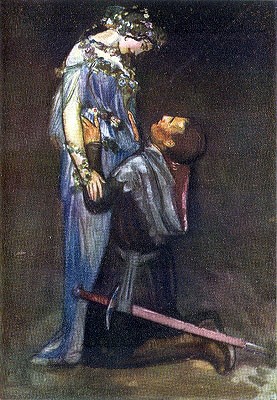
File:La Belle Dam Sans Merci.jpg
"La Belle Dame Sans Merci" by Frank Bernard Dicksee.

One of the most famous poems by John Keats is "La Belle Dame Sans Merci" (meaning "the beautiful woman without mercy" in old French). It is not exactly a short poem, but twelve stanzas is not exactly that long, either. There is an alternate manuscript version, but I chose the 1819 published version to dissect. I chose it because of the supernatural elements suggested in the poem, alluding to a 'farey', her powers, and her merciless disposal of men. A few relevant stanzas are: 

Oh what can ail thee, knight-at-arms,
    Alone and palely loitering?
The sedge has withered from the lake,
    And no birds sing. 

I met a lady in the meads,
    Full beautiful - a faery's child,
Her hair was long, her foot was light,
    And her eyes were wild.

I set her on my pacing steed,
    And nothing else saw all day long,
For sidelong would she bend, and sing
    A faery's song. 
-(English, 2011). 

 To begin with, a paragraph of a summary of the poem reads:  
File:Robert Anning Bell - La belle dame sans merci.jpg
"La Belle Dame Sans Merci" by Robert Anning Bell
“La Belle Dame sans Merci,” written in 1819 and published the next year in a form slightly different from the one here, depicts a knight-at-arms who has been seduced and abandoned by a capricious fairy. Told in the form of a dialogue, the poem recounts the experience of loving dangerously and fully, of remaining loyal to that love despite warnings to the contrary, and of suffering the living death of one who has glimpsed immortality," (enotes, 2011). 

This poem could be interpreted in a myriad of ways. There are some people who think that the fairy exists only in the imagination and others who believe her to be equitable to a siren, luring men into become her emotional slaves. One analysis takes a different route:

"The references to "faery" and "elfin" suggest enchantment or imagination. Her "sweet moan" and "song" represent art inspired by imagination. The lady, symbolizing imagination, takes him to an ideal world. The knight becomes enraptured by or totally absorbed in the pleasures of the imagination--the delicious foods, her song, her beauty, her love or favor ("and nothing else saw all day long"). But the imagination or visionary experience is fleeting; the human being cannot live in this realm, a fact which the dreamer chooses to ignore. The knight's refusal to let go of the joys of the imagination destroys his life in the real world," (Melani, 2010). 

In poetry analysis, it may be hard to differ opinion from objective analysis. While searching articles and websites online, I was struck by how similar they all sound. After reading a number of them, I was able to tell them apart more easily. Here is one example of an opinion about Keats' poem:  

File:Arthur Hugues - La belle dame sans merci.jpg
"La Belle Dame Sans Merci" by Arthur Hugues.
“La Belle Dame sans Merci” is one of Keats’s most beloved poems and one of the few important works that seems to evade the kind of critical argumentation invoked by the odes and long poems. Typical of critics’ magnanimity toward the ballad is T. Hall Caine’s 1882 assessment of the poem as the “loveliest [Keats] gave us.” He writes that the ballad is “wholly simple and direct, and informed throughout by a reposeful strength. In all the qualities that rule and shape poetry into unity of form, this little work strides, perhaps, leagues in advance of ‘Endymion,’”  (enotes, 2011). 

One can tell that it is an opinion because of the use of words like "beloved" and "important". The author believes the poem to be a beloved and important work, and that is all based on the author's own opinions. This opinion offers little in the way of new information or analysis.  


English. (2011). La belle dame sans merci. Retrieved on July 25, 2011 from http://englishhistory.net/keats/poetry/labelledamesansmerci.html

Enotes. (2011). La belle dame sans merci: summary. Retrieved on July 25, 2011 from http://www.enotes.com/la-belle-dame-sans-meri/summary

Melani, L. (2010, September 27). The significance of 'la belle dame sans merci'. Retrieved on July 25, 2011 from http://academic.brooklyn.cuny.edu/english/melani/cs6/belle.html#sig

Friday, July 22, 2011

Global Perspectives in the Development of Gender Studies

File:A woman's eye.JPGElizabeth Cady Stanton and Susan B. Anthony are two names synonymous with women’s suffrage in history. They are two women who made a difference in the world of women’s rights, but at the same time, their experiences make up only a small part of women in society. 

When most people think of gender studies, they think of women’s suffrage. However, there are many other important facets of feminist history and societal impacts that make up gender studies; “The history of notable women is the history of exceptional, even deviant women, and does not describe the experience and history of the mass of women,” (Lerner, 1975, p. 5).

Gender studies was once referred to as women’s studies. However, many universities on an international scale felt the term turned students off and so women’s studies changed to gender studies. By using ‘gender studies’ as opposed to ‘women’s studies’, universities in Mexico and the U.K. were able to legitimize the study of gender and feminism, (Stromquist, 2001, p. 375). Stereotypes about gender studies have slowly begun to fade. While there are still many pre-conceived notions regarding the main points of gender studies (feminism, female history, and women’s roles), global perspectives have helped to change the field of gender studies.

            The term ‘global perspectives’ can be described as the collective voice of the international academic community on any given subject. For example, it is how the study of gender studies would differ in the U.S. and in Spain. Women are regarded differently in both countries; both countries have a different status for women, and show their expectations for women through media or cultural forms. Religious views in either country, along with the roles of high officials (queens, politicians) compared with that of other women (artisans, teachers) can produce new insights. When both the American and Spainish perspectives on gender studies are analyzed together, they can complement one another to create new schools of thought. Global perspectives in the field of gender studies has raised new questions and shaped new theories. 

File:Knut Ekwall-Frieriet.jpg
As observed by Nelly Stromquist, gender studies were once generalized by the following sub-topics: family, work, motherhood, marriage, science, the state, power, law, social class, and ethnicity. In more recent applications of gender studies, it has become apparent that there are more complex sub-topics that made up gender studies. New questions have been raised and changes in gender studies include: “marriage and divorce, educational opportunities, economic struggles of working women, female sexuality, the subordinate position of women,” (Lerner, 1975, p. 7). A big part of creating new and varied perspectives on gender studies is  remembering that while women have been largely victimized throughout history, that should not be the central theme when relating their experiences, thoughts, and roles to society.

In literature and other forms of mass media, women’s roles have been generalized. At times, it is hard to set women apart from their described roles in media from their actual lives. Though mass media is an ethereal part of life, it can sometimes infiltrate conceptualized versions of reality.  In the Victorian era, society’s expectations of women dictated a woman’s place.

Mass media is not the only hindrance to gender studies; racial inequalities in gender studies can create generalizations as well. White women do not have the market on gender studies, nor do African Americans. There are other marginalized groups like Native Americans, Asians, and Hispanics that were almost ignored in relation to gender studies up until the 1990’s (Dubois, 2003). Marginalized views are necessary to the diversification of gender studies. At the same time, Ellen Carol Dubois feels there is a danger in creating a narrow lens that focuses on the racism of early white feminist, and how feminism can be inherently racist in and of itself. Again, that is an unfortunate part of gender studies, (much like women’s suffrage and victimization), but by no means should it become the core of any gender studies curriculum.
File:Ach bitte sitzt meinHut gut.png            
One more assumption of gender studies that has been renewed is the belief that U.S. gender studies have been internationalized successfully. Dubois strongly believes that that is not the case. She believes that U.S. women’s history has failed to include anything beyond our own national interests. Dubois feels that scholars in continents like Europe, Asia, and Africa will shape the perspectives needed to open up American gender studies to a fuller extent.

Gender studies is still a new field, even though it was introduced into the university system in the 1970’s. Forty years for an academic interdisciplinary field is not that impressive when traditional disciplines like history, philosophy, and literature have been part of the academic world for centuries. Given that gender studies is still in its infancy, it is changing everyday and global perspectives has a lot to do with said changes. When society is analyzed from only one nationalized perspective, the study itself becomes severely limited. In the United States, there are so many classes to be studied, both by race and class. There is much to be gained by looking at gender studies through the kaleidoscope of a larger worldview. The understanding of women evolves as each international school of thought is added to the mix. Gender studies will continue to adjust to the changes brought on by global perspectives and marginalized voices.    

Dubois, E, C. (2003, May 16). “Three decades of women’s history”. Women's Studies, 35(1).
Retrieved on July 17, 2011 from the Utrecht American Studies Network.
Lerner, G. (1975, Autumn). “Placing women in history".  Feminist Studies, 3, (1/2), 5-14.
Retrieved on July 17, 2011 from JSTOR Database.

Stromquist, N., P. (2001, June). “Gender studies: a global perspective of their evolution,


contribution, and challenges to comparative higher education”. Higher Education, 41,


(4), 373-387. Retrieved on July 17, 2011 from the JSTOR Database.  

Friday, July 1, 2011

"N."- A Short Story of O.C.D., Different Dimensions, and Stonehenge

File:Stonehenge LomografĂ­a.jpgStephen King is the author of countless short stories. Two of his most famous short story collections are Nightmares and Dreamscapes and Just After Sunset. Recently, he released another set of short stories titled, Full Dark, No Stars. Many people that have reviewed Full Dark, No Stars have said it is a book of dark stories with dark endings. While that may be true, perhaps one of his most strange and terrifying short stories would be "N.".

"N." was featured in Just After Sunset and is longer than most of the stories in the book. The length of the story is part of the allure; it is a long enough story to build the story and characters, but the reader is relieved the story ends because of how truly disconcerting it is. "N." is a told from the perspective of different patient-case studies written down by N.'s psychiatrist. N. used to be a regular man with a boring job as an accountant. When passing by Ackerman's Field one day, he is drawn to explore the field by a force he cannot name. Once at the field, he is changed by what he finds there. He realizes Ackerman's Field is a "thin" spot in reality, where demons are trying to break through to the human world.

In order to protect the world, he feels he has to go through obsessive compulsive behavior (OCD) rituals to keep balance in the world. After completing each OCD task, N. believes he has kept the monsters at bay by maintaining the rituals that a sane world needs in order to function. It is his newly-acquired OCD symptoms that prompt N. to see a psychiatrist. Yet, by sharing his discovery of the field, N. passes the torch on to someone new after he commits suicide. Suicide, as N. believes, is the only way to end the guardianship of the field. Though the psychiatrist is not sure whether to believe N.'s fantastical story of Ackerman's Field, he was also wants to see the existence of the field for himself.

File:Field.JPGDue to the increased demonic presence in the field during summer months (after the Summer Solstice), the psychiatrist also cannot handle the immense responsibility that comes with merely knowing about Ackerman's Field. He too commits suicide. His sister finds his patient transcripts from his sessions with N., though they are labeled "BURN THIS". Curiosity drives the sister to visit the field as well, even as it is only implied that she does so through her letter to a friend, warning said friend not to go to Ackerman's Field. The last few pages of the story show that the guardianship of the field is ceremoniously passed down by a cycle of discovery, insanity, and suicide.


Ultimately, "N." perfectly sums up the feelings behind OCD behavior. Indeed, many people afflicted with OCD feel that their monotonous rituals "right the world", and that if they don't carry them out, it would put their whole world out of balance. Those who have OCD repeatedly wash their hands, check the locks, or touch a surface to assure themselves that the world is still there, and that the world is okay. N. feels the same way: "I had to keep renewing the protection [of the field] with symbolic acts," (King p.316).

Ackerman's Field is a loose representation of Stonehenge. King even has N. refer to Stonehenge in comparison with the field: "[Stonehenge could be] protecting something  [...] Locking out an insane universe that happens to lie right next to ours," (King p.317). N. knows that without the formation of the stones at both Stonehenge and the field, the other universe would be allowed to come into the human world. The problem with the stones is that there has to be a specific number of them to keep the protection going strong, eight total (a good and even number, as far as OCD N. is concerned). When human eyes look at the field, there are only seven stones, and that's bad. Only a camera or anything else with a lens can restore the eighth stone. Even then, the stone is only replaced temporarily. The guardian of the field has to keep coming back to the field to restore the stone, because the eighth stone sometimes winks out of existence by pure will of the demons that are trying to get through.

"N." is comparable to stories like "The Ring" or "The Grudge", as they are all similar stories depicting an entity that infects, kills, and spreads. However, "N." is a much scarier story because of the monsters N. describes seeing in the field, and because of King's trademark in being able to manipulate such a simple setting (Ackerman's Field) into a horrifying one.

Saturday, May 14, 2011

Three Dimensional Villains in "Under the Dome"


Of all of the notable antagonists in literature, most derive their key actions from a desire for greater power: Grendel, Claudius, Sauron. Then there are the villains who only do what they do because they can. However, the best villains are the ones with depth, or three dimensions. Two lead antagonists from Stephen King's Under the Dome illustrate what makes a three dimensional character. 


"Big" Jim Rennie is a used-car salesman, town Second Selectman, and the head of the country's largest methamphetamine distribution. To himself, and to others, he rationalizes away his sins by saying what he does is always "for the good of the town". Even the murders he commits is part of the greater good, including the smothering of his late wife. She was in pain and going to die anyway, Rennie thinks to himself. The other citizens he kills to cover up his other crimes, as they were the two people bent on exposing him. Again, Rennie believes he killed them for the greater good, because he is the best leader for the town. A leader can't lead from jail, now can he? Though Rennie swears he only deals meth to raise money for the town and strengthen the business district, the only businesses he props up are those directly linked to him or his co-conspirators. Theoretically, Rennie can retire on any beach of his choosing, considering the millions he's made for himself. Yet, on a beach, Rennie would become just a man. By staying in Chester Mill, his supposed talents are put to good use as Second Selectman. What makes Rennie a more realistic character is his heavy Christian background, and his love for his son, Junior. Even as he snaps the neck of innocent women, Rennie does not forget to thank the Lord Almighty, or tell his son he loves him. 
 
Junior Rennie is another great antagonist in Under the Dome. Unlike his father, Junior does not want power. What Junior wants is an abatement to his chronic migraines, which he does not know are caused by a brain tumor. In part, his migraines (and tumor) are to blame for his bad behavior, but then again, the apple does not fall far from the tree. Junior murders his fair share of people, even keeping them in a pantry to visit and sleep with, calling them his dead "girlfriends". As mentally ill as he is, Junior is able to recognize his father's own disconnect from reality and remarks upon it: "Dad, has anyone ever told you that you're crazy?" Junior is also smart enough not to take part in the gang-rape of Sammy Bushey. There is also a point in the book when Junior does a genuinely good thing; he and a fellow officer rescue two abandoned children from starvation. When one of the kids wrap their arms around Junior's neck in gratitude, he thinks that he has never felt better.

Rennie and Junior's characters are reprehensible, but they are also human, and their depth leaves room for the reader to hate and understand them at the same time. 

Monday, April 25, 2011

Tragic heroes and Perspective in "Carrie"

Stephen Kings first and iconic novel, "Carrie", is as much a chilling horror story as it is one about tragic heroes. Heroes may be too broad of a term for the characters of Carrieta White, Tommy Ross, and Sue Snell. Certainly, in the small world of Chamberlain, Maine, they were heroes in their own way.


Carrieta White (or Carrie) was a girl conflicted to belong and to ultimately destroy everything she touched. She was driven to a state of rage over a long period of time after years of bullying from girls at school. Underneath the latent rage was a sweet, vulnerable girl, and at times, a beautiful one, "She felt that her heart would break if he [Tommy] uttered so much as the wrong sound, and if he laughed she would die," (King, 1974, p. 127). None of her classmates would have pegged her as either of those things, but before the terror of prom night came to fruition, Carrie was a shining star, flashing brightly, and fading just as quickly: [Tommy to Carrie] "You're like Galatea [...] We read about her in Mr. Ever's class. She turned from a drudge into a beautiful woman and nobody even knew her," (King, 1974, p. 134). The tragic part of Carrie's character is the betrayal she feels at being humiliated at the prom during the King and Queen coronation, which she and Tommy Ross unexpectedly won. It was not the two buckets of pigs blood that drove Carrie White over the edge; it was the subsequent laughter that followed, largely mixed in with her horror over the sudden death of Tommy Ross.


Tommy Ross could have been pigeon-holed as a jock character, intent on popularity and chasing the hottest girl in school. He was all those things, but with a conscience. Not only did Tommy possess a moral compass, but he also displayed the ability to look ahead, to see past high school: "High school isn't a very important place. When you're going you think it's a big deal, but when it's over nobody really thinks it was great unless they're beered up," (King, 1974, p. 48). That is not to say that Tommy's character was above reproach, because he admitted to doing a despicable thing, possibly to grow closer to Sue Snell, or to put the Carrie White situation in perspective for her. When in seventh grade, Tommy relates how he kicked a bully in the stomach when he had already been passed out on the ground. Clearly, it was a cowardly act, but one he felt was not entirely merit less since his victim was a bully. However, he told Sue, Carrie had never harmed her and her friends, so why oh why pick on her so? Despite his good advice and good intentions, Tommy was the first to die on prom night, thanks to a quarter-full bucket of pigs blood striking him on the skull as it fell to the stage. What was most tragic of all about his character (and for Carrie) was that he had begun to love Carrie, even after knowing her for only a short while. This did not deflect from the love he felt for Sue, it was merely another woman in his life.


Sue Snell was as popular and beloved as Tommy Ross, but not as confident to stand alone in matters when it came to doing the right thing. All that changed after the shower incident with Carrie White. After whole-heartedly taking part in bullying Carrie, Sue felt actual remorse and wanted to make Carrie feel as though she belonged. Sue struggled with this, questioning if she was helping Carrie to abate her feelings of hypocrisy, or if it really was a selfless act. This sort of honest self-analyzation shows a certain maturity and morality in Sue. In the end, she gave up her own prom date (Tommy Ross) for Carrie, an act that had unintended consequences. The tragic part of Sue's character was that she lost her high school sweetheart, and most of her friends in during the hellish prom night.

During the story, King highlights different character perspectives that make for an interesting insight on what people see happening, and what 'really happened'. For example, Carrie reflects on her power as something unknown, and not really evil. Yet, her mother thinks of it as a devilish creation, stemming from the way she saw the power drive her grandmother insane. Also, it is interesting to note that once the blood came down on Carrie, most of the students watching were just as horrified and confused as she was. Really, to break the silence and to keep from going insane, they turned to laughter, and only so because the image of Carrie's bright eyes surrounded by all the red was a comic one. When she tripped on her way off of the stage, the laughter was easier to come by, and when a student tripped her, the laughter positively swelled. To Carrie, once the blood came down, there was silence and then she finally heard the expected laughter. It broke her heart, along with the knowledge that Tommy was dying right next to her. In her grief, she hurried off of the stage, only to stumble slightly. The final cap on the night was when a student cruelly tripped her and she fell to the floor, blood smearing everywhere. She even waited for someone to kick her while she was down, but that did not happen. Perspective is a funny thing, and not one easily written.

Monday, February 14, 2011

The Times They Are a Changin'

The 20th century changed the world of poetry. Major world events boded on the mind of many a writer, reflecting in their work. Diaspora in the British Empire, the two World Wars, and cultural and societal events was behind the poetic change that took place in the early 1900's.

Claude McKay's "If We Must Die" is a poem that depicts the racial issues he experienced as a Jamaican born citizen living in white neighborhoods. His prose is as full of eloquence as any Romantic or Victorian writer, but the issue he is writing about is something either of those writers could not relate to: being persecuted or even killed because of skin color. "If we must die, O let us nobly die/ So that our precious blood may not be shed/ In vain; then even the monsters we defy/ Shall be constrained to honor us though dead!" (Greenblatt et al, 2006). When reading his poem from an objective stance, one could assume he is describing a bloody battle in any war during any time period. His ultimate message of the poem could be achieving honor, even in death.

Seamus Henley writes about a blacksmith, ever present and non-changing though the world is changing around him: "He leans out the jamb, recalls a clatter/ Of hoofs where traffic is flashing in rows/ then grunts and goes in, with a slam and a flick/ To beat iron out, to work the bellows," (Greenblatt et al, 2006). Though the job of the blacksmith has not differed for decades upon decades, the world has, bringing with it industry and technology.

The world that these poets saw was very different from the world of the Romantics and Victorians. Things in the world of the Romantics and Victorians were easier in a way, more black and white. While the world of the 20th century writer became muddled with grey, full of detail and chaos.

References:
Greenblatt, et al. [Eds]. (2006). The Norton Anthology of English Literature: The Romantic
Period Through the Twentieth Century [vol. 2] (8th ed.). New York,
NY: W.W. Norton & Company, Inc.

Tradition

Tradition. It is a word that has many different meanings, as plenty of words tend to do. For writers, it means repetition, boredom. To T.S. Eliot and other poets of his era, tradition meant a certain quality of writing. Specifically, tradition came into play when comparing modern poets with Romantics and Victorians. Romantics and Victorians influenced writers for generations to come.

The writing styles of the Romantics and Victorians have their differences and their points of agreement. While the Romantic writer fancied nature and created poems with ethereal backdrops, the Victorian writer had a more modern standpoint and wrote more realistically about nature and issues that interested them. This is not to say that either of the the writers had more imagination than the other, but they merely used it in ways that suited them. Poets of the 20th century seemed to have taken both of these styles and merged them, to create poems that are full of modern sentiment, but romantically spoken.

English writer T.E. Hulme would have disagreed because he was a man who longed for writers to lose their "romantic view[s] which drag in the infinite," (Greenblatt et al, 2006). He believed that Romantic poems were always "moaning or whining about something or other [...and true romance and...] beauty may be a small, dry thing," (Greenblatt et al, 2006). Many of T.S. Eliot's works echo this sentiment, such as "The Love Song of J. Alfred Prufrock". In this poem, Eliot writes of the mundane but presents it in such light that it takes on a life of it's own: "Let us go, through certain half-deserted streets/ the muttering retreats/ of restless nights in one-night cheap hotels/ and sawdust restaurants with oyster shells" (Greenblatt et al, 2006).

Eliot's view of traditionalism stemmed from his respect for Hulme and his base of literary history. He believed that in order to be a great writer, one had to study about literature. By learning different styles and reading about different stories, a writer would know better about how to develop their own style; "This historical sense, which is a sense of the timeless as well as of the temporal and of the timeless and of the temporal together, is what makes a writer traditional. And it is at the same time what makes a writer most acutely conscious of his place in time, of his contemporaneity," (Greenblatt et al, 2006)".

References:
Greenblatt, et al. [Eds]. (2006). The Norton Anthology of English Literature: The Romantic Period Through the Twentieth Century [vol. 2] (8th ed.). New York, NY: W.W. Norton & Company, Inc.