Showing posts with label article. Show all posts

Monday, November 5, 2012

"53% of the Brotherhood of Man is the Sisterhood of Woman", and other thoughts by Ursula K. LeGuin


The opening line of Ursula K. LeGuin's “America Sf & the Other” sums up the tone of the article perfectly: “One of the great early socialists said that the status of women in a society is a pretty reliable index of the degree of civilization of that society. If this is true, then the very low status of women in SF should make us ponder about whether SF is civilized at all”.
File:UrsulaLeGuin.01.jpg
Meet-the-author Q&A session;
Bookworks bookstore, Albuquerque, NM

Photo taken by Hajor, 15.Jul.2004.
Source: Wikimedia Commons
Much of LeGuin’s article makes an argument on behalf of all Others, as she acknowledges that there are many types of Others, such as sexual, racial, class, and cultural. She goes on to insist that the patriarchal SF establishment is the tip of the iceberg, not only in literature, but in society, leading to a greater ill: women are portrayed (and not just in SF) as LeGuin describes them, “squeaking dolls subject to instant rape by monsters”.
Real people, as in neighbors, teachers, the poor, and the like are rarely ever present in SF (or at least they weren't present in LeGuin’s generation of SF). People of LeGuin’s SF are simply masses, described as ‘they’, never as the individuals that they are. Thus, the reader is indoctrinated, becoming desensitized to the needs of the un-described and faceless ‘they’ that are constantly harmed in SF stories.
Another point LeGuin makes about the masses in SF is this: “The people, in SF, are not people. They are masses, existing for one purpose: to be led by their superiors.” Imperialism is a turn the article takes for the better, going on to compare Galactic Empires with Roman Empires. Early pulp SF always made sure to conquer the alien invaders and to never portray them in a sympathetic light. The problem with that, in LeGuin’s view, is that SF has not really strayed from that old pulp notion that ‘the only good alien is a dead alien’, creating the sense that anything unknown =something not good (kill it, kill it!).
What’s worse is the creation of the godlike aliens of SF, that come to Earth with wisdom to better our sorry species. It may seem better to revere a being rather than kill it, but either way, LeGuin suggests that these two ideals only serve to distance human consciousness from one another. Or, to put it more eloquently, LeGuin states that with the distance from the other entity, either through hate or reverence, “You have made it into a thing, to which the only possible relationship is a power relationship. And thus you have fatally impoverished your own reality. You have, in fact, alienated yourself.”
The article ends with LeGuin surmising on the state of a male-led SF community, and her call to readers and writers of SF alike to end their longing for a return to Victorian standards, and instead to remember that “53% of the Brotherhood of Man is the Sisterhood of Woman”.  

Friday, December 2, 2011

Morris Sweetkind and "Poetry in a Scientific World"

Morris Sweetkind’s article “Poetry in a Scientific World” offers a different view on why poetry is still relevant to a society engulfed by technological advances.
File:Bradstreet first edition.jpg
Author: John Forster, 1678.
Source: Library of Congress via
Wikimedia Commons
Some of Sweetkind’s main points include the importance of poetry in curriculum. While it is true that many students do not see poets at the helm of society (primarily it is politicians and engineers), poetry has a place in education because it can teach things that science cannot. Sweetkind outlines the four components of a healthy individual that the writer Matthew Arnold once spoke of:
 (1) the power of conduct; 
(2) the power of  intellect  and knowledge; 
(3) the power of beauty;
(4) the power of  social life  and manners

In excluding poetry in the sole pursuit of scientific query, Sweetkind believes that a person is only reaching one-fourth of their potential (the power of intellect and knowledge), (360).
Even with all the knowledge of science at his or her fingertips, there is a still a question as to how it can be applied to the world. Will the student use the knowledge they have to judiciously better the world, or will they use it irresponsibly to destroy the world?

Though Sweetkind’s essay is written in the 1970’s, the points he makes about the division of poetry and science are still relevant. Our society today is still heavily centered around technology and advancement. It seems as if everyone has a Smartphone attached to their finger. Book sales have declined and everything is becoming digitized. Still, a complete digitalization of things like books, movies and music is not all bad. Inventions like Amazon’s Kindle have encouraged reading, and Kindles are even being used in some school classrooms.

Sweetkind spoke of technology as being desensitizing and I partly agree with him. Technology is efficient and convenient, but, as Sweetkind suggests, at what cost? 

Works Cited:

Sweetkind, Morris. “Poetry in a Scientific World”. The English Journal, 59.3 (1970): 359-36. JSTOR. Web. 3 October 2011.  

Monday, August 9, 2010

What Makes a Good Blog?

The key to a successful blog is the effective use of purpose, design, content, and audience. Forgetting all of that, what truly makes a good blog is a certain “it” factor that makes the reader want to come back for more. This week I reviewed three of my classmates’ academic blogs:


All three blogs taught me how to pull together a blog of my own that might be worth reading.
To begin with, a good blog has a catchy title or quote that sums up the blog in its entirety. For example, Kritina’s blog has a headline beneath her title that reads:

“A through the eyes view of the world around us. The dynamics of effective communication and expression from interpersonal communication, organizational communication, and conflict resolution.”

In a few sentences, she included different types of communication, illustrating to the reader what her blog is about in detail.
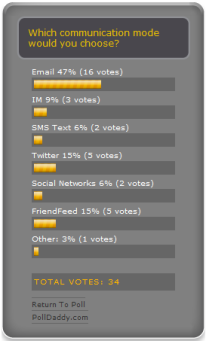
Another example of a good blog is one that features an interactive element, like a poll. Several of my other classmates had a poll in their academic blog, with questions like, “How important is intercultural communication?” A poll lets the reader learn something new in just a few seconds, and shows them that other people are reading that same thing they are. Videos are an easier way to involve the reader. Youtube.com has several videos that could be used in a blog, even videos on communication styles, methods, and theories.

Visually, a blog has to have appeal as well. A lackluster blog is one that has few pictures, a boring background, and a layout that does not make any sense. My classmate, Markita, has a blog that is full of visuals depicting communication issues and other pictures that are important to her blog theme. A blog is about the content of the copy, that is certain, but pictures help to entertain the reader further. An entertained reader is more likely to continue reading.

A well-written, well-researched, and proofread posting helps to create a good blog. No one wants to read passages like, “I have not gotten around to yet cuz of that thing.” Text-type such as ‘cuz’, ‘u’, ‘lol’ and others have no place in academic writing, or really writing of any kind. In order to be taken seriously, a blogger must follow the basic rules of the English language. Spelling errors can become annoying to a reader, especially when any online writer or reader is aware that spell check is just a click away.

Blogging is not as simple as chatting about the day’s events or what the weather in Florida is like. A good blog is written for a reason, and has a theme that the writer follows. As the days, weeks, and years go by, I hope to maintain my focus and achieve the status of a ‘good blogger’. No wait, I hope to become a great blogger!

Monday, August 2, 2010

Babies Have Another Way to Communicate: Sign Language!

Until they are about 8-12 months of age, babies only have one sure way of communicating: crying. Other subtle signs babies communicate like yawns, wetting their lips, or wiping their eyes can also cue a parent in to issues of hunger or sleepiness. However, babies begin to understand the cadence of language and meanings of words well before their first birthday, (Babies, 2006 ). Therefore, a baby might have more complex desires beyond that of the standard clean diaper, full tummy, and well-rested body. For instance, a baby might want to cuddle with their favorite stuffed animal or blanket, be read a story, or inform the parent that they are feeling too hot. In order to harness the full communication potential in an infant, a parent can utilize the power of sign language.

“Signing with babies, whether hearing or deaf, has proven to be beneficial,” (Berke, 2009). Not only will a baby or young toddler be able to let a parent know that they want their blue socks instead of their red socks, but American Sign Language is the 3rd most common language in the United States. That means, “Should your baby continue to learn American Sign Language past his or her 3rd year, she will have acquired a 2nd or even 3rd language,” (Babies, 2006). When a child cannot verbalize exactly what they want, a tantrum can occur. To avoid frustration, a parent can show their child the hand signs for common words used on a daily basis, like “milk”, “water”, “teddy bear”, “blanket”, “sleep”, “more”, “hug”, and others. Another benefit of teaching an infant sign language is the improved relationship between parent and child.

References:
Babies. (2006, n.d.). Baby sign language with your infant or toddler. Retrieved on August 2, 2010, from http://www.babies-and-sign-language.com/

Berke, J. (2009, July 14). Using baby sign language with your baby. Retrieved on August 2, 2010, fromhttp://deafness.about.com/cs/signfeats1/a/babysigning.htm

Case Study: Delivering Bad News Tactfully


Delivering bad news is never easy, especially in a professional environment. When work performance slips, or even worse, when a person needs to be let go, communicating in such situations can be uncomfortable for both parties. Consider the case study and how the employee would have to be approached:

“You are a department manager in a mid-sized company that provides technology support services. You have ten employees who are required to maintain a high level of technical expertise and deliver excellent customer service. One of your employees, who has been with the company for two years, is performing at a substandard level and you have received numerous complaints from customers and coworkers. In addition, this employee has displayed confrontational behavior which has created a hostile environment. You must now meet with this employee and deliver an ultimatum regarding the need for immediate improvement or dismissal.”

First off, the employee might have different reasons for their decrease in work performance. Perhaps they had a death in the family, a bad break-up, or other personal problems to contend with. However, since the employee has been with the company for two years, they might simply feel a sense of entitlement that transcends to laziness. Before speaking with the employee, both states of mind of the employee should be taken into account. Therefore, planning for both variations of conversations would be prudent, (Michaels, 1983, p. 1307).
It is highly likely that the employee’s response would be defensive, given the subjects that are to be broached. The employee might say something like, “I was having a bad day,” or, “I have been an employee here for two years and I have never had complaints before!” To counter the employee’s various excuses, one might answer, “Regardless of any personal problems, they should be left at the door since every single human being has their own emotional dilemmas to contend with on a daily basis. If a death in the family, depression, or other serious issues are at hand, then after a few months of counseling, I will re-evaluate your professional attitude and performance.”

By following a conflict resolution style known as NORMS, a solution can be more smoothly facilitated. NORMS is an acronym that stands for, “ N-Not biased or personal interpretation; O-Observable, situation is seen and touched or experienced by staff; R-Reliable, two or more people agree on what took place; M-Measurable, parameters of conflict can be distinguished and measured; S-Specifics are not subjective, but objective and non-confrontational, (Huber, 2007). Maintaining an objective, calm attitude helps to alleviate unnecessary tension while keeping the path clear for the true problem that needs to be addressed.

References:
Huber, B. (July, 2007). Maintenance and Operations Conflicts. Rock Products, 110 (7),16-16. Retrieved September 8, 2007, from Academic Search Premier Database.

Wednesday, July 21, 2010

Four media technologies that can be found in almost every modern household


Communicating in the modern day world is a great deal easier than it was even 50 years ago. There are several new technologies that have reshaped communication, such as cellular phones, fax machines, e-mail, and television. These devices and others like it are referred to as media technology.

When most people try to imagine what it was like before cell phones, they cannot even remember such an inconvenient time ever existing in their history. No longer hindered by proximity, callers can have conversations anywhere they would like, and often do despite how it might annoy others who might be forced into overhearing private calls. Cell phones are intended for personal and business use; therefore the audience for them is not target-specific. "In fact, in many countries, cellular telephones are more popular than traditional land-line telephones," (Roebuck, 2001, p. 256). The difference between a land-line and a cell phone is that a cell phone can be taken anywhere, whereas a land-line is stuck at home.
Fax machines convey information over phone lines as well, just in a less ephemeral way than cellular phones. Memos and other necessary documents can be quickly transmitted to whoever requests them. Fax machines may appear to be a dying breed of media technology in the new world of e-mail and scanners, but they do serve a purpose. Offices that cannot afford internet or need a hard-copy form of a document can rely on a fax machine, especially because the sender also receives a confirmation that their message was sent successfully, (Roebuck, 2001, p. 257). The audience intended for fax machines would be primarily businesses, but they can certainly appeal to people who wish to maintain a small office in their own home.

E-mail is the quickest way to send an informal memo or message. A message can be sent to someone thousands of miles away with the mere click of mouse. Seconds later, the receiver is opening their virtual mail and reading the message. The only problem with email is that unreliable internet connections can garble a message or even stop it from being sent. Another downside to email is that, unlike a fax machine, there are no confirmations for the sender to feel confident of their message's arrival. The internet has opened up plenty of new media technologies to utilize, but e-mail is by far the most universal.
Television has created a unifying effect as well, because if there is a disaster, the public will know about it within hours or even minutes with a live 'news-breaking broadcast'. News stations keep their viewers informed not only on disasters and weather predictions, but other stories such as ways to solve credit issues. Television shows and movies provide entertainment for the masses, with the quality shows and movies providing insight into culture and possibly even humanity. Each individual news station, show, and movie is geared towards a specific target audience. For example, the HBO show "Sex and the City" most likely has a target audience of 18-49 year old females who enjoy sardonic comedy and have a keen fashion sense.
Media technology changes with each generation. In ten years, the new media technologies will probably amaze and further the convenience of mobile communication.
References:
Roebuck, B., D. (2001).Improving Business Communication Skills[3rd Ed.]. Upper Saddle River, New Jersey: Prentice Hall