Showing posts with label sf. Show all posts

Monday, November 5, 2012

"53% of the Brotherhood of Man is the Sisterhood of Woman", and other thoughts by Ursula K. LeGuin


The opening line of Ursula K. LeGuin's “America Sf & the Other” sums up the tone of the article perfectly: “One of the great early socialists said that the status of women in a society is a pretty reliable index of the degree of civilization of that society. If this is true, then the very low status of women in SF should make us ponder about whether SF is civilized at all”.
File:UrsulaLeGuin.01.jpg
Meet-the-author Q&A session;
Bookworks bookstore, Albuquerque, NM

Photo taken by Hajor, 15.Jul.2004.
Source: Wikimedia Commons
Much of LeGuin’s article makes an argument on behalf of all Others, as she acknowledges that there are many types of Others, such as sexual, racial, class, and cultural. She goes on to insist that the patriarchal SF establishment is the tip of the iceberg, not only in literature, but in society, leading to a greater ill: women are portrayed (and not just in SF) as LeGuin describes them, “squeaking dolls subject to instant rape by monsters”.
Real people, as in neighbors, teachers, the poor, and the like are rarely ever present in SF (or at least they weren't present in LeGuin’s generation of SF). People of LeGuin’s SF are simply masses, described as ‘they’, never as the individuals that they are. Thus, the reader is indoctrinated, becoming desensitized to the needs of the un-described and faceless ‘they’ that are constantly harmed in SF stories.
Another point LeGuin makes about the masses in SF is this: “The people, in SF, are not people. They are masses, existing for one purpose: to be led by their superiors.” Imperialism is a turn the article takes for the better, going on to compare Galactic Empires with Roman Empires. Early pulp SF always made sure to conquer the alien invaders and to never portray them in a sympathetic light. The problem with that, in LeGuin’s view, is that SF has not really strayed from that old pulp notion that ‘the only good alien is a dead alien’, creating the sense that anything unknown =something not good (kill it, kill it!).
What’s worse is the creation of the godlike aliens of SF, that come to Earth with wisdom to better our sorry species. It may seem better to revere a being rather than kill it, but either way, LeGuin suggests that these two ideals only serve to distance human consciousness from one another. Or, to put it more eloquently, LeGuin states that with the distance from the other entity, either through hate or reverence, “You have made it into a thing, to which the only possible relationship is a power relationship. And thus you have fatally impoverished your own reality. You have, in fact, alienated yourself.”
The article ends with LeGuin surmising on the state of a male-led SF community, and her call to readers and writers of SF alike to end their longing for a return to Victorian standards, and instead to remember that “53% of the Brotherhood of Man is the Sisterhood of Woman”.  

Wednesday, September 12, 2012

"The end of masculinity would also mean the end of femininity", and other thoughts from Marlene Barr

Source: Google Images

All female societies, pregnant nursing males, and the end of masculinity are only a few of the topics discussed by Marlene Barr in her book Lost in Space: Probing Feminist Science Fiction and Beyond. Through a series of essays, Barr comments on the equality (or disproportions) between men and women, using feminine sf stories as a basis of comparison. Authors like LeGuin, Russ, and Gilman are quoted by Barr, though she is fair in her feminist sf study by including male authors (an unwanted but undeniable presence in feminist sf).

In the introduction to her SF analysis, Barr shares the story of her academic rise. By choosing to study sf through a feminist lens, Barr says that many of her male colleagues were threatened and tried to negate the academic quality of sf for study. Sf writer Gary Westfahl is quoted by Barr, warning sf writers to “never conceal, compromise, or apologize for [your] interest in this field” (p. 2). If sf was a laughable avenue of study to her colleagues, Barr realizes that a feminist-led criticism sf might be met with greater laughter. Still, she forges ahead with the dismantling of patriarchal sf by comparing them to feminist sf stories of the same caliber.

Chapter 6 talks about the end of masculinity. At face value, the term ‘end of masculinity’ could be interpreted as a threat to men everywhere. What Barr means by the end of masculinity is to also end the other side of that particular coin, femininity. Like ying and yang, one cannot exist without the other. Without masculinity or femininity, men and women would unite under a singular definition of gender, one in which both men and women would be caregivers, providers, and valuable members of society. Barr's text is a valuable tool in the study of sf, especially given her gender critiques.

Barr, S., Marlene. Lost in Space: Probing Feminist Science Fiction and Beyond. North Carolina: The University of North Carolina Press, 1993. Print.

Saturday, June 2, 2012

"A Princess of Mars"- A novel where being a princess means being helpless

File:John Carter.svg is a former Virginian confederate officer. Penniless after the end of the Civil War, Carter is not without courage, honor, and a friend: James Powell. When Powell is taken by a band of Native Americans, Carter follows and finds his friend dead. He later takes refuge in a cave and is almost overtaken by the same band of Native Americans. Though, some noise or presence scares them off (maybe a foreign spacecraft; Burroughs never says) and when Carter next awakes, he is on the planet Mars.
The first sign of life Carter is exposed to are green men called the Tharks. They are a harsh sort of civilization, comparable to the culture of Spartans. They relish brutality, respect violence, and laugh only when these two things occur. Carter is lucky because he kills two of their chieftains, and gains the Tharks esteem, becoming a chieftain himself. His female mentor (all Tharks are raised by female mentors, not mothers or fathers) is Sola, and she shows him compassion and kindness. Carter’s other companion on Barsoom (the Thark word for Mars) is his dog-like companion, Woola.
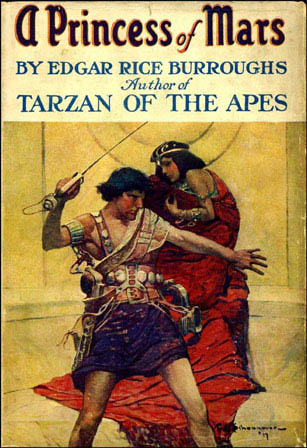
File:Princess of Mars.jpg
Cover art by Frank Earle Schoonover
AC McClurg Publishing, 1917
Source: Wikimedia Commons
Carter finds out that there are other humanoids on Barsoom when he meets Dejah, a captive of the Tharks. She looks like an Earthling, but for her copper skin. Through her, he learns that Barsoom thrived over a thousand years ago, but due to failing resources, it fell into a state of disrepair ruled by the warring Tharks and other creatures.
A constant theme (and perhaps even a fear held by Burroughs) is the unjust nature of a communal civilization, as displayed by the Tharks. Personal possession is unheard of, unless it is something consequential like a blanket. Children do not learn love or even who their parents are. From the first year, they are taught warrior codes, and always to fight for what they want. Tharks do not even recognize love or friendship when the concepts are presented to them by John Carter. “Friendship?” asked Tars Tarkas. “There is no such thing.” (p. 62). Dejah laments the loss of love from the Tharks, a race that once mixed with her own to create hybrid Barsoomians.
Burroughs chooses to make the female character of Sola independent, brave and strong (as she is a Thark). Yet, the more ‘civilized’ female character, Dejah (the Barsoomian Princess of Helium), is not either of those things. Carter thinks of her as ‘earthly womanly’, giving that comparison whenever Dejah displays affection, weakness, or abject stupidity (at least, she does not seem that bright to me, the reader). For example, when Dejah convinces herself that Carter is an alien, she does not do so from any deductive reasoning, but rather she says her conviction comes from “her heart telling her to believe because she wishes to believe it”, a logic that Carter deduces is a “good logic, good, earthly, feminine logic.” (p. 48-49).
It seems that Burroughs idea of a Communist society was one in which barbaric pleasures reigned, as the Tharks did nothing but create a menacing picture of a communal faction, unlike the Utopian commune depicted in Gilman’s Herland. Carter’s ideas on ‘real’ women are borderline offensive at times, but probably reflective of the decade in which the novel was written.

Burroughs, Rice, Edgar. A Princess of Mars. Chicago: AC McClurg Publishing. 1917. Print.