
Wednesday, January 30, 2013
COUNTDOWN....!


Monday, January 21, 2013
A Further Realization of Utopia: Edward Bellamy's "Equality"
Given ten years
to reflect on his work, Bellamy was able to expand upon the thoughts and issues
of the utopian society in Looking
Backward. Equality is not so much a sequel to that novel than it is a
continuation. There were questions in Looking
Backward that went unanswered and that is where Equality comes up with the answers. For example, the gender gap is
one that Bellamy took into account and remedied.
 |
| A photo of Edward Bellamy, as seen in the Libary of Congress, (1889). Source: Wikimedia Commons |
In the first
novel, a woman’s role in the 20th century is not all that different from their
role in the 19th century. The women West meets still dress relatively the same,
and they seem to defer to their male counterparts, content in the role of
daughter and mother. Bellamy explains this away by describing Letee’s need to
make West comfortable in his first few weeks in the year 2000. He had his wife
and daughter dress in a similar fashion to that of women in 1887 so that West
would not be shocked to discover that women are allowed a more independent lifestyle,
one that involves wearing pants and working any job they please.
A further
explanation of the banking and work placement system are other issues tackled
in Equality. West is allowed to open
his own account, and he questions the teller about how the system works without
capitalism. In summation, the teller recounts the old capitalist system and how
it was designed to trick the consumer into thinking that capitalism and
individual freedoms were synonymous, when in fact, the opposite was true. With
the new system of the year 2000, many commodities are paid for by the
government, like utilities, music, news, theater, postal and electronic
communications, and transportation. Because of that, small stipends are awarded
each citizen, totaling to around 7,000 dollars a year, enough so that they can
still purchase the things that they would wish, like food, clothing, and rent.
The new economic system was created under the mindset that “nobody owes
anybody, or is owed by anybody, or has any contract with anybody, or any
account of any sort with anybody, but is simply beholden to everybody for such
kindly regard as his virtues may attract” (34).
The idea of the
loss of individual liberty in a Marxist society is addressed and debunked by
Bellamy in Equality. For decades, it
has been assumed that if a government nationalized the banking and job systems,
then that security is the trade people would have made in exchange for their independence.
However, West
enters the nationalized workforce and learns that he can choose whichever
profession he would like to study, and if that position is not available to him
later on, he can transfer to another city where it is available, or make do
with a second or third choice in his profession. The government does not assign
professions to citizens, rather it assigns what hours each job receives for a
day’s work (shorter work hours for more physically demanding jobs, like coal
mining), and what pay each worker receives (each worker receives equal pay, be
it a doctor or bookkeeper). When people receive different pay for different
work, they begin to assume that they are better than others, and that is where
class warfare really begins. Human beings that are working, regardless of the
job, should be regarded with the same respect that everyone else receives.
There are many that would find Bellamy’s Marxist society as distasteful or
unnatural, but in retrospect, our Capitalist (not ‘free-market’ society as
suggested by the media, but Capitalist) society is the unnatural one, as it
fosters poverty, a feudal class system, and creates gods out of the top
money-makers.
Bellamy,
Edward. Equality. Boston: D. Appleton
& Company, 1897. Print.
Tuesday, January 8, 2013
Edward Bellamy's "Looking Backward: 2000-1887" is a surprising reflection of modern society
 |
| Dust Jacket of "Looking Backward" by Edward Bellamy (1888). Source: Scan from the original book as shown on WikiMedia Commons |
The setting for the beginning of the novel is the year 1887, but at times, I felt as if I were reading about the year 2012 in relation to
economic unrest. Many workers of that time were protesting, demanding higher
wages, less exploitation, and safer work environments, much like many of the
union workers in Illinois, New York, Wisconsin and more. The narrator, Julian
West, is a plutocrat that is disgusted by the protests, viewing them as a nuisance
to his plans to refurbish his mansion.
His views about the class system begin to change, but only
after he enters a Van-Winkle state of sleep to wake up in the year 2000.
A difference between this novel and other feminist utopian
sci-fi novels would be the driving theme. In Mizora and Herland,
social issues like children and education were of the greatest import. However,
in Bellamy's story, the class and economic system take center theme. Women and
their roles do not vary much from 1887 to 2000. West meets two 20th century
women, and while he finds one of them attractive (based on her girlish beauty),
he ultimately dismisses their import, and instead the male friend Doctor Letee,
who discovered West, is given more attention.
In the year 2000, all men are equal and receive equal amounts
of work and pay. The class system has been completely abolished, even though
there are still jobs that would be considered ‘dead-end’. Menial jobs, as told
by Letee, are no longer thought of as menial, only necessary. When Letee and
West eat at a restaurant, they are served by a waiter. Letee treats the waiter
respectfully, never speaking down to him. Similarly, the waiter does not seem
ashamed of the job he is performing, and West notes that the young man appears
to be very poised and educated. Letee and his daughter set forth the idea that
it is immoral to abhor a person for doing a service that you would not be
willing to, in turn, do for them.
There are several societal ideas presented in the novel, a
great many of them rooted in Marxism. There is no more capitalism in the year
2000, as the government itself is the sole capitalist, handing out stipends of
cash to each citizen every year. Possessions are no longer revered, and nor is
wealth. Instead, during their lifetimes, people strive to possess as little as
possible, because to have less is better (as the upkeep for large estates is
seen as frivolous). If a relative dies and leaves their assets behind to a
relative, that is not seen as a boon, but rather as an inconvenience that must
be rid of quickly. The same negative thoughts about accumulation of wealth are
echoed in the novel A Strange Manuscript
Found in a Copper Cylinder.
After reading about many utopian (and often Marxist)
societies in sf literature, I could not find myself sympathetic to the society
laid out by Bellamy. It seemed too much like a Stalinist-Russia, one in which
individual freedoms where stripped away, leaving a compliant citizen with no
rights or dreams for themselves. However, as I kept reading, I discovered that
my resistance to Bellamy’s imagined society was mere prejudice, perpetuated by
my fear of what a truly Marxist society would mean. The citizens in Bellamy’s novel
are not stripped of their individual freedoms, only of their oppression. It was
after reading Equality, the follow-up to Looking
Backward, that I fully understood that.
Bellamy,
Edward. Looking Backward. Boston:
Houghton Mifflin, 1888. Print.
Thursday, November 29, 2012
The pre-writing stage and why every writer needs it

When searching for a prompt on teaching
composition, I thought of the few friends I have tutored over the years. One of
the main things my friends seemed to struggle with the most was getting their
inspiration, getting their start. They would always turn to me and ask,
"What should I write about"? After I considered their question, I
would suggest using the internet, annotating articles, considering the subjects
that they felt passionate about, or just debating with one another on the
subject of the paper until a prompt came into being. While I thought myself to
be an adequate impromptu tutor, I had yet to pick up the book A Writer’s Reference, or read any
articles on composition theory. Still, I was not off to a bad start, as many of
the pre-writing tools I mentioned are in Diane Hacker and Nancy Sommers A Writer’s Reference, but there were
plenty more that I had not explored. In order to write an efficient and
articulate academic paper, it is necessary to try one or many of the
pre-writing tools found in Hacker’s, and to remember that writing tools are not
rules, they are loose steps intended as stones for you to create your own
pathway.
Every writer has their own method, and usually
that method works for them. There is no problem in using your own writing method,
so long as your method is evolved from established methods. Some writing
methods involve writing a first draft the night before the paper is due and
riding off the C or even B that is awarded. Notice how pre-writing did not
occur in that example, and pre-writing could have made the difference between
an average quality paper and a great paper. Even before writing this very
paper, I was going to begin without using any pre-writing methods. I was going
to commit the ultimate form of hypocrisy by lecturing on the necessity of
writing steps without first taking any of them myself. However, I paused before
writing this paper, reminding myself to utilize a few of the pre-writing
methods outlined in pages 1-64 of A
Writer’s Reference.
To start, I re-read parts of Hacker’s and other
articles on composition. Next, I thought about what interested me most about
the texts I had read. What was in those texts that inspired me to write? After
narrowing down my focus, I drafted a thesis. Thus far, the steps I took to in writing
this paper are all steps one can find in Hackers, beginning on page 3, titled
“Planning”. The planning, or pre-writing stage of writing, is where ideas are
hatched, nurtured, and finally given freedom. Though I had my thesis, I was not
ready to move on to the writing stage, not at full-blast. What I needed next
was a place to put those ideas in neat rows where I could get at them, critique
them, and add to them. I decided to write out an informal outline.
What is an informal outline you say, and how does
it differ from a formal outline? First, an informal outline is a great way to
list your ideas quickly, aligning them so that they make sense to your chosen
thesis, whereas Hackers says that “a formal outline may be useful later in the
writing process, after you have written your rough draft […to] help you see
whether the parts of your essay work together” (12).
The writing tools I used as part of my planning
stage are not the only ones available. In fact, Hackers lists a number of
pre-writing ideas, such as free-writing, clustering, and asking questions. Many
writers scoff at the idea of using pre-writing tools, and most of the time they
have never tried them. Pre-writing tools do work, if only to calm the jumble of
the many thoughts racing through a person’s mind while writing. A case study in
Sondra Perl’s article “Understanding Composing”, talks about the distractible
quality that is always present while writing: “My mind leaps from the task at
hand to what I need at the vegetable stand for tonight’s soup to the
threatening rain outside to ideas voiced in my writing group this morning, but
in between ‘distractions’ I hear myself trying out words I might use” (363).
Thus, think of pre-writing as a way to muddle through the myriad of thoughts
that bombard your brain. From the grocery list to the weather, pre-writing is
the glue that brings the important thoughts of writing together in a meaningful
way.
It is easy to think of writing as a fluid
process, one that begins with pre-writing and ends with revisions, but that is
not always the case. Writing is a messy process, even when one follows the
loose guidelines set forth by teachers and composition books. Writing is what
Sondra Perl believes to be a recursive process. A recursive writing process is
one that is far from a continuous process, and as the writer puts words down on
paper (either during pre-writing or beyond), he or she is constantly going back
to look over their words, re-reading for context and understanding, mentally deciding
what needs to written next. Writing as a muddied process is a sentiment echoed
by composition theorist Donald M. Murray, in his article “Making Meaning Clear:
The Logic of Revision”: “The writer’s meaning rarely arrives by room-service,
all neatly laid out on the tray. Meaning is usually discovered and clarified as
the writer makes hundreds of small decisions, each on igniting a sequence of
consideration and reconsideration” (88). Recursive writing is not wrong, and
one does not need to bury the recursive writing habit to write an academic
paper. However, to write a great academic paper, it helps to train your brain
to use pre-writing tools during that recursive process.
Another way to increase your quality of writing
is to harness what Perl calls the ‘felt sense’. The description of felt sense
is powerful, because for some, it describes what writing is: "The move [or felt sense] draws on sense experience, and
it can be observed if one pays close attention to what happens when writers
pause and seem to listen or otherwise react to what is inside of them"
(365). Part of what Perl is saying is that all writers experience physical feelings as they are writing,
and as they are trying to describe a particular scene, place, or emotion, they
should draw on their own inner emotions to fully convey their meaning through
prose. In other words, when writers say they have a muse, that muse can be a
place or a person, but the way that the writer translates their feelings for
that particular muse onto paper is the writing process known as felt sense.
Felt sense can be a pre-writing tool because if a writer can learn how to
recognize their felt sense, they can take advantage of that to create clear and
concise text.
Pre-writing tools are not the necessary evils that they have at times
been painted to be, rather they are simply necessary. It is also important to
remember that writing is a process full of varied steps that can be utilized in
different ways, so long as they are utilized. Writing is a large contradiction to itself,
being at once a process that requires certain steps and at the same time, a
process that seeks to avoid those steps and create new ones. Academic writing,
while different in many ways from fictional writing, is not the large boot that
stomps on creative writing as so many fear it is. Rather, one may keep their
own tone throughout the body of an academic paper, as long as the paper retains
structure, attention to detail, and clarity, all the perks that pre-writing has
to offer.
Works Cited
Hacker, Dianne & Sommers,
Nancy. A Writer’s Reference. Boston:
Bedford/St.Martins, 2011. Print.
Murray, M., Donald. Learning
by Teaching. Montclair:
Boyton, 1982. Print.
Perl, Sondra. “Understanding
Composing”. College Composition and
Communication 31.4 (Dec., 1980): 363-69. JSTOR Online Database. Web. 14 Nov. 2012.
Monday, November 19, 2012
The Importance of Charlotte Perkins Gilman's "Herland"
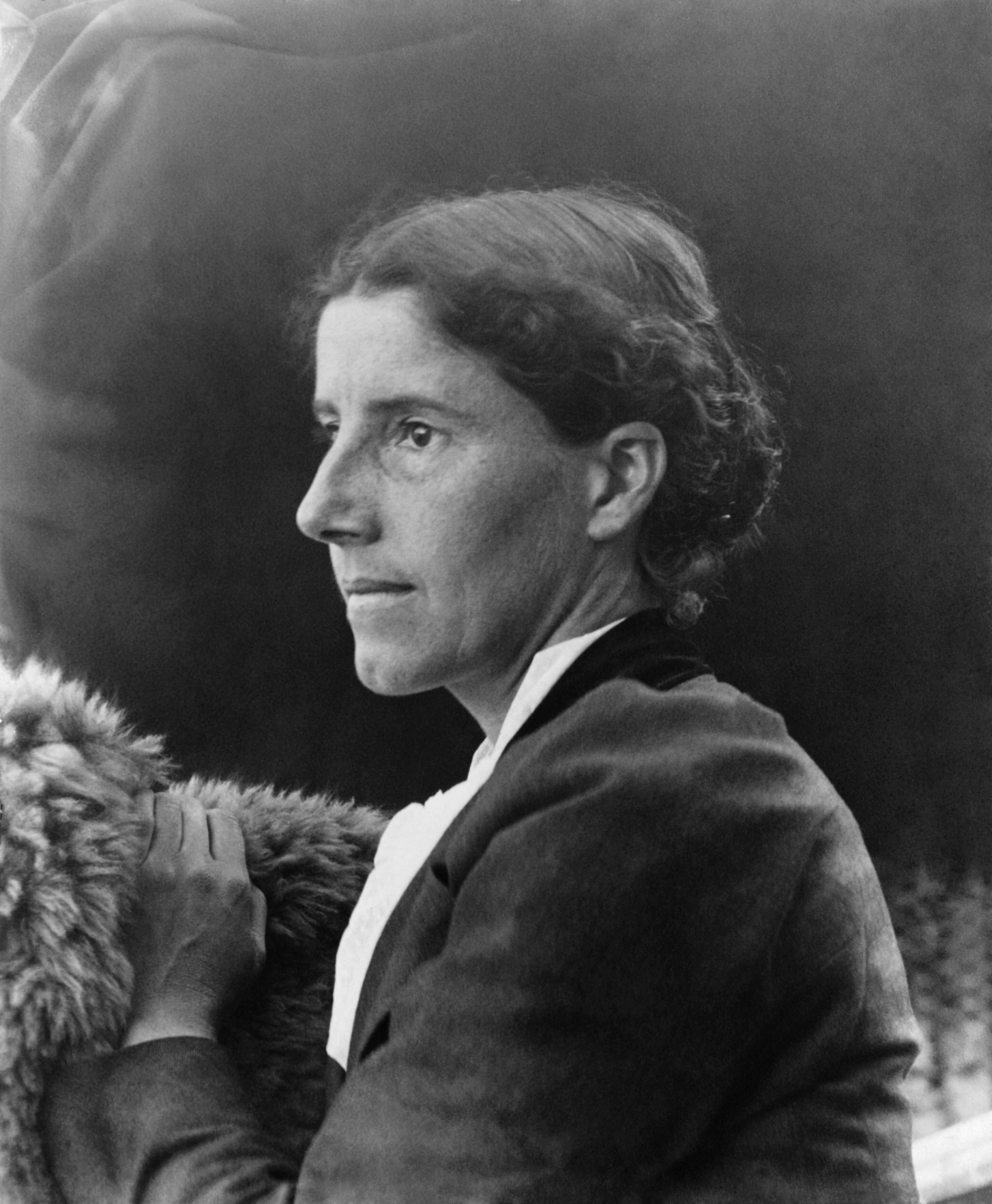 |
| Photographic portrait of Charlotte Perkins Gilman, American author, c. 1900. This is a cropped version of the digital image from the Library of Congress online collection, as identified below. Copyright has expired on this image. Source: Wikimedia Commons |
Charlotte Perkins Gilman was many things: a writer, a feminist, and at times, fan of eugenics based on her staunch racism. Aside from her failings, Gliman managed to write a groundbreaking novel called Herland that went unnoticed until it gained popularity in the 1970's. First appearing as a serial in 1915, Herland is one of the first works of feminist Utopian fiction.
Three
young students set out to explore a legend shared by the locals of the foreign
country that they are residing in. The legend is of a hidden community
comprised solely of women. Since the three students are also young men, their
interest is more than piqued.
All
three men have different views on women, ranging from the extreme to the
sympathetic. Jeff is the biologist, and
an idolizer of women. The narrator, Van, stays neutral on most every subject as
a sociology major. Terry is a geologist, and straddles the line between
gentleman and chauvinist pig.
Before
they find out that the legend of Herland is indeed true, the three men surmise
on what sort of civilization could arise if maintained by only women. Their
prejudices and sexist views come to the fore during these discussions; “We
mustn’t look to find any sort of order and organization […] Also we mustn’t
look for inventions and progress; it’ll be awfully primitive.” (p. 8-9).
The
civilization the three men discover is far beyond anything they could have
imagined. Herland is a beautiful country, with gardens and forests that are
carefully tended to yield the most food (there is no room for crops or cattle
in Herland's tiny strip of territory). Men are nowhere to be found. In fact,
the arrival of Terry, Jeff, and Van mark the civilization’s first sighting of
men in two-thousand years.
Though
Herland is not a distant planet, it might as well be for the all the
differences Van takes note of in his journal. At first, Van believes his
‘world’ to be more advanced, but as he learns more and more about the women of
Herland, he becomes ashamed at the state of his world in comparison to their
paradise.
Many
notions of femininity come into question in this short novella from Charlotte
Perkins Gilman. The women of Herland keep their hair cropped short, wear
clothes free of adornment, are intelligent, and work hard doing things that the
three men considered only for men. Not every woman is young, giggling, and
beautiful: [Van’s perspective]- ‘Woman’ in the abstract is young, and, we
assume, charming. […] Most men do think that way, I fancy.” (p. 21). By the end
of the story, Van and Jeff come to see that Terry’s view about women is
entirely wrong, that indeed all their thoughts about women are entirely based
on their society’s perception of gender roles.
Gilman, Perkins,
Charlotte. Herland. New York:
Pantheon Books, 1979. Print.
Wednesday, November 7, 2012
Amateur tips on reading, writing, and teaching composition
 |
| A hand holding a pen on the statue of Isaiah at Piazza Spagna in Rome. 27 October 2008 Flickr: Roma Italy - Creative Commons by gnuckx |
Inspiration
is crucial to any type of writing, be it creative or academic. There are times
when the line between academic and creative writing can become blurry, but all
writing is technically a creative outlet. There are no strict rules on writing,
only guidelines set forth by texts like A
Writer’s Reference. A writer must find their own voice and style, while
adhering to the writing structure necessary for the audience.
Audience
is a big thing to consider when writing. If the audience is a fiction fan, then
as a writer, it is possible to leave them out of the writing, to keep some
secrets and surprises in store for later. An academic audience must be included in the writing process at all
times, because they need to fully understand the research and purpose of the
paper. A writer can always break some rules to include tone, as long as the
writing makes sense. Academic papers deal with structure, surrounding a thesis
that requires sources, sort of like a big argument cushioned by a series of
smaller supporting arguments. In contrast, creative writing is a showcase for
the writer’s story and style. Eric Mast of the Writing Center echoes Flowers
& Hayes on the purpose of writing by saying, “writing is a thought process
and the reader should identify with that process”.
Mast
also has some other tips for writers, specifically writing teachers. He
believes that it is not possible to fully learn about teaching until the first
day of class. A new teacher may prepare thoroughly, but what Mast suggests is
to pretend confidence as a new teacher, even when the outcome is unsure (as it
will most often be in the first year of teaching).
A
composition teacher’s best friend may always be Hacker & Sommers A Writer’s Reference. It is a textbook
filled with easy to follow steps on all types of writing, and included are
several examples on how to utilize each writing step. Planning a draft, writing
a thesis and introduction, creating body paragraphs, and writing a conclusion
are writing steps outlined in A Writer’s
Reference, and they are steps all composition teachers should be
comfortable with.
Background
and real world knowledge are other tools a teacher can apply to their teaching
methods. Though, Mast warns that even as professional work environments and
teaching environments share similarities, they are definitely not the same
thing. Teachers should find their own balance of control to maintain in a
classroom, remembering that the students are not employees and there are
different rules in a classroom than in a workplace.
Reflecting
on learning, writing, and teaching can appear to be a boring exercise. However,
once completed, the process is an eye opening one because it expands the
writer’s overall knowledge on their competencies and their deficiencies in each
area. A writer/learner/teacher can discover things about their own writing and
learning curves, and discovery leads to improvement. Self-improvement puts any
writer/learner on the right road to becoming an effective teacher. Teachers
should be familiar with the learning process from both sides (student and
teacher) so that they can recognize their students’ needs at a relatable level.
Monday, November 5, 2012
"53% of the Brotherhood of Man is the Sisterhood of Woman", and other thoughts by Ursula K. LeGuin
The opening line of Ursula K. LeGuin's “America Sf & the Other” sums up the tone of the
article perfectly: “One of the great early socialists said that the status of
women in a society is a pretty reliable index of the degree of civilization of
that society. If this is true, then the very low status of women in SF should
make us ponder about whether SF is civilized at all”.
 |
| Meet-the-author Q&A session; Bookworks bookstore, Albuquerque, NM Photo taken by Hajor, 15.Jul.2004. Source: Wikimedia Commons |
Much of LeGuin’s article makes an argument on behalf of all Others, as
she acknowledges that there are many types of Others, such as sexual, racial,
class, and cultural. She goes on to insist that the patriarchal SF
establishment is the tip of the iceberg, not only in literature, but in
society, leading to a greater ill: women are portrayed (and not just in SF) as LeGuin
describes them, “squeaking dolls subject to instant rape by monsters”.
Real people, as in neighbors, teachers, the poor, and the like are rarely
ever present in SF (or at least they weren't present in LeGuin’s generation of
SF). People of LeGuin’s SF are simply masses, described as ‘they’, never as the
individuals that they are. Thus, the reader is indoctrinated, becoming
desensitized to the needs of the un-described and faceless ‘they’ that are constantly
harmed in SF stories.
Another point LeGuin makes about the masses in SF is this: “The people,
in SF, are not people. They are masses, existing for one purpose: to be led by
their superiors.” Imperialism is a turn the article takes for the better, going
on to compare Galactic Empires with Roman Empires. Early pulp SF always made
sure to conquer the alien invaders and to never portray them in a sympathetic
light. The problem with that, in LeGuin’s view, is that SF has not really
strayed from that old pulp notion that ‘the only good alien is a dead alien’,
creating the sense that anything unknown =something not good (kill it, kill
it!).
What’s worse is the creation of the godlike aliens of SF, that come to
Earth with wisdom to better our sorry species. It may seem better to revere a
being rather than kill it, but either way, LeGuin suggests that these two
ideals only serve to distance human consciousness from one another. Or, to put
it more eloquently, LeGuin states that with the distance from the other entity,
either through hate or reverence, “You have made it into a thing, to which the
only possible relationship is a power relationship. And thus you have fatally
impoverished your own reality. You have, in fact,
alienated yourself.”
The article ends with LeGuin surmising on the state of a male-led SF community,
and her call to readers and writers of SF alike to end their longing for a
return to Victorian standards, and instead to remember that “53% of the
Brotherhood of Man is the Sisterhood of Woman”.
Subscribe to:
Posts (Atom)
