Showing posts with label charlotte perkins gilman. Show all posts

Monday, February 24, 2014

Women Can Be Strong, Peaceful, and Violent in Sally Gearheart's "The Wanderground"


Through a series of short stories, Gearheart tells the stories of the Hill Women. The Hill Women live in serene world, communing with nature at every turn. Their world seems to have reached the apex of peaceful living, until the reader learns why the women live in the forests: they are forced to. Men have taken over the cities, and control every facet of a woman’s life. The women that rebelled fled the cities and learned to live among the trees and animals. In doing so, they developed psychic abilities, like “speaking” with animals, astral projection, and telepathy to name a few.

While the comparisons between the Hill Women and Gilman’s Herlanders are strong, Gearheart brings realism to the Hill Women by depicting them in the throes of irrational, or even violent fits of anger. One thing which seems to be reiterated in feminist utopian fiction novels is the lack of physical violence in women, but Gearheart is not afraid to admit her peaceful characters are still human, and within their range of human emotions, anger can be counted among them. Russ and Tepper bring similar elements to their female characters in The Female Man and The Shore of Women. In both novels, the female characters are part of war-less societies, but they are still capable of individual acts of violence.

Gearheart, Sally. The Wanderground: Stories of Hill Women. New York: Alyson Books, 1978. Print.

Picture linked from:
http://www.amazon.com/The-Wanderground-Sally-Miller-Gearhart-ebook/dp/B009XIDI4K

Monday, November 19, 2012

The Importance of Charlotte Perkins Gilman's "Herland"

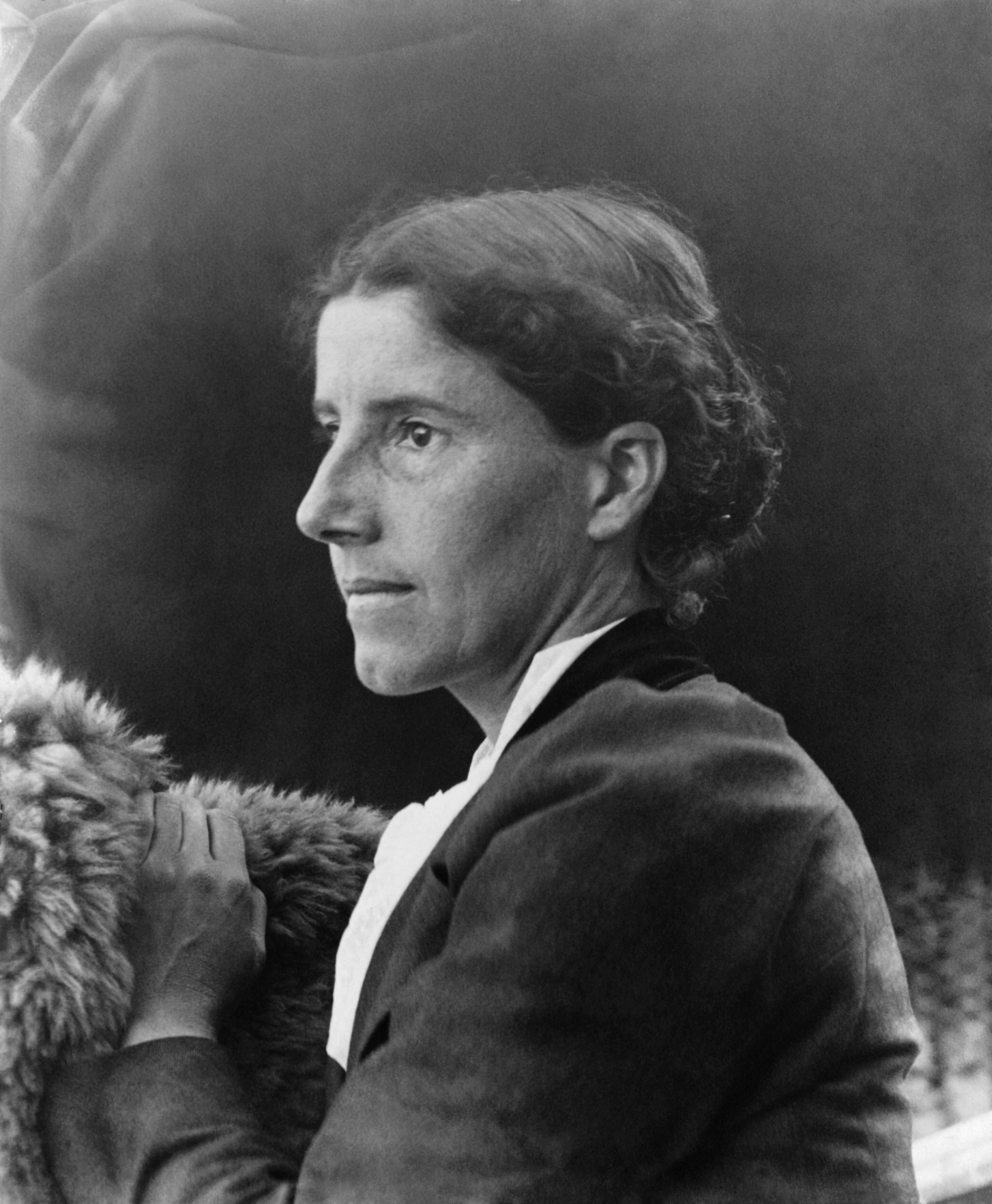
Photographic portrait of Charlotte Perkins Gilman,
American author, c. 1900. This is a cropped version
of the digital image from the Library of Congress online
collection, as identified below. Copyright has expired on this image.
Source: Wikimedia Commons

Charlotte Perkins Gilman was many things: a writer, a feminist, and at times, fan of eugenics based on her staunch racism. Aside from her failings, Gliman managed to write a groundbreaking novel called Herland that went unnoticed until it gained popularity in the 1970's. First appearing as a serial in 1915, Herland is one of the first works of feminist Utopian fiction.
Three young students set out to explore a legend shared by the locals of the foreign country that they are residing in. The legend is of a hidden community comprised solely of women. Since the three students are also young men, their interest is more than piqued.
All three men have different views on women, ranging from the extreme to the sympathetic. Jeff  is the biologist, and an idolizer of women. The narrator, Van, stays neutral on most every subject as a sociology major. Terry is a geologist, and straddles the line between gentleman and chauvinist pig.
Before they find out that the legend of Herland is indeed true, the three men surmise on what sort of civilization could arise if maintained by only women. Their prejudices and sexist views come to the fore during these discussions; “We mustn’t look to find any sort of order and organization […] Also we mustn’t look for inventions and progress; it’ll be awfully primitive.” (p. 8-9).
The civilization the three men discover is far beyond anything they could have imagined. Herland is a beautiful country, with gardens and forests that are carefully tended to yield the most food (there is no room for crops or cattle in Herland's tiny strip of territory). Men are nowhere to be found. In fact, the arrival of Terry, Jeff, and Van mark the civilization’s first sighting of men in two-thousand years.
Though Herland is not a distant planet, it might as well be for the all the differences Van takes note of in his journal. At first, Van believes his ‘world’ to be more advanced, but as he learns more and more about the women of Herland, he becomes ashamed at the state of his world in comparison to their paradise.
Many notions of femininity come into question in this short novella from Charlotte Perkins Gilman. The women of Herland keep their hair cropped short, wear clothes free of adornment, are intelligent, and work hard doing things that the three men considered only for men. Not every woman is young, giggling, and beautiful: [Van’s perspective]- ‘Woman’ in the abstract is young, and, we assume, charming. […] Most men do think that way, I fancy.” (p. 21). By the end of the story, Van and Jeff come to see that Terry’s view about women is entirely wrong, that indeed all their thoughts about women are entirely based on their society’s perception of gender roles.

Gilman, Perkins, Charlotte. Herland. New York: Pantheon Books, 1979. Print.