Showing posts with label woman. Show all posts

Monday, November 19, 2012

The Importance of Charlotte Perkins Gilman's "Herland"

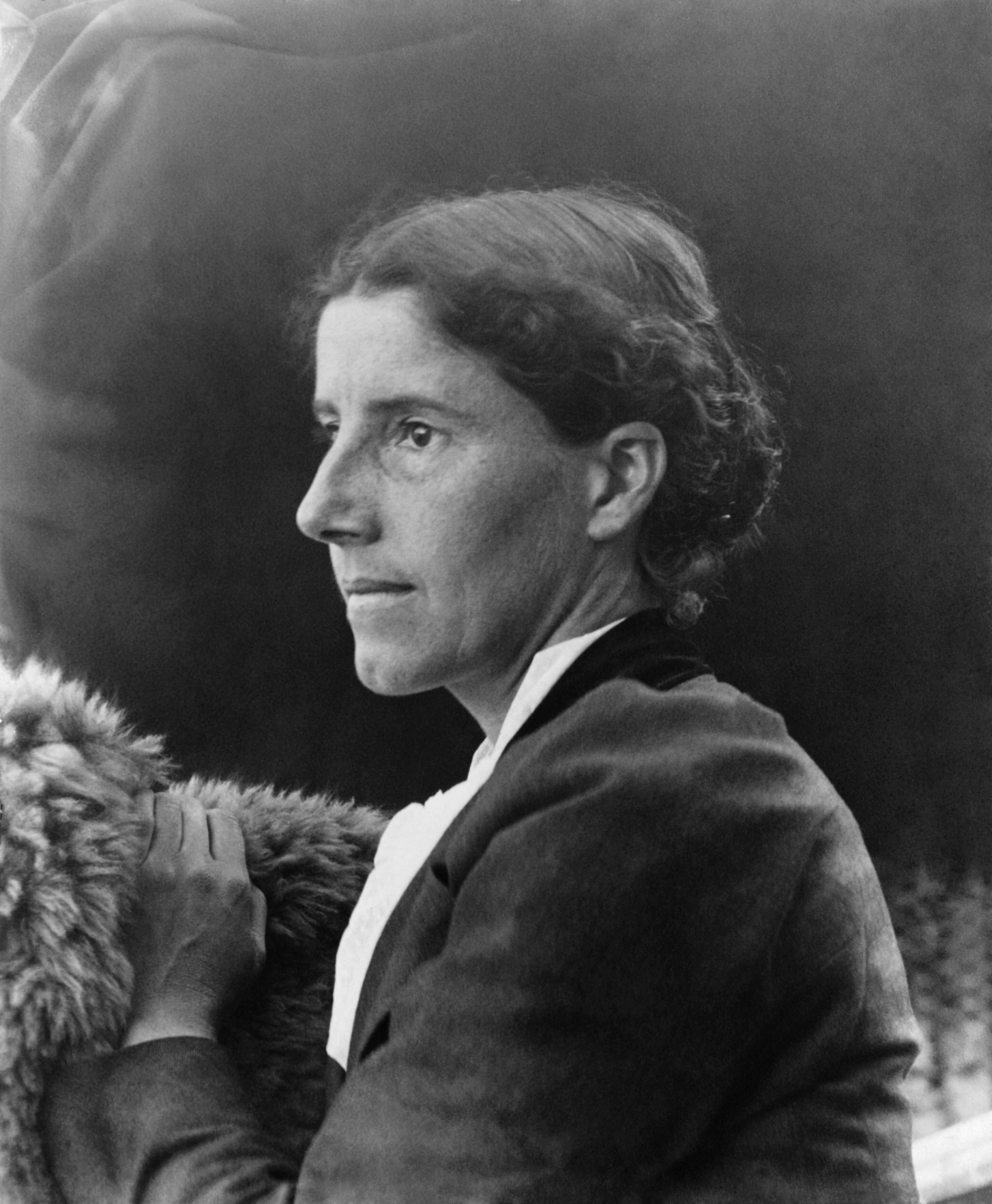
Photographic portrait of Charlotte Perkins Gilman,
American author, c. 1900. This is a cropped version
of the digital image from the Library of Congress online
collection, as identified below. Copyright has expired on this image.
Source: Wikimedia Commons

Charlotte Perkins Gilman was many things: a writer, a feminist, and at times, fan of eugenics based on her staunch racism. Aside from her failings, Gliman managed to write a groundbreaking novel called Herland that went unnoticed until it gained popularity in the 1970's. First appearing as a serial in 1915, Herland is one of the first works of feminist Utopian fiction.
Three young students set out to explore a legend shared by the locals of the foreign country that they are residing in. The legend is of a hidden community comprised solely of women. Since the three students are also young men, their interest is more than piqued.
All three men have different views on women, ranging from the extreme to the sympathetic. Jeff  is the biologist, and an idolizer of women. The narrator, Van, stays neutral on most every subject as a sociology major. Terry is a geologist, and straddles the line between gentleman and chauvinist pig.
Before they find out that the legend of Herland is indeed true, the three men surmise on what sort of civilization could arise if maintained by only women. Their prejudices and sexist views come to the fore during these discussions; “We mustn’t look to find any sort of order and organization […] Also we mustn’t look for inventions and progress; it’ll be awfully primitive.” (p. 8-9).
The civilization the three men discover is far beyond anything they could have imagined. Herland is a beautiful country, with gardens and forests that are carefully tended to yield the most food (there is no room for crops or cattle in Herland's tiny strip of territory). Men are nowhere to be found. In fact, the arrival of Terry, Jeff, and Van mark the civilization’s first sighting of men in two-thousand years.
Though Herland is not a distant planet, it might as well be for the all the differences Van takes note of in his journal. At first, Van believes his ‘world’ to be more advanced, but as he learns more and more about the women of Herland, he becomes ashamed at the state of his world in comparison to their paradise.
Many notions of femininity come into question in this short novella from Charlotte Perkins Gilman. The women of Herland keep their hair cropped short, wear clothes free of adornment, are intelligent, and work hard doing things that the three men considered only for men. Not every woman is young, giggling, and beautiful: [Van’s perspective]- ‘Woman’ in the abstract is young, and, we assume, charming. […] Most men do think that way, I fancy.” (p. 21). By the end of the story, Van and Jeff come to see that Terry’s view about women is entirely wrong, that indeed all their thoughts about women are entirely based on their society’s perception of gender roles.

Gilman, Perkins, Charlotte. Herland. New York: Pantheon Books, 1979. Print.

Saturday, September 29, 2012

Orlando: The Man, The Woman

File:Portadaorlando.jpg
Original cover
User: El-luismi
Source: Wikimedia Commons

Orlando is a novel by Virginia Woolf that takes the idea of being a man and woman in one lifetime (or several lifetimes) and puts it to good use. The title character, Orlando, is a nobleman living in England during the Elizabethan period. He is content with his life except for the loneliness, having been engaged, married, or assumed to be engaged to four women in his lifetime. When he meets a Russian princess, he thinks that life has finally rewarded him with his one true love. Unfortunately, the princess does not reciprocate and leaves Orlando. Distraught, Orlando turns to his other passion: writing. He takes writing seriously, writing plays, poems, and stories, all odiously long. Away in his country manor he writes and writes, until he is visited by a famous writer Nicolas Green. Green reads Orlando's work and writes up a poem to satire it, thus making Orlando hate humans and turn even more inward while at his country estate.
Later on, Orlando visits other European countries, encountering gypsies as he does so. One night, he has a strange dream, and as a by-product, becomes a woman. There is no shocking reveal or loathing from Orlando at having turned into a woman, only acceptance. With his/her new worldview, Orlando comes to see how different her life will be as a woman. Her return to London is a lesson in women's rights, because she realizes that she can no longer own her land, manage her finances, or vote. Small things come to Orlando's attention now that she is a woman, like the fact that men cannot cry in front of an audience. A man falls in love with her, and when she refuses him, the man begins to cry, and though Orlando knows from experience that men cry just as women do, that they are not supposed to openly weep, and so she is shocked at the emotion display of her thwarted lover.
File:Orlandoasaboy.jpg
"Orlando as a boy"
paiting by Cornelious Nuie
(1650)
User: El-luismi
Source: Wikimedia Commons
Orlando life spans many generations. He/she goes into deeps slumbers every few years, almost like a bear hibernating, and this (or some other type of magic) prolongs Orlando's life from the 1500's, taking the story all the way to the 1920's.
As a man, Orlando never questioned his privilege or sexuality (believing himself to be inherently heterosexual and powerful). Yet, as a woman, Orlando's eyes open up to see that the world is often one-sided in its treatment of women. Orlando the man fought in wars and dueled men to the death, but he/she is aghast when a gentleman treats her like a dainty flower, as she feels much more capable than she is given credit for, not just as a woman, but as an equal division of humanity.

Woolf, Virginia. Orlando: A Biography. New York: Harcourt Brace & Company, 1956. Print.