Showing posts with label herland. Show all posts

Wednesday, July 17, 2013

Noah Bertlatsky: The (Short) History of Feminist Utopian Literature

"Nancy Porter"
Source: Wikimedia Commons
“Imagine there’s no gender: the long history of feminist utopian literature” is an article in The Atlantic highlighting the history of feminine utopian literature. However, writer Noah Bertlatsky does not delve far enough into said history. Based on Bertlatsky’s subtitle: "From Wonder Woman to Shulamith Firestone to Joanna Russ, visions of societies run by women or absent of gender altogether have existed for almost a century”, it’s obvious he either has decided to ignore earlier examples of feminine utopian literature, or he is unaware it exists.
The beginning of the article focuses on feminist writer Shulamith Firestone, and her views expressed in her text The Dialectic of Sex. Bertlatsky quotes Firestone as having said in 1970, “There is no feminine utopian literature in existence”. He believes the claim to be exaggerated, especially given the fact of several publications he cites, like The Left Hand of Darkness (1969), Herland (1915), and graphic novels like Wonder Woman (1941- ).
In Bertlatsky’s view, the most distinct part of Firestone’s philosophy is her description of feminism, which has roots in utopian theory: “[as radical feminists, we] are talking about changing a fundamental biological condition." Inequality, according to Firestone, is begot foremost by gender differences, and can be overcome when gender differences are gone (a notion shared by many a feminist, whether they be man or woman). Without gender to get in the way, Firestone imagined utopias in which technology would eliminate the need for work and even the need for live childbirth (an idea found in several utopian/dystopian novels, like Woman on the Edge of Time, The Shore of Women, and Brave New World).
Overall, it was refreshing to see an article on feminist utopian theory in the popular media, because it is not seen often. However, I feel like Bertlatsky deprived his readers by limiting his scope of feminist utopian history to a mere hundred years. He also displayed his male outlook on feminist utopian literature by including the Wonder Woman graphic novels. The world of graphic novels is notorious (much like science fiction) for being a good ol’ boys club, so to include any graphic novel (especially Wonder Woman, a graphic novel objectifying women on a grand scale) speaks volumes.
It saddens me that this article was written this past year, illustrating just how much further the world needs to progress to attain gender equality, which, consequentially, in the words of Marlene Barr, would bring an end to feminism.

Bertlatsky, Noah. “Imagine there’s no gender: the long history of feminist utopian literature”. The Atlantic. The Atlantic Mag., 15 April 2013. Web. 20 May 2013. http://www.theatlantic.com/sexes/archive/2013/04/imagine-theres-no-gender-the-long-history-of-feminist-utopian-literature/274993/

Tuesday, January 8, 2013

Edward Bellamy's "Looking Backward: 2000-1887" is a surprising reflection of modern society

File:Looking Backward.jpg
Dust Jacket of "Looking Backward"
by Edward Bellamy (1888).
Source: Scan from the original
book as shown on
WikiMedia Commons

The setting for the beginning of the novel is the year 1887, but at times, I felt as if I were reading about the year 2012 in relation to economic unrest. Many workers of that time were protesting, demanding higher wages, less exploitation, and safer work environments, much like many of the union workers in Illinois, New York, Wisconsin and more. The narrator, Julian West, is a plutocrat that is disgusted by the protests, viewing them as a nuisance to his plans to refurbish his mansion.
His views about the class system begin to change, but only after he enters a Van-Winkle state of sleep to wake up in the year 2000.
A difference between this novel and other feminist utopian sci-fi novels would be the driving theme. In Mizora and Herland, social issues like children and education were of the greatest import. However, in Bellamy's story, the class and economic system take center theme. Women and their roles do not vary much from 1887 to 2000. West meets two 20th century women, and while he finds one of them attractive (based on her girlish beauty), he ultimately dismisses their import, and instead the male friend Doctor Letee, who discovered West, is given more attention.
In the year 2000, all men are equal and receive equal amounts of work and pay. The class system has been completely abolished, even though there are still jobs that would be considered ‘dead-end’. Menial jobs, as told by Letee, are no longer thought of as menial, only necessary. When Letee and West eat at a restaurant, they are served by a waiter. Letee treats the waiter respectfully, never speaking down to him. Similarly, the waiter does not seem ashamed of the job he is performing, and West notes that the young man appears to be very poised and educated. Letee and his daughter set forth the idea that it is immoral to abhor a person for doing a service that you would not be willing to, in turn, do for them.
There are several societal ideas presented in the novel, a great many of them rooted in Marxism. There is no more capitalism in the year 2000, as the government itself is the sole capitalist, handing out stipends of cash to each citizen every year. Possessions are no longer revered, and nor is wealth. Instead, during their lifetimes, people strive to possess as little as possible, because to have less is better (as the upkeep for large estates is seen as frivolous). If a relative dies and leaves their assets behind to a relative, that is not seen as a boon, but rather as an inconvenience that must be rid of quickly. The same negative thoughts about accumulation of wealth are echoed in the novel A Strange Manuscript Found in a Copper Cylinder.
After reading about many utopian (and often Marxist) societies in sf literature, I could not find myself sympathetic to the society laid out by Bellamy. It seemed too much like a Stalinist-Russia, one in which individual freedoms where stripped away, leaving a compliant citizen with no rights or dreams for themselves. However, as I kept reading, I discovered that my resistance to Bellamy’s imagined society was mere prejudice, perpetuated by my fear of what a truly Marxist society would mean. The citizens in Bellamy’s novel are not stripped of their individual freedoms, only of their oppression. It was after reading  Equality, the follow-up to Looking Backward, that I fully understood that.

Bellamy, Edward. Looking Backward. Boston: Houghton Mifflin, 1888. Print.

Monday, November 19, 2012

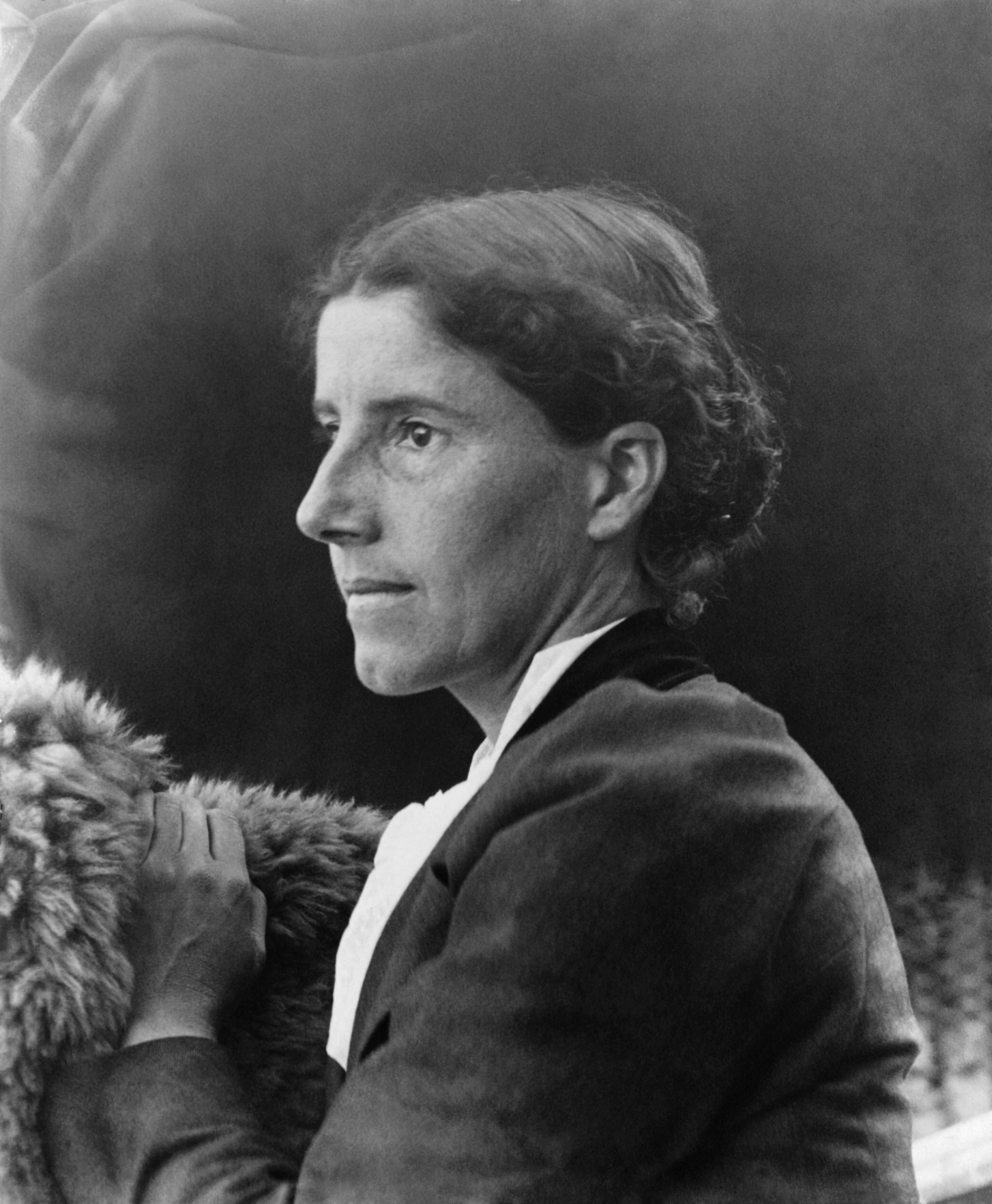
The Importance of Charlotte Perkins Gilman's "Herland"

Photographic portrait of Charlotte Perkins Gilman,
American author, c. 1900. This is a cropped version
of the digital image from the Library of Congress online
collection, as identified below. Copyright has expired on this image.
Source: Wikimedia Commons

Charlotte Perkins Gilman was many things: a writer, a feminist, and at times, fan of eugenics based on her staunch racism. Aside from her failings, Gliman managed to write a groundbreaking novel called Herland that went unnoticed until it gained popularity in the 1970's. First appearing as a serial in 1915, Herland is one of the first works of feminist Utopian fiction.
Three young students set out to explore a legend shared by the locals of the foreign country that they are residing in. The legend is of a hidden community comprised solely of women. Since the three students are also young men, their interest is more than piqued.
All three men have different views on women, ranging from the extreme to the sympathetic. Jeff  is the biologist, and an idolizer of women. The narrator, Van, stays neutral on most every subject as a sociology major. Terry is a geologist, and straddles the line between gentleman and chauvinist pig.
Before they find out that the legend of Herland is indeed true, the three men surmise on what sort of civilization could arise if maintained by only women. Their prejudices and sexist views come to the fore during these discussions; “We mustn’t look to find any sort of order and organization […] Also we mustn’t look for inventions and progress; it’ll be awfully primitive.” (p. 8-9).
The civilization the three men discover is far beyond anything they could have imagined. Herland is a beautiful country, with gardens and forests that are carefully tended to yield the most food (there is no room for crops or cattle in Herland's tiny strip of territory). Men are nowhere to be found. In fact, the arrival of Terry, Jeff, and Van mark the civilization’s first sighting of men in two-thousand years.
Though Herland is not a distant planet, it might as well be for the all the differences Van takes note of in his journal. At first, Van believes his ‘world’ to be more advanced, but as he learns more and more about the women of Herland, he becomes ashamed at the state of his world in comparison to their paradise.
Many notions of femininity come into question in this short novella from Charlotte Perkins Gilman. The women of Herland keep their hair cropped short, wear clothes free of adornment, are intelligent, and work hard doing things that the three men considered only for men. Not every woman is young, giggling, and beautiful: [Van’s perspective]- ‘Woman’ in the abstract is young, and, we assume, charming. […] Most men do think that way, I fancy.” (p. 21). By the end of the story, Van and Jeff come to see that Terry’s view about women is entirely wrong, that indeed all their thoughts about women are entirely based on their society’s perception of gender roles.

Gilman, Perkins, Charlotte. Herland. New York: Pantheon Books, 1979. Print.

Tuesday, October 30, 2012

Mizora: The Secret Society Founded by Women


Mary Bradley's novel, Mizora: A Prophesy, reads like a less publicized and earlier version of Gilman's Herland. It is a country of women located in a hidden pocket of the Earth (the Arctic instead of Africa), discovered by a regular citizen. After that, comparisons between Mizora and Herland are not so easy to come by.
The explorer who stumbles upon Mizora is alone, Russian, and a woman. Through the narrator's perspective, the reader views gender hypocrisy in a new way. The female narrator time and time again cannot understand how a society of women can get along without men, beliefs that were enforced by her own binary culture.
Mizoran women raise their children themselves, like in “When It Changed”, but unlike the communal parenting seen both in Herland and A Princess of Mars. While Mizoran women value their children greatly, the thing they hold to the greatest esteem is education. They believe that when they made education (including college) free for all, many of their social problems solved themselves. For example, the poverty rate is extremely low. Due to an influx of students, more mathematicians and scientists graduated, producing people capable of engineering affordable food, fuel, and most any commodity. A Mizoran educated populace also saw a decline in crime, and by the time the narrator finds Mizora, the most heinous crime committed by a citizen was the striking of their child almost a century before.
While reading Mizora, the parallels between a strictly female society and a peaceful society are argued in detail. Once men are out of the equation, more important societal questions are pursued that aid in harmonizing a populace. One stark trait of the Mizorans is their exaggerated femininity. In Herland, the women are spoken of as being beautiful, but in a more neutral, androgynous way. In Mizora, their delicacy is emphasized. All Mizorans have blond hair, a product of the eugenics practice that was perfected centuries before. Silk, flowing dresses and artfully made up faces are staples among the Mizorans, though in other all-female (or androgynous) populations found in the Left Hand of Darkness and Herland, beauty is a natural part of the citizens, not something artificially constructed through the use of exaggerated clothing and make-up.
          While Bradley sought to undermine gender roles in Mizora, some parts of her novel only reinforce them. The most illuminating part of the novel is when the female narrator is in disbelief over the roles of women in Mizora, and her ideas of a woman’s place (below that of a man’s) as opposed to theirs (women as human beings, not as a separate entity from men). The narrator’s point of view about women is one that is still present today. Plenty of women believe that the station they are currently in, (whether it be mother, daughter, wife, sister) is a station they cannot ascend beyond, and that they in fact should not strive to ascend beyond that station. Men are not the only oppressors of women. As Bradley illustrates, women can be their own worst enemies in the fight for gender equality, especially when women believe that the fight is not a valid one.


Bradley, Mary. Mizora: A Prophesy. New York: G. W. Dillingham, 1890. Print.