Head to the Twinja review blog to check out the cover reveal and giveaway for Daughter of Zeus.
Wednesday, May 21, 2014


Wednesday, April 23, 2014
Soon to be featured on Twinja's Blog for a Cover Reveal!

The super fab gals at Twinja are going to do a cover reveal for my upcoming science fiction novel, Daughter of Zeus.
The reveal will most likely happen on Wednesday May 21st, with the book's release happening on July 7th. Until then, here's a teaser for Daughter of Zeus. Be ready for the cover reveal, which will include a giveaway!
A human battery...
Too bad she didn’t
really know what she was doing. Ada’s powers had recently manifested, and she
was still learning how to use them. Zapping roaches and overriding ATM machines
came to her naturally, like breathing. Powering a car would hopefully come as
naturally.
Ada closed her eyes and took deep breaths,
the kind of deep breaths her mom would be proud of. She imagined her mom on the
brink of one of her many anxiety attacks, and it was hard not to smile: Just doin’ my breathin’ exercises. Deep
breathing worked, brought her out of the panic bubble. In her state of rest,
she reached out with her mind to the dormant engine. She imagined the car alive
with electricity. The car started. Immediately, Ada felt a pull, like an
invisible harness on her chest. The harness was tied to the engine, pulling and
pulling but she wasn’t going anywhere. It hurt being a human power source.
“Route to home.” Ada gasped.
“Routing to home. We will reach your
destination in five minutes.”
Five minutes? She doubted she could withstand another ten
seconds.
Tuesday, April 8, 2014
One of the first (feminist) Utopian stories, "The Book of the City of Ladies"
In The Book of the City of Ladies, Christine
de Pisan imagines she is transported into another world, a world in which women
have rights they never had before. Given the year she penned her story was
1405, some of her ideas of freedom are limited, but they were a step in a much
bigger direction.
Pisan starts her
story by recalling male-penned stories and articles, all with one thing in
common: their negative view of women. As the criticism and outright derision
happens so often, Pisan shares her confusion. Surely, all of the men with their
view on women couldn’t be wrong, especially since men of 1405 were allowed
higher education and women were not, therefore they were considered to be smarter.
A large collection of intelligent men could not be wrong, Pisan believed. It is
only later when Pisan meets the three Ladies (Lady Reason, Lady Rectitude, Lady
Justice) that she rationalizes their
views as wrong, citing details as to why men believe women to be inherently
stupid and immoral (men are jealous, men are blind). One of the Lady’s puts
things into perspective for Pisan through use of comparison. Men believe Eve,
the first woman, was evil and she poisoned the whole of women for every generation
to come. If men believe women to be inherently evil, why is it they also
believe education will corrupt women? How can women be corrupted further if
they are born corrupt? Lady Reason sums it up for Pisan, “Here you can clearly see that not all opinions of men are based
on reason and that these men are wrong” (para. 2).
Other
parts of Pisan’s story tell of inventions and advantages by women, and other
causes of misogyny.
While
Pisan’s allegories strive to understand equality for women, there is still a
patronizing tone to them throughout, almost an echo of the patriarchy still
holding Pisan (and all women) back. She spoke of equality and education for
women, but at the same time, the tone of her writing suggested she could never
imagine a woman not being defined as a “lady” and a man not be defined as a
“gentleman”. In Pisan’s equal world, woman probably would be educated but under
male-supervision, and she could probably not have imagined women carrying out
roles men traditionally held, such as going to war, being doctors, lawyers, and
scientists. Again, in 1405, women had very little rights, and it is arguable
that Pisan’s story was realistic in its outlook.
Monday, February 24, 2014
Women Can Be Strong, Peaceful, and Violent in Sally Gearheart's "The Wanderground"
 |
Through a series
of short stories, Gearheart tells the stories of the Hill Women. The Hill Women
live in serene world, communing with nature at every turn. Their world seems to
have reached the apex of peaceful living, until the reader learns why the women
live in the forests: they are forced to. Men have taken over the cities, and
control every facet of a woman’s life. The women that rebelled fled the cities
and learned to live among the trees and animals. In doing so, they developed
psychic abilities, like “speaking” with animals, astral projection, and
telepathy to name a few.
While the
comparisons between the Hill Women and Gilman’s Herlanders are strong,
Gearheart brings realism to the Hill Women by depicting them in the throes of
irrational, or even violent fits of anger. One thing which seems to be
reiterated in feminist utopian fiction novels is the lack of physical violence in
women, but Gearheart is not afraid to admit her peaceful characters are still
human, and within their range of human emotions, anger can be counted among
them. Russ and Tepper bring similar elements to their female characters in The Female Man and The Shore of Women. In both novels, the female characters are part
of war-less societies, but they are still capable of individual acts of
violence.
Gearheart,
Sally. The Wanderground: Stories of Hill
Women. New York: Alyson Books, 1978. Print.
Picture linked from:
http://www.amazon.com/The-Wanderground-Sally-Miller-Gearhart-ebook/dp/B009XIDI4K
http://www.amazon.com/The-Wanderground-Sally-Miller-Gearhart-ebook/dp/B009XIDI4K
Friday, February 14, 2014
Feminism and Utopian Theory are Nearly Intangible (According to Frances Bartkowski)
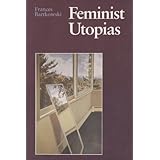 |
| Feminist Utopias by Frances Bartkowski Image linked from: http://www.amazon.com/ Frances-Bartkowski/e/B001IOHA3M |
In so many
utopian analytic texts, the tone is one of a jaded scholar, one who relies heavily in Suvin’s famous science fiction description of “cognitive
estrangement”. Estrangement is surely at the heart of utopian texts, and yet, Frances Bartkowski takes Suvin’s description and
pairs it with a more optimistic view, an echo of Karen Horney’s tone in Feminist Psychology.
Bartkowski’s
definition of utopia is taken from William Morris’s News from Nowhere, as she believes “utopia is anywhere but here and
now. It is alternatively the good place (eutopos) and no place (outopos) […]
which could also be anywhere” (4). Her view of utopia is unique, but succinct.
As the text is
named Feminist Utopias, Bartkowski
delves into feminism: “Feminism has done much to bring together the theoretical
differences and similarities of the struggles among classes and between sexes”
(13). She is leading the reader to her conclusion, her conclusion being that
utopian and feminist theory have deeper ties than most people realize, as
utopian theory strives to better the human condition overall, much like feminism.
Bartkowski goes
further in her comparison, stating utopian theory and feminist theory to be
nearly inseparable, if not identical. What she is really saying is feminist
theory is the ideal (the utopian ideal) as it encompasses many utopian elements
and more in its definition. Of non-feminist utopians, Bartkowski summarizes the
women in the stories, and how the creators of the utopias merely “made a place
for women only to mask oppression while imagining patriarchal utopias” (14). Several
science fiction and utopian writers are mentioned throughout the text, like
Suvin, Russ, Butler, Bloch, Bellamy, and more. The chapters are made up of two
feminist utopian works Bartkowski contrasts, comparisons, and analyzes. She
includes novels such as The Female
Man, Woman on the Edge of Time,
and Herland.
Bartkowski,
Frances. Feminist Utopias. Nebraska:
University of Nebraska Press, 1989. Print.
Wednesday, December 11, 2013
Twinja Book Reviews!
Ever notice how novels often leave out the multicultural side of life (particularly those in the fantasy and sf genre)? The gals at Twinja Book Reviews have noticed as well. The twin sisters have a site dedicated to featuring books with multicultural characters. I'm proud to say Cursed was reviewed by Twinja earlier this year.
Check out the book giveaway for Cursed featured on the Twinja Review website. There are 18 days left to enter and win either a paperback or e-copy.
On 12/12/13, I'll be featured on the Twinja site with a Q&A!
Sunday, November 10, 2013
What's in a Name? A Summary of LeGuin's short, "She Unnames Them"
In this powerful short story by LeGuin, the lead character is never
named, but it is inferred that it is Eve, as in Adam and Eve of the Garden. Eve
narrates the story, telling of how she convinced the animals that names are
unimportant. One by one, the animals agree to let go of their names, though the
Yaks have trouble with this concept. The female Yaks hold a council, deciding
to let their names go, and after awhile, the male Yaks agree.
Pets, specifically dogs and parrots, take great issue in letting go of
their names. As pets are closer to man than wild animals, it is understandable
that they would have a harder time in letting go of their identifiers. Yet, Eve
makes the pets understand that they can hold onto their capitalized names, like
Froo Froo, if only they let go of their generic monikers, like dog or parrot,
and so the pets too shed their names.
Among each other, nameless and free, Eve feels a closeness with the
animals of the garden that she has never felt before: “They seemed far
closer than when their names had stood between myself and them like a clear barrier: so
close that my fear of them and their fear of me became one same fear.” The
giving back of names (“loss of names” would hold the wrong connotation) by the
animals makes them equal to Eve, but she realizes that she is the last being in
the garden with a name, and it is not fair of her to hold on to her name when
she asked all the animals to give theirs back.
Eve goes to Adam
to tell him that she is giving back the name bestowed by “you and your father
[…] It's been really useful, but it doesn't exactly seem to fit very well
lately. But thanks very much! It's really been very useful." Though Eve’s
actions are revelatory, Adam does not care. He is described as working on
something, putting parts together, and overall he is only half-listening to
what Eve is telling him. The reader (and Eve) know that Adam does not
understand the import of what she has done by forgoing her name when he asks
the stereotypical patriarchal question: “When’s dinner?”
Names can have
power, and that power can be a divisive one, or at least that is what LeGuin insinuates
with her short story. The binary names humans give to gender (man, woman), the
names humans give to animals, or to objects, those are ways that humans seek to
control what is around them, not to give meaning, but to separate themselves
from nature, to say “I am better than you. I have control over you, and with
that control, I will name you and distance you from me”. Eve, like other women
in sf stories, does the opposite by placing herself in nature and making
herself an equal part of nature. Again, the motif of a loss of identity is
explored in this story, and again the author clearly states that one can be an
individual while at the same time surrendering themselves to the communal way
of living. It is an idea that humans struggle with, because humans only know
individuality in the form that it has been handed to us for generations: it
comes with separation from others, in the form of gender, class, or racial
individual names and personalities.
With Adam’s
response, and his lack of interest, LeGuin is stating that men may not be ready
to be a part of nature. To be equal with women, and then to be equal with
nature, is something men may not conceive of just yet.
Subscribe to:
Posts (Atom)
