|
"The Vampire"
By Phillip Burne-Jones (1897)
Source: Wikimedia Commons |
Every novel is a chance to explore a new world. Anne Rice brought us to the “realistic” life of the vampire with her novel Interview with the Vampire. Dan Brown made history cool again with The DaVinci Code. Part of what makes those books so memorable are the characters. An entire book told from an interview perspective would have gotten old quickly had Louis not been so sensitive and articulate, had Lestat not been so diabolically charming. And only Robert Langdon could solve academic mysteries a la Indiana Jones style while keeping the reader interested. Plot, setting, and pacing are certainly important assets for any good novel. However, a remarkable character can be the difference between a memorable novel and a book that is easy to put down.
In the literary world, character theory is always mentioned in passing. Character theory has been left largely unexplored. There are many reasons as to why, starting with how characters resemble human beings, and it is hard to condense a human being into word form. Closely examining a character can be just as difficult; difficult but not impossible. Throughout this paper, two questions will be explored: what are the prevalent aspects concerning character theory, and what makes characterization important in a novel? Stephen King novels and his methodology concerning characterization will be used as a basis of comparison.
Character theory involves a myriad of factors, beginning with the different types of characters.
Types of Characters
At its base definition, a character is the portrayal of a human in a fictitious work of art. The role played by the character indicates who they are to the reader, and the characters is further defined by their role.
According to author Christina Myers-Shaffer, there are seven common roles found in literature: hero, superhero,anti-hero, villain, protagonist, and antagonist. Sometimes a character can encompass more than one role, and Bill Denborough from King's IT is one such character. Bill is the main hero in IT, but in combination with his psychic abilities and childhood stutter, he is also a superhero and an anti-hero. It is this very complexity that leads to the categorization of character roles. For example, Bill is not just a hero, he is a round character as well. A round character cannot be easily defined and cannot be contained by one role, whereas a flat character can be "summed up in one sentence," (Forster 224). Stock characters are expected to be found in a particular story, such as fairy tales featuring swooning princesses and evil witches. Type characters represent an entire class or group of people. Stereo types are the last subset of characters and they are predictable in their actions that are usually derived from cultural assumptions. Of all the characters sub-sets, flat and round are the most fascinating, thanks to E.M Forster's critique.
 |
"Clown"
By Graeme Maclean (2005)
Source: Originally uploaded from
Flickr to Wikimedia Commons |
E.M. Forster was an author and literary critic. In his book Aspects of the Novel, he actually coins the literary terms 'flat' and 'round' characters. While many writers hope to evade flat characters, Forster makes the case that flat characters can lend an advantage to storytelling in two ways: they are easily recognized and easily remembered, (227). Forster is aware that in life human beings can rarely be summarized in one sentence, but he contends that in novels, they can and should be. Books can be overcome by a cast of strictly round characters because then there would be no room for anything else. Flat characters help to move the story along, like Mr. Nell in IT. He is an Irish policeman concerned with the dam built by the children that is flooding the town, and that is all he is. Even so, he is the necessary catalyst that shifts the children's focus from dam-buidling to taking down the monster, Pennywise. Everyday, there are people like Mr. Nell who come in and out of the picture suddenly, but their impact on a life can be profound. Forster says something similar of literature, "A novel that is at all complex often requires flat people as well as round, and the outcome of their collisions parallel life [...] accurately," (227).
Classifying a character type can become formulated, but the art of character creation is a bit more subtle.
How to Create a Character
Deciding factors in a character's development can stem from environmental or cultural influences. Myers-Shaffer reports that there are four elements used to shape a character: attitude, emotional state, response mechanisms, and intrinsic values, (175). By attitude, Myers-Shaffer means the way a character carries themselves. Emotional state is the intense responses felt by a character. A response mechanism is the way in which a character deals with situations. And finally, intrinsic values are the layers (or lack of) morals inherent to the character's personality. Cohesively, those four elements can be used to create a character, but there are other unconventional methods to characterization.
 |
"Passengers Waiting in Line..."
By Jim Pickerell (1936)
Source: Wikimedia Commons |
To make a new character, it isn't necessary to adhere to a list of literary elements. Character creation can be as easy as considering the klutz of the office, or a friend's over-the-top mother. Either one of those people can form the base of a realistic character. A conversation overheard at the store or waiting in line at the bank could prove useful in character development as well. If a book can mimic real life, why not use everyday people and conversations to make new characters? Ideas like these are taken from Orson Scott-Card's book Characters and Viewpoint. Scott-Card notes that "what seems ordinary to you will seem strange to someone else" (162). Perspective is the key; Scott-Card is saying that no one leads an ordinary life, therefore a writer needs only to look around for potential characterization material. Of course, the method in which a character's details are presented is essential to preserving their validity to the reader. Character details can overlap with motivation, another character creation tool.
Motivation is an underrated part of character theory. Authors worry about the character's appearance, dialogue, actions, and that is when motivation can get lost, (Janeczko 9). Yet, motivation is useful in explaining character actions, background, and foreshadowing their possible future.
Why is a character mean/nice, smart/stupid, or a hero/villain? What drives them to the point that they are at now in the story? Past human interactions and situations can be used later in character development. For example, in King's fantasy novel The Gunslinger, anti-hero Roland Deschain's short-term goal is to pursue the man in black, and there are reasons why he wants to catch the man in black: Roland believes that the man in black holds the answers to finding the Dark Tower, which is Roland’s main goal in The Dark Tower series. Roland later believes the man in black may have been the person responsible for bringing about the end of his kingdom. These reasons help to shape Roland's personality, and they give insight to the reader on what actions he might next decide upon. Scott-Card warns that character motivation should not be overlooked because then the reader settles on their own idea of motive, usually an archetype or cliche, (106).
An additional character creation method is to dissect characters from other novels. If a character like Roland can be taken apart for examination, his traits could help clarify for the reader what type of protagonist he resembles and why.
 |
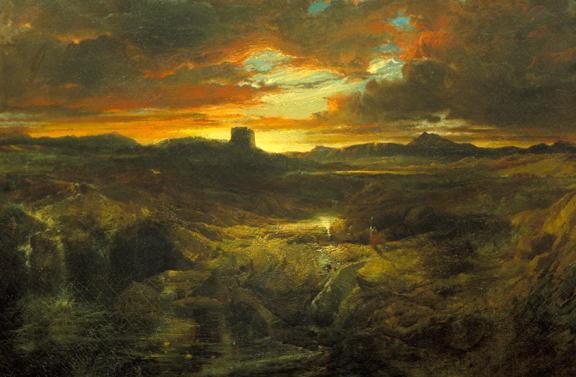
"Childe Rowland to the Dark Tower Came"
By Thomas Moran (1859)
Source: Wikimedia Commons |
It helps to begin by listing the characters distinguishing traits. A few words that could be used to describe Roland would be: powerful, relentless, cold, kind, focused. By Myers-Shaffer's standards, Roland possesses a mixture of positive and negative traits, thus he can be defined as an anti-hero. Like Bill Denborough, Roland fits the category of superhero, because he is trained in the sacred art of the Gunslinger, a talent that imbues the person with unnatural dexterity, speed, and precision while shooting a firearm. Character dissection can serve as concrete evidence of a character's persona.
Apart from types of characters and character creation, there is another vital feature to character theory, and that is the function of major and minor characters.
Major and Minor Characters
“Not all characters are created equal,” (Scott-Card 59).
A novel is a narrative that can feature one central character, or a cast of several central and surrounding characters. Central characters are also known as major characters, with the less marginal characters being dubbed minor characters. Despite the connotations of the names major and minor, the labels themselves do not dictate a character’s importance to the story, or their place in it.
In his book, The One Vs. the Many: Minor Character's and the Space of the Protagonist in a Novel, author Alex Woloch describes the relationship between major and minor characters through comparison from Homer’s the Iliad: “The Iliad is about one life and many […] this arrangement of characters is structured around the relationship between one central individual who dominates the story and a host of subordinate figures who jostle for, and within, the limited space that remains,” (2).
Woloch also speaks about the dilemma an author comes across when a major character must withdraw from the story for a period of time. How can a story progress? Woloch’s answer is that secondary characters then become essential in reflecting the conflict of the story from their point of view, (3).
Minor characters differ in degrees of importance, from secondary to background. Secondary characters complement the major characters and are distinct because they can speak, emotes, and act out in ways that make the reader care for them. A background character is just the opposite, with his development being stunted. Background characters merit a quick mention, such as “The men arrived”, “My sisters laughed”, or “The people watched”. Background characters are a necessary element to a story because they instill a sense of reality; their presence shapes not just a story, but an entire world. Scott-Card advises that when creating background characters, a writer should remember that there are people in the story who must be there, who might be there, and who have been there, (34-35).
The idea of the major and minor character can seem redundant after discussing round and flat characters. It is an assumption that they are one and the same. However, that is not true, since a major character is capable of being flat, and a minor character is capable of being round.
 |
"Oliver Twist"
By James Mahoney (1898)
Source: Wikimedia Commons |
Dickens is an author who is accused of using flat characters as his constant in every book. Major characters from any Dickens novel manage to capture a reader’s interest and hold it. Yet, that is not due to the character’s depth; “Probably the immense vitality of Dickens causes his characters to vibrate a little, so that they borrow his life and appear to lead one of their own,” (Forster 227). Consider Oliver Twist’s character: his is innocent, naive, and trusting. Twist shares the traits of many fairy tale protagonist, and like a fairy tale, Oliver Twist gets his happily ever after. There is little to learn from Twist as a character that they reader has not already seen in other hero-types. Nevertheless, Twist is the major character in Oliver Twist.
An exemplary minor character that exhibits round attributes would be Allie from The Gunslinger. At first, she is merely a bartender, made noticeable by the scars on her face. Roland Deschain notes that, “if she had been pretty once, it had moved on long ago” (King 34). Allie starts to emerge as a minor character of greater significance after she tells Roland that she cannot rid her mind of the thought of asking a dead bar patron (brought back to life by the man in black’s magic) about the afterlife. She knows the answers wrought from the dead man would drive her insane, but she wants to know them anyway. She exercises restraint, until she gives in to the madness, at which point she begs Roland to kill her. From King’s initial description of Allie, the reader assumes she is a mean, ugly woman only meant to serve Roland a beer and then move on. Allie becomes more than the reader could have presumed upon, and through her interactions with the major character, Roland, the reader sees that Roland is not made of stone. Allie humanizes Roland, and she lends her own depth to glorify his at the moment of her death by his hand.
Stephen King is known for creating memorable characters, whether they be major or minor in magnitude. He has created an intricate network of literary characters that can interact with one another through different novels. By doing this, King has made what some of his fans refer to as “The King Universe”.
The King Universe
 |
"Stephen King at 2007's Comicon"
By Pinguino
Source: Originally from Flickr,
uploaded to Wikimedia Commons |
On Writing is King's semi-autobiographical account of his life as a writer and his tips on how to become a good writer. Briefly, King outlines his approach to characterization: "The situation comes first. The characters- always flat and unfeatured to begin with- come next. [While narrating] I have an idea of what the outcome may be, but I have never demanded of a set of characters that they do things my way. On the contrary, I want them to do things their way," (165). King gives his characters free reign in a story, allowing them to make the story their own through their actions and words. Characters even break free from one book to show up in another.
In most every novel written by King, there is a mention or interaction with characters from previous novels. There could be a reason as to why King does this: it is fun for him and/or he wants to solidify the world his characters reside in to his audience. Scott-Card is a like-minded author that feels “the characters in your fiction are people. Human beings,” (6). It would then make sense to a reader why characters form different novels could be aware of one another, since human beings are also aware of one another, regardless of a separation of distance or words. King runs with this idea, and here are some examples of character links:
Salem's Lot-The Dark Tower: The Wolves of Calla
Father Donald Callahan disappears in Salem's Lot (and presumed dead), only to appear in Wolves of Calla.
Eyes of the Dragon-The Stand
Randall Flagg appears in both books in some form as an antagonist.
The Regulators-Desperation-The Dark Tower Series
Tak is the main antagonist in both Desperation and The Regulators, and he is also mentioned in The Dark
Tower series as a mischievous spirit.
The Regulators-Desperation
Both books feature the exact same array of characters, juxtaposed in an alternate dimension.
The Dark Tower series has numerous character links to other books, as characters are 'pulled' out from books (like Father from Salem's Lot) and put into the story of The Dark Tower. Another prominent character connection is the one between Dolores of Dolores Claiborne, and Jessie Burlingame of Gerald's Game. At the same moment in time, though they are separated by miles, both women experience a psychic connection with each other that occurs during the solar eclipse that is paramount to each novel. It is implied that either the power of their mutual suffering or the power of the solar eclipse enabled them to share minds for a fleeting moment.
King doesn't only connect characters to emphasize the size of his universe. He also sets stories in the same towns, making sure to include landmarks, places, and other things. Derry and Castle Rock are two cities in Maine that receive plenty of attention in King's World. There are websites dedicated to the Derry Connection. Castle Rock is the setting or somehow mentioned in these novels: The Dead Zone, Cujo, The Body, Needful Things, Under the Dome, and Lisey's Story.
Small details perpetuate the realism of the King Universe, such as Desperation's Ellie Carver reading the Misery Chastain novels, the various mentions of Shawshank Prison, The Inside View (a tabloid referenced in Desperation and The Dead Zone). The list of King connections could fill an entire book, and in fact, they do. Stephen Spegnasi crafted The Complete Stephen King Encyclopedia, a book that can be described as thicker than a telephone book in length. Spegnasi realized the potentially long list of links that complete the King Universe. There are plenty of other undocumented links to be found and taken note of, tenuous as they may be.
King's Universe of novels is alluring both for the story and the world they immerse the reader in. From book to book, King's world is a palpable, breathing entity, made even more real by the characters he chooses to create that drive his stories.
Conclusion
Character theory is a vast territory to explore. The fundamentals underlining character theory are types of characters, character creation tools, and minor and major character analysis. Real people and motivation can develop characters in new ways, and help a story reach its potential. Characters are the bread and butter of any novel. It is a character's humanity that keeps the reader coming back. Unfortunately, a full understanding of character theory is difficult to grasp because of a character's realism. As Scott-Card said, a character is a human being.
Works Cited
Card, Orson. Elements of Fiction Writing: Characters & Viewpoint. New York: Writers Digest
Books. 1999. Print.
Janeczko, Paul. “In Their Own Words: An Interview with Stephen King”. The English Journal
69.2 (1980): 9-10. JSTOR. 6 October 2011.
King, Stephen. Dolores Claiborne. . New York. Signet Publishing. 1993. Print.
---. Gerald’s Game. New York. Signet Publishing. 1993. Print.
---. The Gunslinger: The Dark Tower 1. New York: Viking Press. 2003. Print.
---. IT. New York: Signet Publishing. 1980. Print.
---. On Writing. New York: Signet Publishing, 2000. Print.
Meyer-Schaffer, Christina. Principles of Literature, The: A Guide for Readers and Writers.
Barron’s Educational Series. 2000. Print.
Stevick, Phillip. The Theory of the Novel. New York: The Free Press, 1967. Print.
Woloch, Alex. The One vs. the Many: Minor Characters and the Space of the Protagonist in
the Novel. Princeton University Press. 2003. Print.