Tuesday, December 12, 2017

Guest Post by Jeremy Raynolds - 5 Main Problems Writers Face When Starting

Being a writer is comparable to the work of a painter in terms of designing a special universe in which the audience is able to lose itself. Creative people appear to be wizards because they form grotesque stories out of nothing. Still, they are human beings who have their own baggage of puzzles, resulting in grievances or thoughts holding one down from doing the job: writing. In fact, authors often struggle with the concept of an idle page, with the construct of story writing format, and failure to love their own art. However, all writers experience similar feelings.


Today, we are going to lift the veil on ‘how to write a story’, along with the major challenges arising during the process of creating.

Writer's Block
Unfortunately, this problem is the most common to creative people, especially writers. At the same time, it’s normal, as you cannot simply have your inspiration overflowing all the time. So, you wake up, day by day, with no creative ideas, and all you want is to push this aside and write, but you can't. You feel totally crushed, and certainly, not in the mood for constructing any valuable content. Such writer's block can be very risky, especially if this emotional state persists. Frequently, such trouble occurs when you are sitting still. To fight this, engage in sport activities. Make sure you are getting enough workouts; it will not only make you strong, but also set your mind in the right direction. Walk outside, meet with friends, and have fun. You will be surprised at how productive you are at the end of the day, and creative writing ideas will come naturally.

The absence of thoughts
You might be assured that you are skilled enough, but still be out of plan or writing ideas, because writing a story is much harder than writing an essay. No worries, it’s a regular thing among contributors, and the good news here is that there is always a solution.

Creative writing is based on two points: observation and reading.  Admire sights around you, be it trees or any other part of nature. Read and discover everything that comes your way. Reading is an elixir to the poverty of sense.

Being timid and doubtless
These are the main problems which may afflict a novelist. No matter how much experience you have or how valuable your skills , you cannot move on until your confidence with the subject builds. Removing doubt is not only about being aware, it is also about being prepared to claim your own worth.

In case you cannot quiet the crippling voice of disbelief inside, another thing to remember is to find a person who will understand and support you. This individual will help you accept yourself and think big. Also, and this is important...join writing groups or writing courses to get acquainted with someone who can be your ‘champion’ and, in turn, can champion you.

A so-called ‘perfect style of everything’
Everything starts before you take a pen or press a button on a keyboard. You try to draw an ideal picture in your imagination, and you never find it possible to transfer the right meaning. It is all about perfectionism, and the whole nine yards. Many people have a battle with the peculiarities of perfectionism, and this is why a short story may take two months to write. The reason for such procrastination is that the artist prefers not to release anything to the audience until it's fully edited and "perfect", and sometimes, this can be our undoing. Do not be afraid to free write, and then improve upon it later. You'll be amazed at how much writing you get done.

Fear of rejection
It is the consequence of being criticized by the society or even your followers. You might be overwhelmed by the emotional breakdown. The first step is to realize that it is just a feeling, not a reality. Surround yourself with devoted friends who can help you build fortitude and work on reconstructing your self-assurance.


In fact, there are no perfect “fit-all” story writing tips. There is only self-confidence, getting things done, and being focused. The key to getting more done is to concentrate.

_________________________________________________________________________________

Contact Jeremy Raynolds at jeremyrray89@gmail.com

Wednesday, December 2, 2015

Finally here!


After numerous rounds of editing and months of waiting, Daughter of Zeus is now available for pre-orders on the Champagne Book Group website.
Daughter Of Zeus

Synopsis:


    The future can be a terrifying prospect, especially when Ada Freyr discovers she can manipulate electricity. Ada is grief-stricken when her abilities result in the death of her husband. and terrified of being discovered by the Prominent-run State. Unusual citizens are labeled Undesirable, and are never seen again.
    Ada drives to Atlanta, intent on finding her father. She blames everything that’s happened on him, and vows to kill him for ruining her life. However, once Ada meets her father, she realizes he’s no longer the alcoholic she remembers: he’s now a Congressman with a family and a new name, ready for a Senator’s seat.
    Ada’s scheme lands her on the Undesirable list, leads a stranger to stalk her, and stunts her relationship with her siblings. Soon, she has to decide which is more important: a vendetta, or forgiveness.

Join the giveaway below for a chance to win an e-copy and a $15 Amazon giftcard!


Saturday, August 22, 2015

Parmasad- One Brave Little Cookie and SPN’s for Everyone!

While reading Parmasad, I thought about tone and voice. Many of the students I tutor value what they call "objective writing", and many pride themselves on the ability to write for a nameless audience. I tell these same students that even though it's academic writing, it's still writing, and writing should never be boring (a.k.a. voiceless). Good intentions aside, writing to the god of the nameless usually leads to a nameless tone in the writing, and there's no "there" there.
In writing a scholarly personal narrative (or a SPN), one injects personal experience into a larger academic conversation. Thus, to "signify" in a SPN, a writer need not adhere to an autobiographical format, because focusing on specific moments in time as they relate to bigger issues can be just as impactful, (Nash 30). Parmasad displays the effectiveness of SPNs when writing of the cultural disconnect she experienced while growing up as an Indian in Trinidad. Putting moments of her life under the microscope, Parmasad analyzes the importance of writing: "this remarkable exclusion, this invisibility, this feeling of voicelessness filled me with a maddening need to use my writing not as a shield but as a weapon to contest the historical marginalization of a whole people and the negation of my experiences" (135). From her viewpoint, writing is a tool to challenge the cultural limits and bring others to a higher level of understanding. 
In my estimation, an SPN is essential to academia because a properly executed SPN will delve into the "raw marrow" of the writer's life, while bringing the validity of the experience to the forefront of a larger framework, (Nash 26). Developing confidence in writing often goes hand in hand with constructing a narrative, as writers glean key concepts after a re-telling of their experiences. Writing narratives can never be counterproductive, as I'm of the mindset that every high school student should write an SPN, and then again as an undergrad, and then again times again. Much like Nash's idolization of Kimble, the fugitive who reinvents his story in weekly episodic arcs, all writers should endeavor to find their ever-evolving voice to establish meaning (34-35).
Art can be lost if it cannot be understood. An important aspect in writing involves connections and how they're made. To sustain a connection, the language must be effective, and what better use of language as a learning tool utilizing your own voice? As an undergrad, many students are required to write a narrative essay, with no research or larger connection necessary. In contrast, writing an SPN is similar to cutting out a part of oneself, laying it across a table, and magnifying the meaning to fit a larger context. Both types of writing have a purpose, but at differing points in an academic career, an SPN is more purposeful. In fact, several drafts into either, new voice and meaning can be found..
Works Cited

Nash, J, Robert. "What is scholarly personal narrative writing?" Liberating Scholarly Writing. New York: Teachers College Press, 2004. Web. 

Sunday, July 19, 2015

A Red and Gray Giveaway

If you enjoy free books like I do, you have the chance to win a copy of A Gray Life, now through July 25th.

The giveaway is featured on , so click here to activate the good luck monkeys!

As an added bonus, I'm giving away three e-copies of A Gray Life from my blog. To enter, all you have to do is email me or comment below. Tell me about the first book you read and why it was special to you. 

The first chapter book I read was from The Babysitter Club series. I can't remember the exact book, but I can remember the static joy that came after. When I finished the last page, I jumped up from the couch and grabbed my mom, full of the largest sense of accomplishment my 2nd grade self had ever held.

Good luck, readers!

Monday, May 18, 2015

New Blogger and Book Reviewer: Cassie Sparks!


It's an understatement to say the Internet is littered with bloggers and book reviewers, especially when the sentiment is coming from a blogger! However, blogger Cassie Sparks is different from the rest of the herd because of a few things:

1. She doesn't charge for reviews or promotions.

2. She's open to reviewing most genres, except for Westerns (sorry, Westerns).

3. Her response-time is quick (for the time being until she becomes too popular for her own good!)

4. She supports indie authors. 

From her mouth:

I am a full-time mom of boys, nursing student, and professional reader/reviewer. I love to read anything and everything but usually shy away from westerns. I love helping out authors, especially up and coming authors. Feel free to contact me for reviews. I will let you know a general timeline on when to expect my review. I will post reviews here, goodreads, amazon, smashwords, and audible if an audiobook.

Read about her review and promtional policies on her website.


Thursday, April 23, 2015

Free Copy of A Gray Life from Amazon


On April 24th-25th, A Gray Life will be available on Amazon for free!

Download a copy to your respective devices, and then look out for a giveaway and fanfic contest soon after...!

Saturday, April 11, 2015

The Ugly Truth About Micro Loans


Micro loans. They're presented as a benevolent force, especially the NGO's operating in Bangladesh. Most forms of capital, i.e. loans, have been traditionally denied to the poor, who had no collateral to offer. However,  micro loans in Bangladesh are offered without the expectation of collateral, barring the strategic use of honor and shame. 

According to Lamia (1998), honor and shame already play a heavy role in Bangladesh society, beginning with women. Honor is an exemplarary asset to wield in rural Bangladesh, and can be measured and lost by how honorable a woman behaves. Even as micro loans are offered to women,  Lamia (1998)concludes that over 90% of the loans are used by the men of the household. Therefore, the practice of lending money to rural women under the pretense of economic freedom seems a bit misleading, further complicated by the issue of shame.

As theorized by Spradley & McCurdy (2009), philanthropic efforts and/or gifts, usually come with unseen strings attached. With micro loans, the unseen string is shame. To lose face, or experience shame, in Bangladesh is something a family might not recover from. Since women are the extensions of family honor, and therefore shame, when the loans are not paid on time, shame is a powerful instrument used by NGO's to secure a return on their investment.  Lamia (1998) goes into detail about how women are shamed into paying back their debt: spitting on them as they go by, pulling their hair, hitting, cursing them publicly.  Lamia (1998) suggests that the 98% repayment of micro loans can be viewed in a whole new way when shaming is considered.

Overall, micro loans in Bangladesh have positives and negatives,  but mostly negatives.  One positive thing about the micro loans would be the 50-60% interest, compared to that of rural loans, which can inflate to 120% interest (Lamia, 1998). Many negatives attached to micro loans stem from the revolving sides of honor and shame.  If not for those two societal elements already present in the society of Bangladesh, the high success rate in repayments would probably be a lot lower than it is. 

Read more about micro loans here.

Or

Watch the documentary Women's Bank of Bangladesh.

Thursday, November 6, 2014

Two Exciting Developments

Recently, Obsolution was selected as one of four Honorable Mentions for both the 2014 Diverse Writers and Diverse Worlds Grants.
Obsolution

The jurors said of the story:

We enjoyed your piece very much. One of our jurors said, "Engaging and addictive. I didn't want to stop reading."

Read Obsolution for free via the Wattpad website, or by downloading the Wattpad app to your phone (works much like Amazon's Kindle app, and thousands of free books are offered).

Also, today I received the link to a 4/5 star review of A Gray Life from Horror Cult Films (HCF) UK (read it here: http://horrorcultfilms.co.uk/2014/11/a-gray-life-by-red-harvey-book-revew/). 

A Gray Life [SAMPLE of Published Book]
Not only that, but HCF editor Stephanie Andrusjak expressed a positive response to my work, and suggested I query Tor. I've queried many a publishing house, but I've yet to try Tor. Today is as good a day as any for a fresh query...!

All in all, a good day :D

Thursday, August 21, 2014

Guest Blog Post: Diverse Book Tours!

Whether we all know it, diverse books are all around us. Many of us have been saying it for years. Some have only started to notice. There are authors and/or books who've been present for decades, and there are books and authors who make waves for themselves in our present.
When and however you've come to the conclusion, you've noticed that lack of representation in books is evident. The lack of people of color, the lack of characters whom are queer or with disabilities. It's disturbing just how little books with main characters who aren't white, able bodied, cis-gendered and/or queer are released in comparison to those that are not.
What's more disturbing is the lack of marketing books that highlight diversity in a positive light. Granted, marketing does not by any means guarantee sales. For the most part, no miracle amount of promotion can "guarantee" to generate sales. But often, authors of color, and authors who write diversely, do not receive strong marketing.
Authors who write any book can tell you, publishing companies nowadays expect a bit of marketing from the author themselves. But when a diverse book fails to generate sales, it's often blamed that it's because it's a diverse book.
We don't just need diverse books. We need smarter campaigns and marketing plans for diverse books as well.
Diverse Book Tours was founded by Sasha Beatty, book blogger of So Bookishly. She approached book bloggers interested in promoting diversity in books, and with everything we've learned book blogging about diversity on our blog Twinja Book Reviews, we were practically shoe-in's to be co-founders. 
We all have different experiences and ideas on why we came to the conclusion there needed to be a virtual blog tour company.
From the words of Libertad: That trip to the bookstore and the dangers of "othering"
It's always an interesting trip to the bookstore near my house. I just happen to live directly downtown in the smack of the Yale area in Connecticut. Sure there's a Starbucks at every corner, restaurants of different ethnicities in walking distance, and I don't think I could go six seconds without seeing someone who is not the same race as me as I journey to the Yale bookstore to scope out new releases.
I love looking at books. I love admiring interesting covers, reading blurbs, and checking out the tables with the new releases.
But there's just one discrepancy. Much of the time I check out books, I walk away more frustrated than I started. Sometimes I'll see eight books with the same cover or blurb. Cute, virginal, Mary-sue archetype, in a pretty flowing dress, who just happens to be white, straight, cis-gendered and for the most part able bodied. I can't assume she is nuero typical, as it is a disability you cant see. But all I see are girls in pretty dresses. Women is a great start, but women should not just be a definition for white.
Books at major and indie bookstores sell more books when a cover is facing forward, but it takes more space to turn them this way, and books with main characters of color are often the ones they omit from the selling floor.
How are we supposed to know that books with diversity on the cover can sell, when they're not allowed the opportunities to do so?
Diversity shouldn't be something that has to be hidden. It should not have to be backdropped to push along the story of a main character whom is a "default."
Representation shouldn't just matter to those who are not being represented. It is a necessity that should be in books. It should be a necessity in life, but books are a great way to start. It doesn't surprise me that many do not see it as an issue, but representation should exist to eradicate this idea of "Othering", or an idea, that anyone different from you is an "other" and therefore not normal.
This is an idea we have to challenge. But we first need to realize there is a problem in the first place about the lack of marketing for diverse books.
From the words from Guinevere: Sales is great, but awareness is better
I'll be upfront. My words will be the most boring out of the three, but it'll be the most obtuse. They may be words that don't effect you now, but when you give yourself time with them, you'll make your opinion of them yourself.
When was the last time you saw a Science Fiction author of color interviewed on television? When was the last time you saw an fantasy author with a disability on television? How many queer/Quiltbag stories make your to-read lists? When was the last time you read a character with a religion different from your own?
Hopefully your answer was similar or in the realms of my own answer: Yesterday. If it wasn't, well....when was the last time you consciously thought "have I read a narrative that I related to, that wasn't exactly the same as my own?"
For people with disabilities, it's nearly all the time. For people of color, it may be on the fence. People who identify with being queer, it's probably more times than you read your own narrative. The issue with this is, for the most part, people who come from marginalized groups have been reading and relating outside there own narratives for years, if not all their lives.
I myself, had never read a novel from the perspective of an Afro-Latina until last year. I turned 29 a week ago. You do the math. But somehow in 28 years, I managed to always enjoy reading. My head never exploded because a character wasn't Afro-Cuban. Ultimately, it was rather damaging to have no Afro-Latino role models in books looking back. But I found I didn't lack representation as far as my race went, as the 90's was much kinder to black women than it's ever been.
At the risk at sounding sarcastic, eyes don't bleed when you diversify the narrative you read from. But ideas might change. Your critical thinking might. Your ability to connect with people might. And by golly gee, you just might learn it reflects the world you already live in.
It's not enough to want diversity in books. It should be a need, a necessity, a given. But books are no where without leg work. Without word of mouth. Without reviews. Without those willing to promote them. Without those willing to read them. You have to be willing to tell EVERYONE. And when you've told everyone, you have to be willing to tell them again.
Promoting diverse books is more than just sales. Sales are great. Sales are amazing. But ultimately nothing can guarantee sales, not even a book tour company. But awareness is. Awareness is more than just sales. Awareness is knowing that these books exist. Where to find them. Where and how to purchase them. Who's read and loved them. Who's read and disliked them. Books can't move if people arent aware of them.
Our audience is small, but we also have an audience who would be most likely to be open to a diverse book. There are plenty of marketing options out there. Ones who've been around longer, and may promise more than we can. But there are little to no options specifically for those who write diversely. That needs to change.
From the words from Sasha: Why I started Diverse Book Tours
All around the world, people are looking to read books that are a breath of fresh air, that are unique, and that include characters who have a different perspective and background than readers themselves. If the #WeNeedDiverseBooks campaign is any indication whatsoever, then we’re well on our way. However, it’s sometimes difficult for readers to find these books in the first place.
I started Diverse Book Tours because I wanted to not only promote the types of books that I seek out and love, but because I want to help facilitate connecting readers with these diverse books and authors in a fun, engaging way. I also wanted to help authors reach a wider audience online so that they can gain an online presence and receive recognition for the hard work they do writing diversity. With the help of my awesome team and partners, and the wonderful bloggers who have signed on to read, review, and promote these books, I’m hoping that we’ll be able to show the book community that diverse books are amazing, are exciting, and are here to stay!
We're also offering tons of prizes for the launch of our tour company for those who sign up as Tour Hosts!

Wednesday, August 20, 2014

Up and Coming Writer: Jeff Martin

Find Jeff Martin on his blog: The Oak Wheel

Jeff Martin contacted me via Twitter, and was kind enough to offer me a guest spot on his blog, The Oak Wheel. Not only a spot. The spot. As in the first spot for a guest author! I'm flattered Jeff wanted to feature me at all, and grateful for the responses his website has generated for my writing.

Now, it's my turn to pay it forward and tell you more about Jeff!

The tag on Jeff's blog describes it as:  Poetry, short stories, the musings of a druid, guest authors and more!

His blog is as varied as he promises, with thoughtful entries like:

Writing Saved My Life

It’s a lofty title, one that I doubt my prose will live up to. Nevertheless, it is a truth, a simple pillar that constitutes the backbone of my existence.
I have always been a storyteller. Ever since I called 9-11 when my grandmother was napping as a kindergartner to tell them that someone had broken into the house, I have been weaving tales in one way or another. Sometimes I have been admonished for telling them, as I was by the slightly amused but mostly annoyed emergency responder that found me hiding behind my grandfather’s rocking chair. For the most part, though, I receive indifference; occasionally, I am given encouragement.
It has recently dawned upon me that praise or a lack thereof has nothing to do with why I tell stories. I tell stories because, if I do not tell them, I become consumed by them. This fact did not become clear to me until months after I suffered a seizure in April of this year.
From what I remember, it was a beautiful day. My wife, son and I had just got back from a trip to the coastal enclave of Fort Bragg in northern California where we visited my mother for the weekend. It was as relaxing as a vacation can be for a (then) practicing alcoholic. The bed and breakfast we stayed in was quaint although the bed was a bit small for the three of us; the restaurants we visited served top-shelf whiskey and knew what I meant when I ordered a shot ‘neat’. We got back to our home in Sonoma County and decided to have lunch at a small Mexican restaurant in our hometown. Life was good. (more on The Oak Wheel)

Or poetry entries like:
Enveloping

The mists around me were
Enveloping
Just like a cloak
I shivered involuntarily
But stayed the course.
There was nothing that could
Deter me now
Or scare me. How I
Got here, no one knows
But I don’t question
Myths passed down by
Liars.
(more on The Oak Wheel)
20140810_135559_Richtone(HDR)
Jeff Martin
Credit: The Oak Wheel

(On the About page of The Oak Wheel): Jeff Martin is the main contributor, started the site and maintains it on a daily basis. Jeff is a poet, aspiring novelist and singer/songwriter based out of northern CA. Having a deep love of the written word since an early age, Jeff’s first loves in literature were the fantasy series novels of Dragonlance and Forgotten Realms. In his teens, Jeff fell in love with the works of Terry Goodkind and Terry Brooks. Jeff has always dabbled in writing but did not seriously begin producing prose until earlier this year. He is working on the first novel in a fantasy series, a sci-fi thriller and is a prolific poet and short story writer.

From the writing he's offered on his blog, I'm excited to see more from this promising new writer!

Visit The Oak Wheel here

Other links:
Links:
You can find Jeff Martin on Twitter by clicking here.You can find Jeff Martin on Facebook by clicking here.You can find Jeff Martin on YouTube by clicking here.


Monday, August 4, 2014

Penned: A New Place for Writers

Penned Is Write in Your Pocket

*On Twitter, Penned Representative Sonia Chopra reached out to tell me about a fun new app called Penned. For any Wattpadians/Booktrackers out there, it's very similar to other writing apps. What sets Penned apart from other apps are the specific genre categories, and the phone-friendly interface. Start posting your stories on Penned!*


Combining elements of Twitter and Instagram.. we give you Penned!.. The power to become a popular author or blogger is WRITE at your fingertips.. Literally! We aim to provide literary artists a platform to create, share, and interact with their readers in an engaging manner. We have been featured on several outlets and blogs as the next big-thing for the literary market... Not only does this motivate us to create the best platform possible, but it gives us the energy to expand to writers and readers of all caliber, genre, and celebrity. Whether you enjoy romance, comedy, fan-fiction, or topics as specific as 1D or True Blood... We have it all! And if we don't, we give you the power to create it! We encourage you to join the force of Penned and put the power of literature and writing, WRITE back in your pocket. 

Visit us at www.penned.me and the appstore for more information on joining! 

Sonia Chopra is a recent graduate of UCLA, with a degree in Communication Studies for PR and Journalism. She joined founder, Brian Sanders in 2013 to launch the app into the public. While Penned is her passion, she also works as a model, celebrity publicist, marketing associate, and freelance writer. 

Friday, May 23, 2014

Latest Book Release, "A Gray Life"


Today, my novel A Gray Life was published, available from Nuff Said Publishing (a small indie press I'm launching). 

If you're into post-apocalyptic stories with more than a few elements of horror, A Gray Life is for you.

Click here to buy your own e-copy, soon to be available in hard-copy everywhere. 

Or, if you're cheap like me, wait until May 26th and May 27th, and get the e-book for free from Amazon.com

Here's what Black Rose Reviewer has to say about A Gray Life:

"This story is brilliant. It should have more readers than its got. This is for someone who wants a Sci-Fi Scare. This will make you cringe, the way it was worded I’m an impressed with the descriptiveness, it sometimes can get graphic and gross you out, but that’s why it’s great."

Book Description: 

Society has crumbled. Loved ones are lost daily. Can an empath and two children survive a violent world filled with crime, vigilantes, and strange things found in the dark? 

To pass the time, a twelve-year-old boy chronicles his experiences as a captive in a deranged man's basement, all the time wondering about the fate of his friend, Ashley Heard. 

Ashley Heard witnesses her father's murder at the hands of home invaders and is forced to flee a decaying city overrun by mutants. Ashley befriends the empath Juniper Jones, a woman that helps her escape the city. 

Despite their hellish surroundings, three people manage to touch each other's lives briefly, but for the better.


Wednesday, April 23, 2014

Soon to be featured on Twinja's Blog for a Cover Reveal!

Fighting to bring Multiculturalism to YA, Fantasy and Science Fiction novels
The super fab gals at Twinja are going to do a cover reveal for my upcoming science fiction novel, Daughter of Zeus.

The reveal will most likely happen on Wednesday May 21st, with the book's release happening on July 7th. Until then, here's a teaser for Daughter of Zeus. Be ready for the cover reveal, which will include a giveaway!

A human battery...

Too bad she didn’t really know what she was doing. Ada’s powers had recently manifested, and she was still learning how to use them. Zapping roaches and overriding ATM machines came to her naturally, like breathing. Powering a car would hopefully come as naturally.
Ada closed her eyes and took deep breaths, the kind of deep breaths her mom would be proud of. She imagined her mom on the brink of one of her many anxiety attacks, and it was hard not to smile: Just doin’ my breathin’ exercises. Deep breathing worked, brought her out of the panic bubble. In her state of rest, she reached out with her mind to the dormant engine. She imagined the car alive with electricity. The car started. Immediately, Ada felt a pull, like an invisible harness on her chest. The harness was tied to the engine, pulling and pulling but she wasn’t going anywhere. It hurt being a human power source.
“Route to home.” Ada gasped.
“Routing to home. We will reach your destination in five minutes.”

Five minutes? She doubted she could withstand another ten seconds.

Tuesday, April 8, 2014

One of the first (feminist) Utopian stories, "The Book of the City of Ladies"

In The Book of the City of Ladies, Christine de Pisan imagines she is transported into another world, a world in which women have rights they never had before. Given the year she penned her story was 1405, some of her ideas of freedom are limited, but they were a step in a much bigger direction.
Pisan starts her story by recalling male-penned stories and articles, all with one thing in common: their negative view of women. As the criticism and outright derision happens so often, Pisan shares her confusion. Surely, all of the men with their view on women couldn’t be wrong, especially since men of 1405 were allowed higher education and women were not, therefore they were considered to be smarter. A large collection of intelligent men could not be wrong, Pisan believed. It is only later when Pisan meets the three Ladies (Lady Reason, Lady Rectitude, Lady Justice)  that she rationalizes their views as wrong, citing details as to why men believe women to be inherently stupid and immoral (men are jealous, men are blind). One of the Lady’s puts things into perspective for Pisan through use of comparison. Men believe Eve, the first woman, was evil and she poisoned the whole of women for every generation to come. If men believe women to be inherently evil, why is it they also believe education will corrupt women? How can women be corrupted further if they are born corrupt? Lady Reason sums it up for Pisan, “Here  you can clearly see that not all opinions of men are based on reason and that these men are wrong” (para. 2).
Other parts of Pisan’s story tell of inventions and advantages by women, and other causes of misogyny.

While Pisan’s allegories strive to understand equality for women, there is still a patronizing tone to them throughout, almost an echo of the patriarchy still holding Pisan (and all women) back. She spoke of equality and education for women, but at the same time, the tone of her writing suggested she could never imagine a woman not being defined as a “lady” and a man not be defined as a “gentleman”. In Pisan’s equal world, woman probably would be educated but under male-supervision, and she could probably not have imagined women carrying out roles men traditionally held, such as going to war, being doctors, lawyers, and scientists. Again, in 1405, women had very little rights, and it is arguable that Pisan’s story was realistic in its outlook. 

Monday, February 24, 2014

Women Can Be Strong, Peaceful, and Violent in Sally Gearheart's "The Wanderground"


Through a series of short stories, Gearheart tells the stories of the Hill Women. The Hill Women live in serene world, communing with nature at every turn. Their world seems to have reached the apex of peaceful living, until the reader learns why the women live in the forests: they are forced to. Men have taken over the cities, and control every facet of a woman’s life. The women that rebelled fled the cities and learned to live among the trees and animals. In doing so, they developed psychic abilities, like “speaking” with animals, astral projection, and telepathy to name a few.

While the comparisons between the Hill Women and Gilman’s Herlanders are strong, Gearheart brings realism to the Hill Women by depicting them in the throes of irrational, or even violent fits of anger. One thing which seems to be reiterated in feminist utopian fiction novels is the lack of physical violence in women, but Gearheart is not afraid to admit her peaceful characters are still human, and within their range of human emotions, anger can be counted among them. Russ and Tepper bring similar elements to their female characters in The Female Man and The Shore of Women. In both novels, the female characters are part of war-less societies, but they are still capable of individual acts of violence.

Gearheart, Sally. The Wanderground: Stories of Hill Women. New York: Alyson Books, 1978. Print.

Picture linked from:
http://www.amazon.com/The-Wanderground-Sally-Miller-Gearhart-ebook/dp/B009XIDI4K

Friday, February 14, 2014

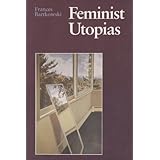
Feminism and Utopian Theory are Nearly Intangible (According to Frances Bartkowski)

Feminist Utopias
by Frances Bartkowski
Image linked from:
http://www.amazon.com/
Frances-Bartkowski/e/B001IOHA3M
In so many utopian analytic texts, the tone is one of a jaded scholar, one who relies heavily in Suvin’s famous science fiction description of “cognitive estrangement”. Estrangement is surely at the heart of utopian texts, and yet, Frances Bartkowski takes Suvin’s description and pairs it with a more optimistic view, an echo of Karen Horney’s tone in Feminist Psychology.
Bartkowski’s definition of utopia is taken from William Morris’s News from Nowhere, as she believes “utopia is anywhere but here and now. It is alternatively the good place (eutopos) and no place (outopos) […] which could also be anywhere” (4). Her view of utopia is unique, but succinct.

As the text is named Feminist Utopias, Bartkowski delves into feminism: “Feminism has done much to bring together the theoretical differences and similarities of the struggles among classes and between sexes” (13). She is leading the reader to her conclusion, her conclusion being that utopian and feminist theory have deeper ties than most people realize, as utopian theory strives to better the human condition overall, much like feminism.
Bartkowski goes further in her comparison, stating utopian theory and feminist theory to be nearly inseparable, if not identical. What she is really saying is feminist theory is the ideal (the utopian ideal) as it encompasses many utopian elements and more in its definition. Of non-feminist utopians, Bartkowski summarizes the women in the stories, and how the creators of the utopias merely “made a place for women only to mask oppression while imagining patriarchal utopias” (14). Several science fiction and utopian writers are mentioned throughout the text, like Suvin, Russ, Butler, Bloch, Bellamy, and more. The chapters are made up of two feminist utopian works Bartkowski contrasts, comparisons, and analyzes. She includes novels such as The Female Man, Woman on the Edge of Time, and Herland.

Bartkowski, Frances. Feminist Utopias. Nebraska: University of Nebraska Press, 1989. Print.

Wednesday, December 11, 2013

Twinja Book Reviews!

Fighting to bring Multiculturalism to YA, Fantasy and Science Fiction novels
Ever notice how novels often leave out the multicultural side of life (particularly those in the fantasy and sf genre)? The gals at Twinja Book Reviews have noticed as well. The twin sisters have a site dedicated to featuring books with multicultural characters. I'm proud to say Cursed was reviewed by Twinja earlier this year.

Check out the book giveaway for Cursed featured on the Twinja Review website. There are 18 days left to enter and win either a paperback or e-copy. 

On 12/12/13, I'll be featured on the Twinja site with a Q&A!

Sunday, November 10, 2013

What's in a Name? A Summary of LeGuin's short, "She Unnames Them"

In this powerful short story by LeGuin, the lead character is never named, but it is inferred that it is Eve, as in Adam and Eve of the Garden. Eve narrates the story, telling of how she convinced the animals that names are unimportant. One by one, the animals agree to let go of their names, though the Yaks have trouble with this concept. The female Yaks hold a council, deciding to let their names go, and after awhile, the male Yaks agree.
Pets, specifically dogs and parrots, take great issue in letting go of their names. As pets are closer to man than wild animals, it is understandable that they would have a harder time in letting go of their identifiers. Yet, Eve makes the pets understand that they can hold onto their capitalized names, like Froo Froo, if only they let go of their generic monikers, like dog or parrot, and so the pets too shed their names.
Among each other, nameless and free, Eve feels a closeness with the animals of the garden that she has never felt before: “They seemed far closer than when their names had stood between myself and them like a clear barrier: so close that my fear of them and their fear of me became one same fear.” The giving back of names (“loss of names” would hold the wrong connotation) by the animals makes them equal to Eve, but she realizes that she is the last being in the garden with a name, and it is not fair of her to hold on to her name when she asked all the animals to give theirs back.
Eve goes to Adam to tell him that she is giving back the name bestowed by “you and your father […] It's been really useful, but it doesn't exactly seem to fit very well lately. But thanks very much! It's really been very useful." Though Eve’s actions are revelatory, Adam does not care. He is described as working on something, putting parts together, and overall he is only half-listening to what Eve is telling him. The reader (and Eve) know that Adam does not understand the import of what she has done by forgoing her name when he asks the stereotypical patriarchal question: “When’s dinner?”
Names can have power, and that power can be a divisive one, or at least that is what LeGuin insinuates with her short story. The binary names humans give to gender (man, woman), the names humans give to animals, or to objects, those are ways that humans seek to control what is around them, not to give meaning, but to separate themselves from nature, to say “I am better than you. I have control over you, and with that control, I will name you and distance you from me”. Eve, like other women in sf stories, does the opposite by placing herself in nature and making herself an equal part of nature. Again, the motif of a loss of identity is explored in this story, and again the author clearly states that one can be an individual while at the same time surrendering themselves to the communal way of living. It is an idea that humans struggle with, because humans only know individuality in the form that it has been handed to us for generations: it comes with separation from others, in the form of gender, class, or racial individual names and personalities.

With Adam’s response, and his lack of interest, LeGuin is stating that men may not be ready to be a part of nature. To be equal with women, and then to be equal with nature, is something men may not conceive of just yet.

Tuesday, October 8, 2013

This Time Next Year...

I'm happy to announce the publisher Champagne Book Group has finalized the contract for Daughter of Zeus, and it will be out in July of 2014. 

Until then, I will shower you with more academic book reviews and articles. I know, the truly fun stuff in life!

Possible back blurb:

The future can be a terrifying prospect, especially when Ada Freyr discovers she can manipulate electricity. Her newly acquired abilities result in the death of her husband. Ada is numb with shock, and terrified of being discovered by the Prominent-run State. Anyone deemed different is deemed an Undiligent, never to be seen again. She is desperate to find the source of her power, believing her estranged father to be the cause.
After her mother is killed by Prominents, she leaves her hometown in Colorado to begin a trip to Atlanta, Georgia. Ada learns new things about her powers along the way, like that she can manipulate anything with electrical impulses, including humans. Her mother's boyfriend, Kressick Lyman, insists on going with her, keeping his own agenda well hidden.

Once in Atlanta, Ada finds her father, Brontes Corentin, is very different from the alcoholic she met as a child: he’s a House Representative with a new family and a new name, ready to ascend to a Senator’s seat. His family has no knowledge of his dark history.

Ada pretends to like Corentin in order to get close to him, because her ultimate plan, the real reason she came to Atlanta, is to kill her father.

            Ada’s revenge scheme lands her on the Undiligent list, leads a stranger to stalk her every move, and stunts her relationship as a sister to her new siblings. Soon, she has to decide which is more important, an old vendetta or forgiving the man she blames for ruining her life.